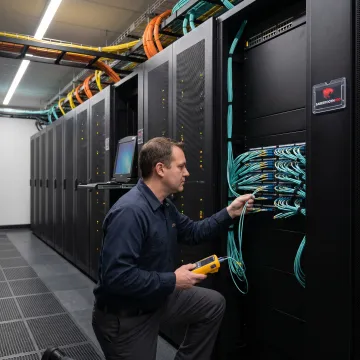
What is data center colocation and how does it benefit Florida businesses?
Data center colocation allows businesses to rent secure cabinet space, power, and connectivity in a professionally managed facility instead of building and maintaining their own on-premises data center. For Florida businesses, colocation offers critical advantages: access to hurricane-hardened infrastructure with backup generators and flood-resistant design, compliance-ready facilities audited for SOC 2, HIPAA, and PCI-DSS requirements, carrier-neutral cross-connects to multiple ISPs and cloud providers for redundancy, and predictable monthly costs without capital expenditure for construction, cooling systems, or 24/7 security personnel.
How do I determine the right colocation facility for my workload?
Selecting the right colocation facility requires assessing six key factors: cabinet space and power density requirements based on your server count and rack units, geographic redundancy needs for disaster recovery and business continuity, compliance certifications matching your industry regulations (SOC 2 for SaaS, HIPAA for healthcare, PCI-DSS for payment processing), cross-connect options for direct connectivity to cloud providers or peering exchanges, carrier diversity to avoid single-ISP dependency, and SLA commitments for uptime and incident response. Sabertooth Tech Group conducts this assessment and sources competitive options from our 300+ provider network.
What compliance certifications should I look for in a Florida colocation facility?
Florida businesses in regulated industries should prioritize colocation facilities with third-party audited compliance reports. A SOC 2 Type II report validates a facility's operational controls for security, availability, and confidentiality—essential for SaaS platforms and financial services. HIPAA-ready environments provide the physical safeguards that protected health information requires. PCI-DSS compliance is mandatory for merchants and payment processors handling credit card data, and government contractors managing controlled unclassified information must also account for CMMC requirements. Sabertooth Tech Group filters providers based on your specific compliance requirements and validates each facility's current audit status during the selection process.
How does colocation pricing work and what should I expect to pay in Florida?
Colocation pricing typically includes three components: cabinet rental fees (half-rack, full-rack, or private cage configurations), power allocation measured in kilowatts or amps with usage-based billing, and cross-connect fees for direct connections to carriers or cloud on-ramps. Florida metro markets like Miami, Tampa, and Jacksonville offer competitive pricing due to strong carrier presence and facility competition. Additional costs may include remote hands support, bandwidth overages, and optional managed services. Sabertooth Tech Group provides transparent TCO analysis comparing total monthly costs across multiple providers, identifying hidden fees, and negotiating contract terms to maximize long-term value.
What is the difference between Tier III and Tier IV data centers?
The Uptime Institute's tier classification system defines facility redundancy levels. Tier III data centers offer N+1 redundancy with multiple power and cooling distribution paths, allowing concurrent maintenance without downtime—delivering 99.982% uptime (about 1.6 hours of annual downtime). Tier IV facilities provide fully redundant, fault-tolerant infrastructure designed for 99.995% uptime (about 26 minutes of annual downtime). Most Florida businesses in financial services, healthcare, and government contracting operate effectively in Tier III facilities. Tier IV is typically reserved for mission-critical applications where even minutes of downtime cause significant financial or operational impact. We assess your uptime requirements and budget to recommend the appropriate tier.
Can I connect my colocation infrastructure directly to AWS, Azure, or Google Cloud?
Yes. Most carrier-neutral colocation facilities offer direct cloud on-ramps or cross-connects to major public cloud providers, including AWS Direct Connect, Azure ExpressRoute, and Google Cloud Interconnect. These private, low-latency connections bypass the public internet, providing consistent network performance, stronger security for data transfers, and lower egress costs for high-bandwidth cloud workloads. Facilities in Miami, Tampa, and Jacksonville commonly offer cloud exchange options that give single-port access to multiple cloud providers. Sabertooth Tech Group evaluates your cloud connectivity requirements and sources facilities with the right peering infrastructure and competitive cross-connect pricing.
How does Sabertooth Tech Group help me select a colocation provider?
We conduct a needs assessment covering your server footprint, power requirements, compliance mandates, geographic redundancy preferences, and budget constraints. Using our 300+ provider network, we source competitive proposals from Florida data center colocation facilities that meet your technical and regulatory specifications. We analyze total cost of ownership, validate SLA commitments, compare cross-connect fees and bandwidth pricing, review contract terms for flexibility and exit clauses, and provide vendor-agnostic recommendations. Our goal is to match you with the right facility at a competitive market rate while ensuring long-term scalability and operational reliability.
What happens if I outgrow my current colocation space?
Reputable colocation providers offer flexible expansion options, including additional cabinet space within the same facility, upgrades from half-rack to full-rack or private cage configurations, and power density increases to support higher-wattage equipment. Expansion to a secondary facility in a different Florida metro, or to an out-of-state disaster recovery site, is also common. Sabertooth Tech Group negotiates contract terms with built-in expansion rights, pre-negotiated pricing for additional capacity, and migration assistance provisions, and reviews capacity plans with you so growth needs are addressed before they become operational constraints.