


Enterprise Internet: Transforming Connectivity for Business

Slow and unreliable internet remains a daily frustration for many IT teams as they juggle secure data exchange, cloud applications, and real-time logistics or patient updates. This challenge is even more pressing for organizations across the Mid-Atlantic where seamless connectivity directly impacts compliance, efficiency, and growth. Understanding the unique strengths of enterprise internet helps your business deliver secure, scalable performance that supports everything from supply chain management to telemedicine and keeps you fully competitive.
Table of Contents
- Defining Enterprise Internet For Business Growth
- Types Of Enterprise Internet Connections Explained
- Key Features Driving Reliability And Security
- Industry Applications In Healthcare And Logistics
- Risks, Costs, And Choosing The Right Solution
Key Takeaways
| Point | Details |
|---|---|
| Infrastructure Support | Enterprise internet provides robust and scalable connectivity tailored for complex organizational demands, enhancing operational efficiency and communication. |
| Connection Types | Organizations have various enterprise internet connection options, including LANs, WANs, and SD-WANs, each addressing specific technological challenges. |
| Reliability and Security | Key features such as encryption protocols and AI-powered monitoring enhance the reliability and security of enterprise internet solutions. |
| Risk Management | Businesses must assess potential risks and costs associated with different enterprise internet solutions to ensure they align with organizational needs and compliance standards. |
Defining Enterprise Internet for Business Growth
Enterprise internet represents a critical infrastructure foundation that enables modern businesses to operate efficiently, communicate effectively, and compete in today’s digital marketplace. Unlike standard consumer internet connections, enterprise internet provides robust, scalable connectivity designed specifically to meet the complex technological demands of organizations across multiple locations and industries.
At its core, enterprise internet involves sophisticated IT infrastructure that connects users, devices, and applications with high reliability and advanced security protocols. Cisco defines enterprise networks as integrated network domains optimized for performance, security, and seamless user experience. These networks support essential digital services like cloud applications, real-time communication, and mission-critical data access that drive business growth and operational efficiency.
The fundamental components of enterprise internet include advanced networking technologies such as:
- High-bandwidth connections with symmetrical upload/download speeds
- Redundant network pathways to ensure continuous connectivity
- Advanced security frameworks protecting against cybersecurity threats
- Software-defined networking (SDN) capabilities for flexible infrastructure management
- Multi-site connectivity enabling distributed workforce collaboration
Pro tip: Conduct a comprehensive network assessment every 18 months to ensure your enterprise internet infrastructure remains aligned with your evolving business technology requirements.
Types of Enterprise Internet Connections Explained
Enterprise internet connections are not one-size-fits-all solutions but complex network infrastructures tailored to meet specific business requirements. Organizations today have multiple connection types available, each designed to address unique technological challenges and operational needs across different business environments.

Enterprise networking technologies encompass several distinct connection types that serve critical functions for modern businesses. These include Local Area Networks (LANs) for internal office connectivity, Wide Area Networks (WANs) for connecting geographically dispersed locations, and cloud networks that integrate on-premises systems with cloud-based services. Software-Defined WAN (SD-WAN) technologies have emerged as particularly innovative solutions, enabling dynamic traffic routing and optimizing network performance across distributed enterprise environments.
The primary types of enterprise internet connections include:
Here is a comparison of key enterprise internet connection types to help guide your selection:
| Connection Type | Best Use Case | Scalability Potential |
|---|---|---|
| Campus Network | Large facilities, high density | Expandable as needed |
| Branch Network | Remote offices | Easy to add new branches |
| Data Center Network | Critical IT operations | High, supports growth |
| Hybrid Cloud Network | Cloud-integrated solutions | Flexible with business |
| Wide Area Network | Multiple site connectivity | Scales with organization |
- Campus Networks: High-density connections supporting users and IoT devices within organizational facilities
- Branch Networks: Connectivity solutions for remote office locations
- Data Center Networks: Low-latency, high-performance connections managing critical workloads
- Hybrid Cloud Networks: Integrated connections bridging on-premises and cloud infrastructure
- Wide Area Networks (WANs): Connections linking multiple sites and enabling centralized communication
Pro tip: Regularly audit your enterprise network infrastructure to identify potential performance bottlenecks and ensure your connection types align with evolving business technology requirements.
Key Features Driving Reliability and Security
Enterprise internet reliability and security have become paramount in an increasingly complex digital business landscape. Modern organizations require sophisticated network infrastructures that can adapt quickly, protect critical assets, and maintain uninterrupted operational continuity across diverse technological environments.
Cloud-native network architectures represent a transformative approach to addressing enterprise connectivity challenges. These advanced frameworks enable businesses to enhance network scalability, implement robust security perimeters, and dynamically manage dispersed endpoints through intelligent technologies like software-defined networking and AI-powered monitoring systems.
Key features driving enterprise internet reliability and security include:
- Encryption Protocols: Advanced encryption mechanisms protecting data transmission
- AI-Powered Monitoring: Intelligent systems detecting and preventing potential security breaches
- Zero Trust Architecture: Comprehensive security model verifying every network access request
- Hybrid Cloud Integration: Seamless and secure connections between on-premises and cloud infrastructure
- Automated Threat Detection: Real-time identification and mitigation of potential cybersecurity risks
Pro tip: Implement a comprehensive annual network security audit to proactively identify and address potential vulnerabilities in your enterprise internet infrastructure.
Industry Applications in Healthcare and Logistics
Enterprise internet technologies are revolutionizing critical industries like healthcare and logistics by providing sophisticated connectivity solutions that transform operational efficiency, patient care, and supply chain management. These sectors increasingly rely on advanced digital infrastructure to meet growing complexity and technological demands.
Healthcare logistics technologies are driving unprecedented improvements in medical supply chains and operational workflows. Emerging technologies such as AI, blockchain, and Internet of Things (IoT) enabled by robust enterprise internet connectivity facilitate predictive planning, transparent supply chains, and automated processes that reduce clinical staff workload and enhance patient outcomes.
Key industry applications of enterprise internet include:
- Medical Supply Chain Management: Real-time tracking of pharmaceutical inventories
- Patient Transportation Coordination: Optimized routing and resource allocation
- Clinical Resource Tracking: Precise monitoring of medical equipment and personnel
- Telemedicine Infrastructure: Reliable high-speed connections supporting remote healthcare services
- Logistics Fleet Management: Advanced telematics and real-time vehicle tracking systems
Pro tip: Develop integrated digital transformation strategies that align enterprise internet capabilities with specific industry workflow requirements to maximize operational efficiency.
Risks, Costs, and Choosing the Right Solution
Selecting the appropriate enterprise internet solution requires a comprehensive understanding of potential risks, associated costs, and strategic alignment with organizational technology requirements. Businesses must navigate a complex landscape of connectivity options that balance performance, security, scalability, and financial investment.
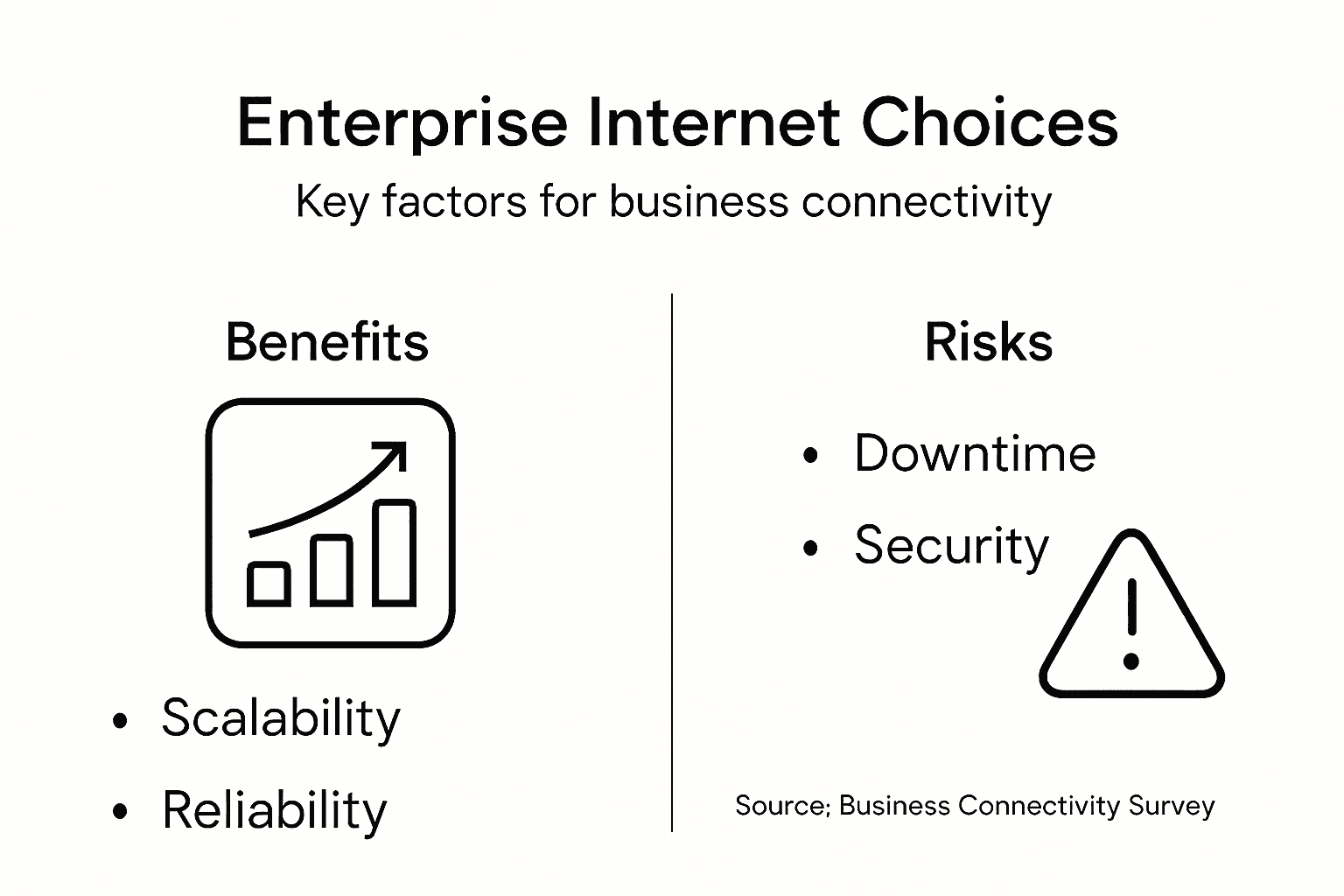
The primary risks associated with enterprise internet deployments include potential network vulnerabilities, unexpected downtime, compliance challenges, and integration complexities with existing technological infrastructure. Organizations must conduct thorough risk assessments that evaluate potential security threats, performance limitations, and long-term technological compatibility before committing to a specific internet connectivity solution.
Below is a summary of enterprise internet risk factors and cost considerations relevant to business decisions:
| Risk Factor | Cost Consideration | Impact on Business |
|---|---|---|
| Downtime | Lost productivity, SLA penalties | Operational disruption |
| Security Vulnerability | Investment in advanced protection | Data breach risks |
| Compliance Issues | Regulatory fines, audit expenses | Legal consequences |
| Integration Complexity | Migration, training, support fees | Implementation delays |
Key considerations for choosing the right enterprise internet solution include:
- Bandwidth Requirements: Matching connection speeds to organizational data transmission needs
- Security Protocols: Comprehensive cybersecurity features and threat mitigation capabilities
- Scalability Potential: Ability to expand and adapt network infrastructure as business grows
- Cost Structure: Total ownership expenses including installation, maintenance, and upgrade costs
- Reliability Metrics: Uptime guarantees and service level agreements (SLAs)
- Compliance Standards: Alignment with industry-specific regulatory requirements
Pro tip: Conduct a comprehensive technology audit and create a detailed requirements matrix before negotiating enterprise internet contracts to ensure optimal alignment between connectivity solutions and organizational objectives.
Unlock Enterprise Internet Potential with SabertoothPro Solutions
The article highlights the pressing challenges businesses face with complex enterprise internet demands such as scalability, security, and multi-site connectivity. If your organization strives to overcome issues like network downtime, costly integration, or evolving bandwidth needs SabertoothPro offers tailored solutions that directly address these pain points. From advanced SD-WAN and secure cloud integration to reliable 4G LTE and 5G hotspots SabertoothPro ensures your infrastructure is future-ready and resilient.
Experience the power of flexible, high-performance internet with our Titan WiFi Hotspot Plans designed for enterprise-scale needs and our cutting-edge Titan WiFi devices crafted to boost coverage and connectivity. SabertoothPro provides a comprehensive approach combining robust hardware and optimized data plans to support your digital transformation while enhancing security and network reliability.
Expand your business capabilities now by visiting SabertoothPro.com and explore smart connectivity solutions built to scale with your organization. Don’t let outdated internet infrastructure hold back your growth. Upgrade today and lead your industry with seamless enterprise internet performance.
Unlock your network’s full potential at SabertoothPro and transform connectivity into a strategic advantage.

Frequently Asked Questions
What is enterprise internet?
Enterprise internet refers to a robust and scalable connectivity infrastructure designed specifically for organizations. It allows businesses to operate efficiently, communicate effectively, and meet complex technological demands across multiple locations.
What are the main types of enterprise internet connections?
The primary types include Campus Networks, Branch Networks, Data Center Networks, Hybrid Cloud Networks, and Wide Area Networks (WANs). Each is tailored to specific connectivity needs and applications within various business environments.
What features enhance the reliability and security of enterprise internet?
Key features that drive reliability and security include encryption protocols, AI-powered monitoring, zero trust architecture, hybrid cloud integration, and automated threat detection, all crucial for protecting critical business assets.
How do I assess the right enterprise internet solution for my business?
To choose the right solution, evaluate bandwidth requirements, security protocols, scalability potential, cost structure, reliability metrics, and compliance standards, ensuring they align with your organization’s specific technology requirements.