


How to Choose Internet Plan for Business Success

Slow, unreliable internet can leave remote teams frustrated and cut into company productivity, especially for businesses in the Mid-Atlantic U.S. With the American Jobs Plan now prioritizing affordable high-speed broadband for all Americans, the right connectivity choice is more important than ever. This guide empowers you to confidently assess your unique business internet needs, compare top providers, and choose a solution that delivers operational efficiency and remote work success.
Table of Contents
- Step 1: Identify Business Connectivity And Speed Needs
- Step 2: Evaluate Available Providers And Coverage Options
- Step 3: Compare Plan Features, Pricing, And Reliability
- Step 4: Assess Device Compatibility And Security Requirements
- Step 5: Verify Performance With Test Connections And Reviews
Quick Summary
| Key Insight | Explanation |
|---|---|
| 1. Assess Your Connectivity Needs | Understand your business’s unique usage patterns to determine the required internet speed and types of activities. |
| 2. Evaluate Local Providers | Investigate availability and performance of internet service providers specific to your business location and requirements. |
| 3. Compare Plan Features | Analyze different providers based on speed, pricing, reliability, and additional features to find the best fit. |
| 4. Ensure Device Compatibility | Check that your chosen internet plan supports all existing devices and necessary security protocols for your operations. |
| 5. Test Your Connection Before Committing | Conduct multiple speed tests and review performance metrics to validate the service quality before finalizing your choice. |
Step 1: Identify Business Connectivity and Speed Needs
Choosing the right internet plan is critical for your business’s digital infrastructure and operational success. In this section, you’ll learn how to systematically assess your organization’s unique connectivity requirements and determine the optimal internet speed and technology for your specific business needs.
Understanding your business’s connectivity needs starts with analyzing your core digital workflows and communication patterns. Advances in information technology have reshaped how companies organize production and communication, making internet connectivity a strategic business decision. Consider the following key factors when evaluating your requirements:
- Number of simultaneous users accessing network resources
- Types of digital activities performed (video conferencing, file sharing, cloud applications)
- Data transfer volumes for daily operations
- Remote work infrastructure requirements
- Critical business applications dependent on internet connectivity
Businesses must recognize that connectivity needs vary significantly between different operational contexts. Local connectivity challenges highlight that urban and rural environments have distinctly different internet infrastructure capabilities. Rural businesses might require specialized solutions to overcome bandwidth limitations, while urban companies can leverage more robust network options.
To accurately determine your speed requirements, conduct a comprehensive audit of your current internet usage. Document your average bandwidth consumption, peak usage times, and identify potential bottlenecks in your existing network infrastructure. This detailed assessment will help you select a plan that provides sufficient speed and reliability without unnecessary overhead costs.
Pro tip: Schedule a professional network assessment to get precise, data-driven recommendations for your specific business connectivity needs.
Step 2: Evaluate Available Providers and Coverage Options
Finding the right internet service provider is a critical step in securing reliable business connectivity. This section will guide you through a systematic approach to researching and comparing internet providers that can meet your specific business communication and operational needs.
Internet service provider coverage varies significantly by location, making it essential to conduct thorough research specific to your business address. The evaluation process involves several strategic steps:
- Verify local provider availability using online tools and address-specific searches
- Compare connection types such as fiber, cable, DSL, and fixed wireless
- Assess bandwidth and speed options for each available provider
- Review service level agreements (SLAs) and contract terms
- Investigate provider reputation through customer reviews and reliability ratings
Strategic provider selection can significantly impact your business’s digital performance and operational efficiency.
Broadband mapping resources offer comprehensive data to help businesses make informed decisions about internet connectivity. Key factors to consider include download and upload speeds, network reliability, customer support responsiveness, and scalability of services.
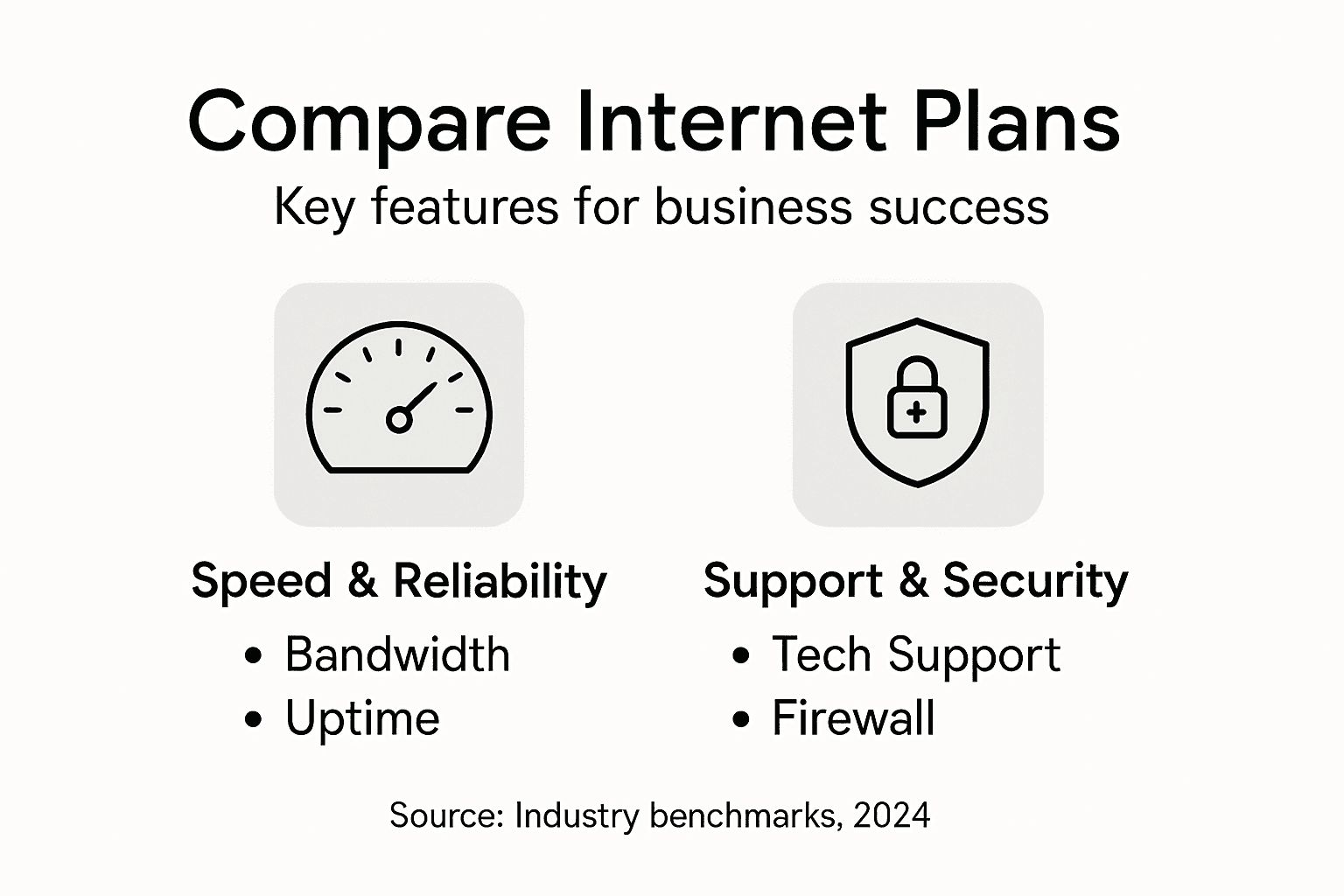
When evaluating providers, request detailed quotes and performance guarantees. Pay close attention to contractual terms, installation costs, monthly fees, and potential early termination penalties. Some providers offer business-specific packages with enhanced support and more robust service level agreements tailored to commercial needs.
Here’s a summary of how different internet connection types can impact your business:
| Connection Type | Reliability | Typical Speed Range | Best For |
|---|---|---|---|
| Fiber Optic | Highly stable | 100 Mbps – 1 Gbps | High-demand businesses |
| Cable | Moderately reliable | 50 – 500 Mbps | Small to mid-size offices |
| DSL | Location-dependent | 10 – 100 Mbps | Rural/small operations |
| Fixed Wireless | Varies by area | 5 – 100 Mbps | Remote or backup connectivity |
Pro tip: Request trial periods or short-term contracts to test provider performance before committing to long-term agreements.
Step 3: Compare Plan Features, Pricing, and Reliability
Navigating the complex landscape of business internet plans requires a strategic approach to comparing features, pricing, and service reliability. This section will help you develop a comprehensive evaluation framework to identify the most suitable internet solution for your specific business needs.
Business internet provider comparisons reveal critical differences in plan structures that can significantly impact your operational efficiency. When conducting your comparative analysis, focus on these essential evaluation criteria:
- Speed tiers matching your bandwidth requirements
- Pricing structures including monthly rates and contract lengths
- Reliability metrics such as uptime guarantees and service performance
- Additional features like static IP addresses or business-grade support
- Scalability options for future business growth
Selecting the right internet plan is not just about cost, but about finding a solution that aligns with your business’s operational demands.
Customer satisfaction benchmarks provide valuable insights into provider performance beyond raw technical specifications. Look beyond advertised speeds and examine factors like customer support responsiveness, technical reliability, and actual user experiences.

When comparing plans, create a detailed spreadsheet to track and compare provider offerings objectively. Pay special attention to contract flexibility, installation costs, equipment fees, and potential performance penalties. Some providers offer specialized business packages with enhanced service level agreements that might justify slightly higher pricing.
Use this table to quickly reference factors that can affect your business internet experience:
| Factor | Impact on Business | Example Consideration |
|---|---|---|
| Number of Users | Network congestion | Needs increase with growth |
| Peak Usage Times | Speed fluctuations | Assess busiest business hours |
| Network Security | Data safety | Importance of encryption |
| Service SLAs | Operational uptime | Uptime guarantees required |
Pro tip: Request comprehensive service documentation and performance guarantees before finalizing your internet plan to avoid unexpected limitations.
Step 4: Assess Device Compatibility and Security Requirements
Ensuring your internet plan supports your business’s technological ecosystem requires a comprehensive approach to device compatibility and network security. This section will walk you through a strategic process of evaluating your current infrastructure and identifying critical security considerations for your internet solution.
Cybersecurity best practices emphasize the importance of thorough device compatibility assessments before selecting an internet plan. When evaluating your technological requirements, focus on these key areas:
- Network interface compatibility with existing hardware
- Security protocol support for your current devices
- Bandwidth requirements for multiple device connections
- Encryption standards matching your business needs
- Potential upgrade paths for future technology integration
Device compatibility is not just about technical specifications, but about creating a seamless and secure technological environment for your business.
Cloud security guidance recommends conducting a comprehensive security assessment that goes beyond basic device checks. Examine your network’s ability to support secure authentication, data encryption, and intrusion prevention across all connected devices and potential access points.
Prioritize internet plans that offer robust security features like built-in firewalls, virtual private network (VPN) support, and advanced threat protection. Consider how different providers handle security updates, provide technical support, and manage potential vulnerabilities in their network infrastructure.
Pro tip: Request a detailed security compatibility report from potential internet providers to ensure complete alignment with your business’s technological ecosystem.
Step 5: Verify Performance with Test Connections and Reviews
Validating your potential internet service goes beyond marketing promises and requires a strategic approach to performance verification. This section will guide you through practical methods to confirm the actual quality and reliability of your prospective internet plan.
Internet speed testing tools offer businesses a precise way to measure real-world connection performance. When conducting your performance verification, focus on these critical evaluation techniques:
- Run multiple speed tests at different times of day
- Compare actual speeds against promised service levels
- Measure upload and download bandwidth
- Check network latency and stability
- Document consistent performance patterns
Performance verification is not about a single test, but understanding your internet connection’s consistent behavior.
Customer satisfaction benchmarks provide additional insights beyond technical measurements. Examine comprehensive provider ratings that reflect real-world user experiences, looking for consistent performance indicators and service quality metrics.
Pay special attention to peak usage times, geographic network performance, and technical support responsiveness. Request trial periods or short-term contracts that allow you to thoroughly test the internet service before making a long-term commitment. Consider collecting data from multiple testing platforms to build a comprehensive performance profile.
Pro tip: Schedule performance tests during your business’s typical operational hours to get the most accurate representation of potential internet service quality.
Make Your Business Internet Choice with Confidence
Selecting the ideal internet plan involves overcoming challenges like matching connectivity to your business size, ensuring device compatibility, and maintaining security throughout your operations. The article highlights the importance of evaluating bandwidth needs, provider reliability, and future scalability — all critical to avoiding downtime and maximizing productivity.
At SabertoothPro.com, we understand these pain points and offer tailored solutions that empower your business with cutting-edge technology and dependable service. Explore our range of high-speed options like Titan WiFi hotspot plans that provide the reliable, scalable connectivity your business demands. Whether you need rural internet options, enterprise-grade security, or advanced IoT integrations, our solutions align with your goals for operational success and seamless communications.

Take control of your business connectivity today with SabertoothPro’s expert-backed offerings. Visit SabertoothPro.com now to discover comprehensive internet plans and technologies designed for your unique needs. Don’t wait until connectivity issues slow you down. Start building a resilient digital infrastructure that grows with your business by checking out Titan WiFi and our special promotions available now.
Frequently Asked Questions
How do I determine my business’s internet speed needs?
To determine your business’s internet speed needs, analyze the number of users, types of digital activities, and data transfer volumes. Conduct a thorough audit of your current internet usage to identify peak hours and potential bottlenecks, which can help you select an appropriate plan with sufficient speed.
What factors should I consider when evaluating internet service providers?
When evaluating internet service providers, consider their coverage options, connection types (like fiber or cable), bandwidth and speed options, and service level agreements (SLAs). Additionally, check customer reviews and provider reputation to ensure reliable service and support.
How can I compare different internet plans effectively?
To compare different internet plans effectively, create a detailed spreadsheet to track features, prices, and reliability metrics of each provider. Include critical factors such as speed tiers, pricing structures, and additional features to visualize which plan aligns best with your business demands.
What are the essential security requirements I need to evaluate?
Essential security requirements include network compatibility with your existing devices, support for security protocols, and encryption standards. Prioritize plans that offer built-in firewalls, VPN support, and advanced threat protection to maintain a secure technological environment.
How can I verify the performance of a potential internet service before committing?
To verify the performance of a potential internet service, run multiple speed tests at different times of day to measure actual connection speeds and latency. Document your findings to assess whether the service consistently meets your business’s needs before making a long-term commitment.
What should I do if my business operates in a rural area with limited internet options?
If your business operates in a rural area, focus on researching specialized solutions that cater to bandwidth limitations, such as satellite or fixed wireless connections. Explore local provider options and assess compatibility with your operational requirements to ensure reliable connectivity.