


Why Choose LTE Internet for Reliable Connectivity

More than 95 percent of American households can now access high-speed mobile internet thanks to advances like LTE. Staying connected shapes daily life, from remote work to streaming, so having reliable options matters more than ever. This article takes a closer look at what makes LTE technology stand out, helping you understand its core advantages and how it compares to fiber and cable solutions for both city and rural users.
Table of Contents
- LTE Internet Basics And Core Advantages
- How LTE Internet Works Across Devices
- LTE Internet Versus Fiber And Cable Solutions
- Enterprise And Rural LTE Use Cases Explained
- Costs, Security, And Common Pitfalls To Avoid
Key Takeaways
| Point | Details |
|---|---|
| High-Speed Connectivity | LTE provides rapid data transfer rates, low latency, and high spectral efficiency, enhancing user experience across devices. |
| Adaptability and Mobility | Unlike wired solutions, LTE enables internet access from various locations with minimal infrastructure, making it ideal for rural areas. |
| Enterprise Application | LTE supports critical business functions such as video conferencing and cloud services, facilitating efficient remote operations. |
| Considerations for Adoption | Users must evaluate costs, device compatibility, and security risks when transitioning to LTE services. |
LTE Internet Basics and Core Advantages
Long-Term Evolution (LTE) represents a revolutionary wireless communication standard designed to deliver high-speed internet connectivity across mobile devices and data terminals. At its core, LTE provides users with unprecedented digital mobility, enabling seamless data transfers and enhanced communication experiences. Advanced wireless technologies have transformed how we interact with digital platforms, making LTE a critical infrastructure for modern communication.
The technological prowess of LTE stems from its remarkable performance capabilities. Key advantages include:
- High Data Transfer Rates: Enabling rapid downloads and uploads
- Low Latency: Reducing delays in real-time applications
- Improved Spectral Efficiency: Maximizing network bandwidth utilization
- Flexible Bandwidth: Supporting carrier bandwidths from 1.4 MHz to 20 MHz
LTE’s architecture represents a significant leap forward in network design. Utilizing advanced technologies like MIMO and OFDM, the network creates a robust, all-IP system that dramatically reduces operational complexity. This streamlined approach not only enhances performance but also contributes to improved energy efficiency, making LTE a sustainable solution for modern connectivity demands. By simplifying network infrastructure, LTE provides businesses and individual users with a powerful, flexible internet platform that adapts to increasingly sophisticated digital communication requirements.
How LTE Internet Works Across Devices
LTE internet represents a sophisticated network architecture designed to deliver seamless connectivity across multiple devices and platforms. The network’s fundamental structure comprises three critical components: User Equipment (UE), Evolved UMTS Terrestrial Radio Access Network (E-UTRAN), and Evolved Packet Core (EPC). This intricate system enables devices ranging from smartphones to IoT sensors to maintain consistent, high-speed internet connections through an advanced packet-switched technology.
The technical mechanics of LTE connectivity involve several key operational modes:
- Frequency Division Duplex (FDD): Allows simultaneous upload and download on different frequencies
- Time Division Duplex (TDD): Enables flexible bandwidth allocation
- Packet-Switched Technology: Supports concurrent voice and data services
- Multi-Device Compatibility: Ensures reliable connections across various device types
Efficient data transmission capabilities distinguish LTE from previous wireless technologies. By supporting high data rates and minimizing latency, the network provides robust internet connectivity that adapts to diverse device requirements. Whether powering a smartphone, tablet, vehicle telematics system, or industrial IoT sensor, LTE’s flexible architecture ensures consistent performance, making it a versatile solution for modern digital communication needs. The technology’s ability to dynamically allocate bandwidth and maintain low-latency connections represents a significant advancement in wireless networking infrastructure.
LTE Internet Versus Fiber and Cable Solutions
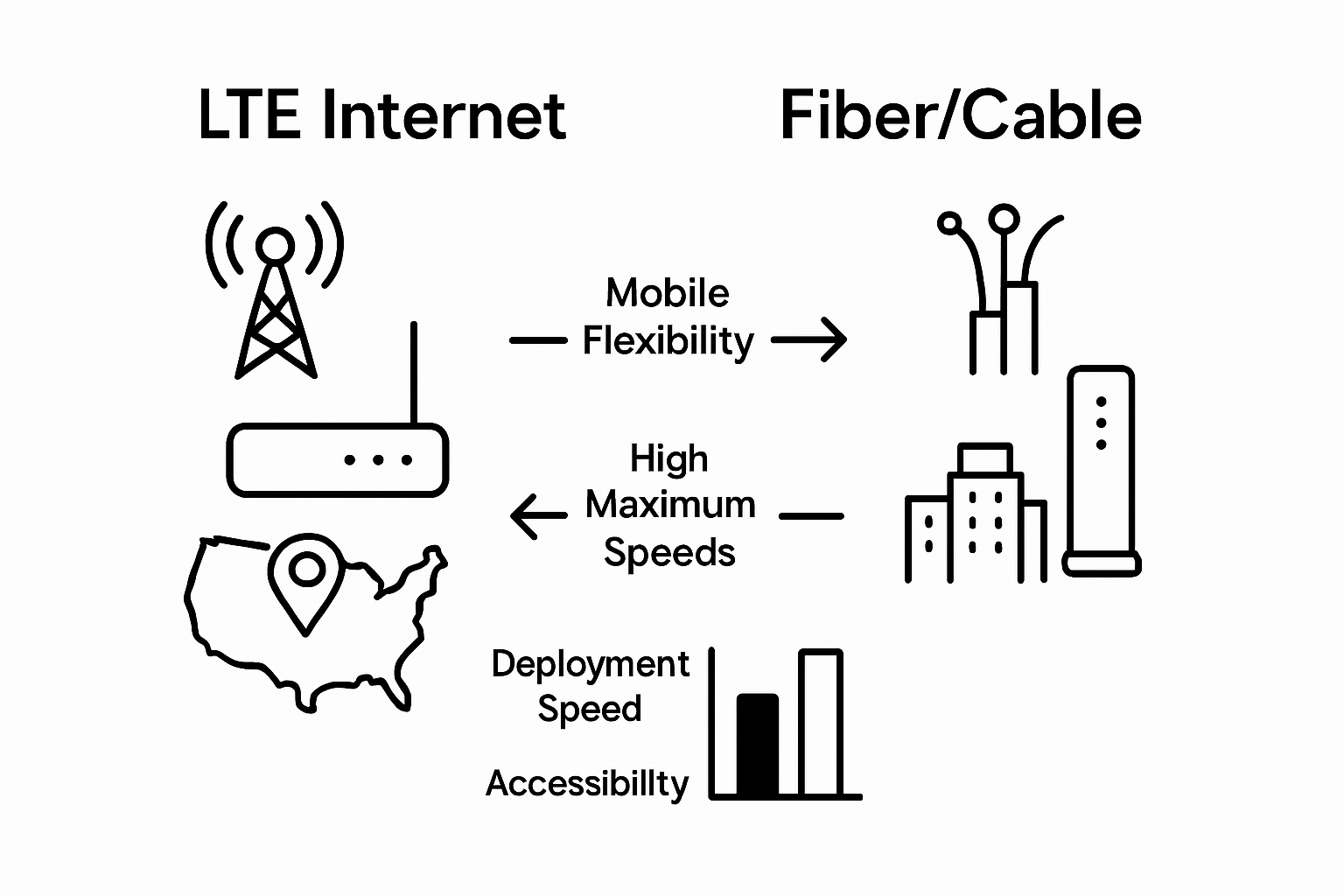
Wireless internet technologies have transformed connectivity options, with LTE emerging as a powerful alternative to traditional wired solutions. Comparing internet technologies reveals distinct advantages and limitations across different infrastructure types. While fiber optic and cable networks have long dominated internet connectivity, LTE offers a unique blend of mobility, flexibility, and accessibility that challenges conventional connectivity paradigms.
Key differences between LTE and traditional internet solutions include:
- Deployment Speed: LTE requires minimal physical infrastructure
- Mobility: Wireless connectivity enables internet access from virtually anywhere
- Infrastructure Requirements: No extensive cable or fiber installation needed
- Accessibility: Ideal for rural or hard-to-reach areas
LTE-based home internet services provide a competitive wireless broadband alternative that addresses connectivity challenges in regions lacking robust wired networks. While fiber optic connections still offer superior maximum speeds, LTE delivers sufficient performance for most household internet needs. The technology’s ability to provide reliable, high-speed internet without complex physical infrastructure makes it an increasingly attractive option for consumers seeking flexible, adaptable connectivity solutions that can quickly respond to changing technological and geographical demands.

Enterprise and Rural LTE Use Cases Explained
LTE technology has revolutionized internet connectivity by providing adaptable solutions for diverse environments. Enterprise applications leverage LTE’s high-speed data transfer capabilities to support critical business functions like video conferencing, cloud services, and VoIP communications. By offering low latency and robust bandwidth, LTE enables businesses to maintain seamless operational connectivity without traditional infrastructure constraints.
Key enterprise and rural LTE deployment scenarios include:
- Remote Office Connectivity: Instant internet access for distributed teams
- Backup Network Systems: Reliable failover for critical business communications
- Field Service Operations: Consistent internet for mobile workforce management
- Agricultural Technology: Supporting IoT sensors and precision farming equipment
LTE’s extensive coverage bridges critical digital connectivity gaps in rural and underserved regions. By delivering high-speed internet to remote locations, the technology empowers communities with access to e-commerce, distance learning, and essential online services. This transformative capability not only supports individual users but also enables small businesses and educational institutions in areas traditionally excluded from robust digital infrastructure to participate fully in the modern digital economy.
Costs, Security, and Common Pitfalls to Avoid
LTE internet technologies present a complex landscape of opportunities and challenges for potential users. Network infrastructure investments and potential vulnerabilities require careful strategic planning, with organizations and individual users needing to understand the nuanced trade-offs associated with wireless connectivity solutions. The decision to adopt LTE involves evaluating multiple technical and financial considerations beyond simple performance metrics.
Key challenges and potential pitfalls in LTE adoption include:
- Infrastructure Costs: Significant expenses for network deployment
- Device Compatibility: Requirements for specialized LTE-enabled hardware
- Coverage Limitations: Inconsistent connectivity in certain geographic regions
- Data Plan Expenses: Potentially higher costs compared to traditional broadband
- Security Risks: Potential network vulnerabilities requiring robust protection strategies
Comprehensive security measures and strategic planning are essential for mitigating potential LTE implementation risks. While the technology offers remarkable flexibility, users must remain vigilant about potential network congestion, data privacy concerns, and the financial implications of widespread adoption. Understanding these challenges allows organizations and individuals to make informed decisions, balancing the transformative potential of LTE against its inherent technological and economic complexities.
Unlock Reliable Connectivity with LTE Solutions from SabertoothPro
If you are seeking dependable, high-speed internet that adapts to your mobility and rural connectivity needs LTE technology offers the perfect solution. The article highlights key challenges such as infrastructure costs, coverage limitations, and device compatibility that are common roadblocks when adopting LTE connectivity. SabertoothPro addresses these concerns through its carefully designed product lineup including Titan WiFi hotspot plans and robust LTE-enabled devices that ensure seamless internet access wherever you are.

Experience the benefits of LTE internet combined with expert enterprise IT solutions by visiting SabertoothPro.com. Take control of your connectivity with plans and equipment built for flexibility reliability and security. Act now and explore our Titan WiFi collection to find the right device and plan to power your personal or business needs. Don’t let connectivity challenges hold you back when a smarter LTE solution is just a click away.
Frequently Asked Questions
What are the core advantages of LTE Internet?
LTE Internet offers high data transfer rates, low latency, improved spectral efficiency, and flexible bandwidth, making it a reliable choice for high-speed connectivity.
How does LTE Internet work across multiple devices?
LTE Internet uses a network architecture that includes User Equipment, Evolved UMTS Terrestrial Radio Access Network, and Evolved Packet Core, allowing it to maintain high-speed connections across various devices including smartphones and IoT sensors.
How does LTE Internet compare to fiber and cable solutions?
While fiber and cable offer high maximum speeds, LTE provides unique advantages such as faster deployment, mobility, and low infrastructure requirements, making it suitable for areas lacking robust wired networks.
What are the potential challenges of using LTE Internet?
Challenges may include infrastructure costs, device compatibility, coverage limitations, higher data plan expenses, and security risks that need to be managed with adequate protection strategies.