


Why Use LTE Routers for Business Continuity

Most American small and midsize companies cannot afford network downtime, yet nearly 35 percent struggle with unreliable remote connectivity every year. As distributed teams grow across the Mid-Atlantic, IT managers face growing pressure to deliver secure and stable internet far from traditional wired lines. LTE routers offer a practical path to flexible, business-grade access without being tethered to fixed infrastructure, and understanding their benefits puts you in control of your company’s remote work performance.
Table of Contents
- LTE Routers Explained For IT Managers
- Business Applications Of LTE Connectivity
- Key Features And Benefits Of LTE Routers
- LTE Failover, Redundancy, And Remote Access
- Comparing LTE Routers To Wired Solutions
- Costs, Challenges, And Implementation Tips
Key Takeaways
| Point | Details |
|---|---|
| Reliability of LTE Routers | LTE routers provide critical connectivity solutions for businesses, especially in remote or temporary settings, ensuring robust internet access without relying on traditional infrastructure. |
| Business Applications | Diverse industries leverage LTE connectivity to address operational challenges, enhancing resilience and enabling seamless remote work capabilities. |
| Advanced Features | LTE routers utilize sophisticated technologies like MIMO and OFDMA, leading to high data speeds, low latency, and improved network reliability. |
| Cost Considerations | Implementing LTE routers involves strategic planning, considering not just equipment costs but also spectrum management and operational challenges for optimal performance. |
LTE routers explained for IT managers
LTE routers represent a critical connectivity solution for businesses seeking reliable, flexible internet access outside traditional wired infrastructure. These specialized network devices leverage Long-Term Evolution (LTE) cellular networks to provide robust wireless broadband connectivity, enabling organizations to maintain seamless internet connectivity across diverse operational environments.
At their core, LTE routers function as advanced networking devices that interface with cellular data networks to deliver high-speed internet access. Unlike traditional wireline connections, these routers utilize cellular signal transmission technologies like Orthogonal Frequency Division Multiple Access (OFDMA) to optimize data transfer rates and network efficiency. Key technical advantages include:
- Enhanced signal processing capabilities
- Lower network latency
- Higher data transmission speeds
- Improved network reliability
- Flexible deployment across multiple geographic locations
Businesses increasingly rely on LTE routers to solve complex connectivity challenges, particularly in remote work scenarios, temporary office locations, or areas with limited broadband infrastructure. The Evolved Packet Core (EPC) architecture underlying these routers enables sophisticated IP-based data transmission, making them versatile tools for modern enterprise networking requirements.
Pro tip: When selecting an LTE router, prioritize devices supporting multiple cellular bands and featuring robust security protocols to ensure comprehensive connectivity and data protection.
Business applications of LTE connectivity
LTE connectivity has transformed how businesses approach network infrastructure, providing robust solutions for organizations across multiple industries. Micro, small, and medium-sized enterprises increasingly rely on LTE networks to maintain operational continuity, expand market reach, and enhance overall business resilience.
Different business sectors leverage LTE connectivity in unique ways, addressing critical operational challenges. Retail environments use LTE routers for point-of-sale systems, enabling transactions during network disruptions. Construction and field service teams depend on mobile connectivity for real-time project management and communication. Remote worksites, such as agricultural operations or mining locations, utilize LTE routers to maintain critical communication channels where traditional internet infrastructure is unavailable.
The versatility of LTE connectivity extends beyond basic internet access. Emerging wireless trends demonstrate how mobile data supports complex business applications including cloud services, mobile collaboration platforms, and Internet of Things (IoT) device management. Key business advantages include:
- Rapid deployment of network infrastructure
- Reduced downtime during connectivity disruptions
- Seamless support for remote and distributed workforce
- Cost-effective alternative to fixed-line internet
- Enhanced operational flexibility across diverse geographic regions
Pro tip: When implementing LTE connectivity, conduct comprehensive coverage mapping and select carrier plans that offer the most consistent signal strength across your primary operational areas.
Key features and benefits of LTE routers
LTE routers represent sophisticated networking solutions that transform business connectivity through advanced technological capabilities. High-performance mobile internet technologies enable organizations to achieve unprecedented network flexibility, delivering robust communication infrastructure that adapts to dynamic business environments.

The core technical advantages of LTE routers stem from their sophisticated design and network architecture. These devices leverage multiple advanced features including Multiple Input Multiple Output (MIMO) antenna systems, sophisticated modulation techniques like Orthogonal Frequency Division Multiple Access (OFDMA), and intelligent bandwidth management. Businesses benefit from capabilities such as high data transmission rates reaching hundreds of megabits per second, low latency communication, and seamless IP-based networking that supports complex operational requirements.
Enterprise-grade LTE router technologies provide comprehensive network performance optimization across diverse operational scenarios. Key benefits include:
- Rapid network deployment without physical infrastructure constraints
- Automatic failover capabilities ensuring continuous connectivity
- Enhanced mobility supporting distributed workforce models
- Cost-effective alternative to traditional fixed-line internet
- Scalable bandwidth allocation matching real-time business needs
- Robust security protocols protecting critical communication channels
Pro tip: When evaluating LTE routers, prioritize devices offering carrier aggregation support and comprehensive frequency band compatibility to maximize network performance and reliability.
LTE failover, redundancy, and remote access
Business continuity depends critically on network resilience, and LTE router technologies provide sophisticated failover mechanisms that ensure uninterrupted operational connectivity. These advanced networking solutions enable organizations to maintain critical communication channels even during primary network infrastructure failures, transforming how businesses manage potential connectivity disruptions.
The technical architecture of LTE routers supports multiple redundancy strategies, allowing seamless transitions between network connections. Server redundancy configurations enable transparent and non-transparent backup modes that minimize network downtime and provide continuous remote access. This approach allows businesses to implement robust failover protocols that automatically switch between different cellular carriers or network interfaces without interrupting active data sessions.
Key failover and redundancy features of LTE routers include:
- Automatic network switchover when primary connection fails
- Multiple carrier network support
- Simultaneous connection monitoring
- Intelligent routing protocol management
- Configurable failback and priority settings
- Seamless transition between wired and wireless networks
Pro tip: Configure multiple cellular carrier SIM cards in your LTE router to maximize network redundancy and ensure consistent connectivity across different geographic regions.
Comparing LTE routers to wired solutions
Wireless networking technologies present significant advantages over traditional wired solutions for businesses seeking flexible and resilient connectivity infrastructure. While wired networks have historically dominated enterprise communications, LTE routers are transforming how organizations approach internet access by offering unprecedented mobility and rapid deployment capabilities.
The performance landscape between wired and wireless networks reveals nuanced trade-offs that businesses must carefully evaluate. Technical comparisons demonstrate that LTE routers excel in scenarios where traditional wired infrastructure proves impractical or cost prohibitive. Wired networks traditionally offer higher raw transmission speeds and more consistent latency, but LTE routers compensate with critical advantages such as:
- Instant deployment without physical infrastructure requirements
- Geographical flexibility across multiple locations
- Lower upfront installation costs
- Built in redundancy and failover capabilities
- Support for distributed and remote workforce models
- Rapid network reconfiguration
While wired solutions remain essential for core data centers and fixed office locations, LTE routers provide a complementary approach that ensures business continuity and operational resilience in an increasingly dynamic technological landscape.
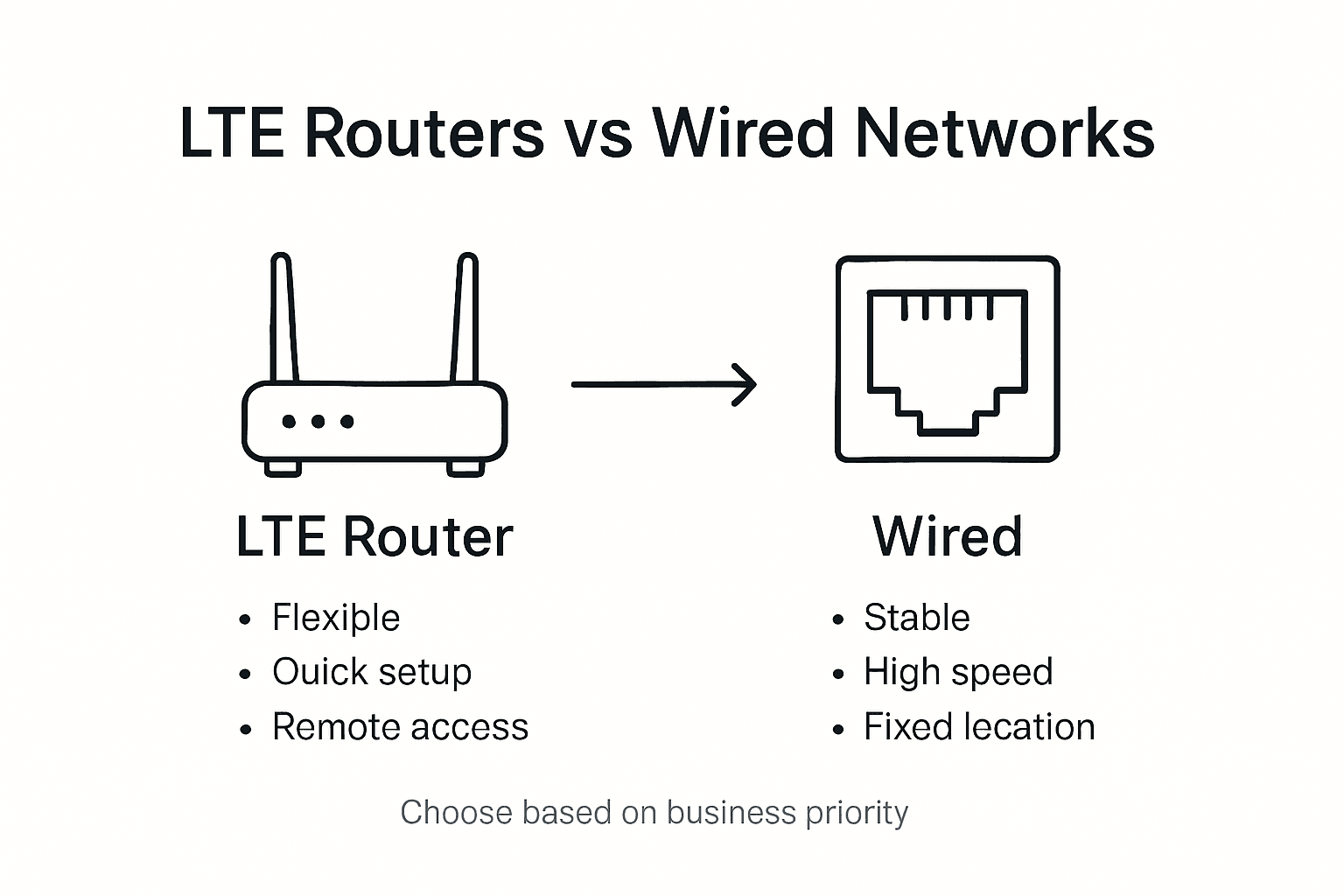
Here’s a side-by-side comparison of LTE routers and traditional wired networks for business use:
| Aspect | LTE Routers | Wired Networks |
|---|---|---|
| Deployment Speed | Instant, no trenching or cabling | Requires physical installation |
| Geographic Flexibility | Operates in remote or mobile sites | Fixed to specific locations |
| Upfront Cost | Lower installation expense | Higher due to infrastructure needs |
| Redundancy Capability | Built-in failover with multiple SIMs | External solutions needed |
| Usage Scenario | Ideal for temporary or mobile offices | Best for stable, permanent setups |
Pro tip: Implement a hybrid networking strategy that combines LTE routers with wired infrastructure to maximize connectivity reliability and operational flexibility.
Costs, challenges, and implementation tips
LTE router implementation involves strategic considerations around technological investment and operational complexity that demand careful planning from IT managers and business leaders. The financial landscape of LTE networking extends beyond simple equipment procurement, encompassing spectrum acquisition, infrastructure integration, and ongoing maintenance expenses.
Businesses must navigate multiple technical challenges when deploying LTE router solutions. Advanced radio network design requires sophisticated interference management and capacity optimization strategies to ensure consistent performance. Key implementation challenges include:
This summary table outlines deployment challenges IT managers should consider with LTE routers:
| Challenge | Description | Example Impact |
|---|---|---|
| Spectrum Management | Allocating frequencies to avoid overlap | Performance reduction |
| Device Compatibility | Ensuring support for multiple networks | Integration issues |
| Security Integration | Applying advanced encryption protocols | Risk of data breaches |
| Interference Mitigation | Minimizing signal disturbances | Unstable connectivity |
| Bandwidth Optimization | Balancing demand and capacity | Service slowdowns |
- Complex spectrum allocation requirements
- Potential signal interference from multiple sources
- Device compatibility across different network generations
- Quality of Service (QoS) maintenance
- Security protocol integration
- Bandwidth management in dynamic environments
Successful LTE router deployment demands a multifaceted approach that balances technological capabilities with financial constraints. Organizations should conduct thorough site surveys, evaluate carrier coverage maps, and develop comprehensive network migration strategies that minimize disruption while maximizing connectivity reliability.
Pro tip: Conduct a pilot deployment in a controlled environment to validate LTE router performance and identify potential integration challenges before full-scale implementation.
Boost Your Business Continuity with Reliable LTE Router Solutions
Ensuring uninterrupted connectivity is a top priority for IT managers facing challenges like network failover, redundancy, and remote access discussed in the article. Businesses need LTE routers that deliver seamless automatic switchover, multiple carrier support, and scalable bandwidth to keep operations running smoothly even during disruptions. At SabertoothPro, we understand the pain points of complex LTE implementation and the goal of maintaining cost-effective, secure, and flexible networking.
Explore our range of advanced LTE routers and failover solutions in the Titan WiFi Collection designed for rapid deployment and robust connectivity.

Take the next step toward building an unbreakable network infrastructure tailored to your business needs. Visit SabertoothPro.com today to discover how our technology stack, including LTE routers and enterprise IT services, can transform your connectivity strategy. Don’t miss out on current offers in our Special Promotion Collection that make upgrading your network easier and more affordable. Act now to safeguard your business continuity with expert solutions built for reliability and performance.
Frequently Asked Questions
What are the main benefits of using LTE routers for business continuity?
Using LTE routers enhances business continuity by providing reliable wireless internet access, rapid deployment capabilities, and built-in redundancy through multiple carrier support, ensuring uninterrupted connectivity even during network outages.
How do LTE routers compare to traditional wired solutions in terms of flexibility?
LTE routers offer significant flexibility over traditional wired solutions, allowing instant deployment in remote or mobile locations without the need for extensive cabling or physical infrastructure, which is ideal for temporary offices or field operations.
What features should I look for when selecting an LTE router for my business?
When selecting an LTE router, prioritize features such as support for multiple cellular bands, automatic failover capabilities, advanced security protocols, and scalability in bandwidth allocation to meet your business’s connectivity needs.
How can LTE routers improve connectivity in remote work environments?
LTE routers provide reliable wireless connectivity options in remote work environments by enabling seamless communication and data access, reducing downtime and supporting team collaboration, especially where traditional broadband infrastructure is limited.