


Dedicated Internet Access: Reliable Connectivity for Business

Slowdowns during critical video calls or cloud-based collaboration can disrupt business flow in busy Mid-Atlantic offices. For IT teams handling vital data and security concerns, choosing the right internet connection is more than an upgrade—it is a foundation for daily operations. This guide explains why Dedicated Internet Access offers a private, non-shared connection that delivers consistently high speeds and reliability, helping your organization stay ahead of network issues and downtime.
Table of Contents
- What Is Dedicated Internet Access?
- Types of Dedicated Internet Access Connections
- Key Features and How DIA Works
- Business Applications and Industry Use Cases
- Costs, Risks, and Common Mistakes
- DIA Compared to Broadband Alternatives
Key Takeaways
| Point | Details |
|---|---|
| Dedicated Internet Access (DIA) offers superior performance. | DIA provides stable, private internet connections with guaranteed bandwidth, essential for businesses reliant on uninterrupted service. |
| Evaluate connection types based on needs. | Different DIA options like Fiber Optic and T1 Lines cater to various bandwidth requirements and business sizes. |
| Investment in DIA justifies operational efficiency. | While more costly than standard broadband, DIA enhances reliability, security, and supports critical business applications. |
| Conduct thorough due diligence on providers. | Before selecting a DIA provider, assess their SLAs, network infrastructure, and potential scalability to avoid future challenges. |
What Is Dedicated Internet Access?
Dedicated Internet Access (DIA) represents a premium connectivity solution designed specifically for businesses requiring consistent, high-performance internet service. Unlike traditional shared internet connections, DIA provides a private, non-shared network pipeline exclusively for an organization’s data transmission needs. This means businesses get a direct internet connection with guaranteed bandwidth that remains stable and predictable.
The fundamental difference between dedicated and shared internet access lies in network architecture. Shared connections function like a congested public highway where multiple users compete for bandwidth, potentially causing slowdowns during peak usage times. In contrast, DIA operates more like a private express lane, ensuring that a business’s internet traffic moves quickly and consistently without interference from other network users. This translates to symmetrical upload and download speeds, minimal latency, and superior reliability critical for operations requiring uninterrupted connectivity.
Businesses across various sectors benefit from dedicated internet access, particularly those with bandwidth-intensive requirements such as cloud computing, video conferencing, large data transfers, and real-time collaboration platforms. Typical users include financial institutions, healthcare providers, technology companies, and enterprises with multiple remote locations that demand secure, high-performance network connectivity. While dedicated internet access typically comes at a higher price point compared to standard broadband, the performance guarantees and consistent speeds often justify the investment for mission-critical business operations.
Pro tip: When evaluating dedicated internet access, request detailed service level agreements (SLAs) that specify guaranteed uptime, minimum bandwidth commitments, and technical support response times to ensure your connectivity meets your business’s specific needs.
Types of Dedicated Internet Access Connections
Businesses have several options for dedicated internet access, each with unique characteristics tailored to different operational requirements. Dedicated internet connection technologies range from fiber optic leased lines to advanced network protocols, providing organizations with flexible connectivity solutions. Fiber Optic Connections represent the gold standard in dedicated internet access, offering exceptional bandwidth, reliability, and symmetrical upload and download speeds. These connections use light-based transmission through fiber optic cables, enabling data transfer rates significantly faster than traditional copper-based networks.
Another prominent dedicated internet access option includes T1 and T3 Lines, which provide dedicated, point-to-point connections with guaranteed bandwidth. T1 lines typically offer 1.54 Mbps of symmetrical bandwidth, while T3 lines can deliver up to 45 Mbps, making them suitable for medium to large enterprises with substantial data transmission needs. Ethernet Private Line (EPL) and Multi-Protocol Label Switching (MPLS) circuits represent more advanced dedicated connectivity solutions, enabling businesses to create secure, high-performance wide area networks that connect multiple locations with consistent performance.
The selection of a dedicated internet access type depends on several critical factors, including bandwidth requirements, geographical availability, budget constraints, and specific business applications. Enterprises in technology, finance, healthcare, and other bandwidth-intensive sectors often prioritize fiber optic and MPLS connections for their superior performance and reliability. Smaller businesses might find T1 or Ethernet Private Line solutions more cost-effective while still providing significant improvements over shared internet connections. Each connection type offers distinct advantages, allowing organizations to select the most appropriate solution based on their unique operational infrastructure and communication demands.
Pro tip: Before selecting a dedicated internet access connection, conduct a comprehensive bandwidth audit of your current network usage to accurately determine the most suitable connection type and capacity for your business needs.
Here’s how the main Dedicated Internet Access (DIA) connection types compare for business needs:
| Connection Type | Typical Bandwidth | Best For | Key Advantage |
|---|---|---|---|
| Fiber Optic | 100 Mbps–10+ Gbps | Large enterprises, high data use | Fastest, highest reliability |
| T1 Line | 1.54 Mbps (symmetrical) | Small offices, basic operations | Stable, widely available |
| T3 Line | Up to 45 Mbps | Medium businesses, data transfer | Robust, upgrade from T1 |
| Ethernet Private Line | 10 Mbps–10 Gbps | Multi-site connections | Flexible, scalable capacity |
| MPLS Circuit | 1 Mbps–10+ Gbps | Inter-branch, security focused | Custom routing, high uptime |
Key Features and How DIA Works
Dedicated Internet Access (DIA) functions through a specialized network infrastructure designed to provide businesses with exclusive, high-performance internet connectivity. Unlike shared connections, DIA establishes a direct, private communication channel that ensures consistent bandwidth and superior network performance. The fundamental mechanism involves creating a dedicated physical circuit exclusively for a single organization, which means no bandwidth sharing with other users, resulting in predictable and reliable internet speeds.

The key features of Dedicated Internet Access include symmetrical upload and download speeds, guaranteed bandwidth, and enhanced security protocols. These connections typically utilize fiber optic or leased line technologies that provide continuous, uninterrupted internet service. Businesses can expect several critical performance characteristics: zero contention with other network users, minimal latency, robust service level agreements (SLAs), and the ability to support bandwidth-intensive applications such as video conferencing, cloud computing, and large data transfers. Network redundancy and multiple connection paths are often built into DIA infrastructure, ensuring maximum uptime and reliability even during potential network disruptions.
The technical implementation of Dedicated Internet Access involves specialized routing equipment, direct connections to internet backbone networks, and comprehensive monitoring systems. Internet Service Providers (ISPs) establish dedicated point-to-point connections using advanced networking technologies like Ethernet, MPLS, or fiber optic circuits. These connections are engineered to provide consistent performance, with bandwidth allocation precisely mapped to the specific needs of each business client. Advanced Quality of Service (QoS) mechanisms ensure that critical business applications receive priority treatment, maintaining optimal network performance across various operational requirements.
Pro tip: When evaluating Dedicated Internet Access providers, request detailed documentation about their network infrastructure, specifically focusing on redundancy capabilities, average uptime percentages, and the specific routing technologies they employ to guarantee consistent performance.
Business Applications and Industry Use Cases
Businesses across multiple sectors leverage Dedicated Internet Access to transform digital communication and operational efficiency. Financial Services represent a critical industry where consistent, secure connectivity is paramount. Banks and financial institutions rely on DIA for real-time transaction processing, secure data transfers, customer relationship management systems, and maintaining robust cybersecurity infrastructure. The symmetrical bandwidth and low latency ensure that complex financial algorithms, trading platforms, and customer interactions operate without interruption.
In Healthcare and Telemedicine, Dedicated Internet Access enables transformative patient care technologies. Medical facilities use high-reliability connections to support electronic health records, remote diagnostic consultations, medical imaging transfers, and interconnected medical device networks. Specialized healthcare applications demand uninterrupted, high-bandwidth connections that traditional shared internet services cannot reliably provide. Manufacturing and logistics companies similarly depend on DIA for supply chain management, implementing Internet of Things (IoT) technologies, coordinating global distribution networks, and maintaining real-time tracking and inventory systems.
Technology companies and Cloud Service Providers represent another critical sector benefiting from dedicated internet infrastructure. These organizations require extensive bandwidth for continuous software development, cloud computing services, massive data transfers, and supporting global collaboration platforms. Enterprises in research, education, and technology innovation utilize DIA to facilitate complex computational tasks, video conferencing, distributed computing projects, and maintaining seamless communication across geographically dispersed teams. The consistent performance and security features of dedicated internet access make it an essential infrastructure component for businesses operating in increasingly digital and interconnected global environments.
Pro tip: Conduct a comprehensive network performance audit before selecting a Dedicated Internet Access solution to accurately map your organization’s specific bandwidth, latency, and reliability requirements.
Costs, Risks, and Common Mistakes
Dedicated Internet Access (DIA) presents significant investment considerations for businesses, with costs varying widely based on bandwidth requirements and technological infrastructure. Cybersecurity and cost management challenges represent critical factors businesses must carefully evaluate. Monthly pricing typically ranges from $500 to $5,000 for enterprises, depending on connection speed, geographic location, and service complexity. Small businesses often face the most significant financial burden, with high-performance dedicated connections potentially representing substantial monthly expenditures that require strategic budgeting and thorough cost-benefit analysis.
Potential Risks and Considerations include technological obsolescence, inadequate service level agreements, and potential infrastructure limitations. Common mistakes businesses make involve overlooking critical contractual details, failing to assess future scalability needs, and selecting providers without comprehensive performance evaluations. Network security represents another crucial risk factor, with dedicated connections requiring robust protective measures against potential cyber threats. Organizations must conduct thorough due diligence, including comprehensive infrastructure assessments, vendor reliability checks, and detailed contractual negotiations to mitigate potential operational disruptions.
The financial landscape of dedicated internet access demands sophisticated strategic planning. Businesses should develop comprehensive evaluation frameworks that consider not just immediate connectivity needs, but long-term technological evolution and organizational growth trajectories. Critical assessment factors include bandwidth requirements, redundancy capabilities, technical support responsiveness, upgrade potential, and alignment with overall technological infrastructure. Small and medium enterprises particularly benefit from staged implementation strategies, potentially starting with lower-bandwidth dedicated connections and scaling incrementally as operational demands increase and financial resources allow.
Pro tip: Create a detailed spreadsheet comparing potential dedicated internet access providers, tracking not just monthly costs but also installation fees, contract terms, bandwidth guarantees, and projected five-year total ownership expenses.
DIA Compared to Broadband Alternatives
Dedicated Internet Access (DIA) fundamentally differs from traditional broadband alternatives through its distinctive network architecture and performance guarantees. Broadband connectivity models vary significantly in reliability, speed, and shared infrastructure characteristics. Unlike shared broadband connections that distribute bandwidth among multiple users, DIA provides a private, exclusive network pipeline with consistent, symmetrical upload and download speeds. This means businesses receive guaranteed performance without experiencing the typical fluctuations and congestion associated with residential or standard commercial internet services.
Key Differentiating Factors between DIA and broadband include bandwidth allocation, service level agreements, and network reliability. Broadband connections like DSL or cable internet typically offer asymmetrical speeds, meaning download speeds are often significantly faster than upload speeds. In contrast, DIA ensures equal upload and download bandwidths, critical for businesses requiring consistent data transmission, video conferencing, cloud computing, and large file transfers. Service level agreements (SLAs) for DIA are substantially more robust, promising minimal downtime, faster repair commitments, and guaranteed performance metrics that standard broadband providers cannot match.
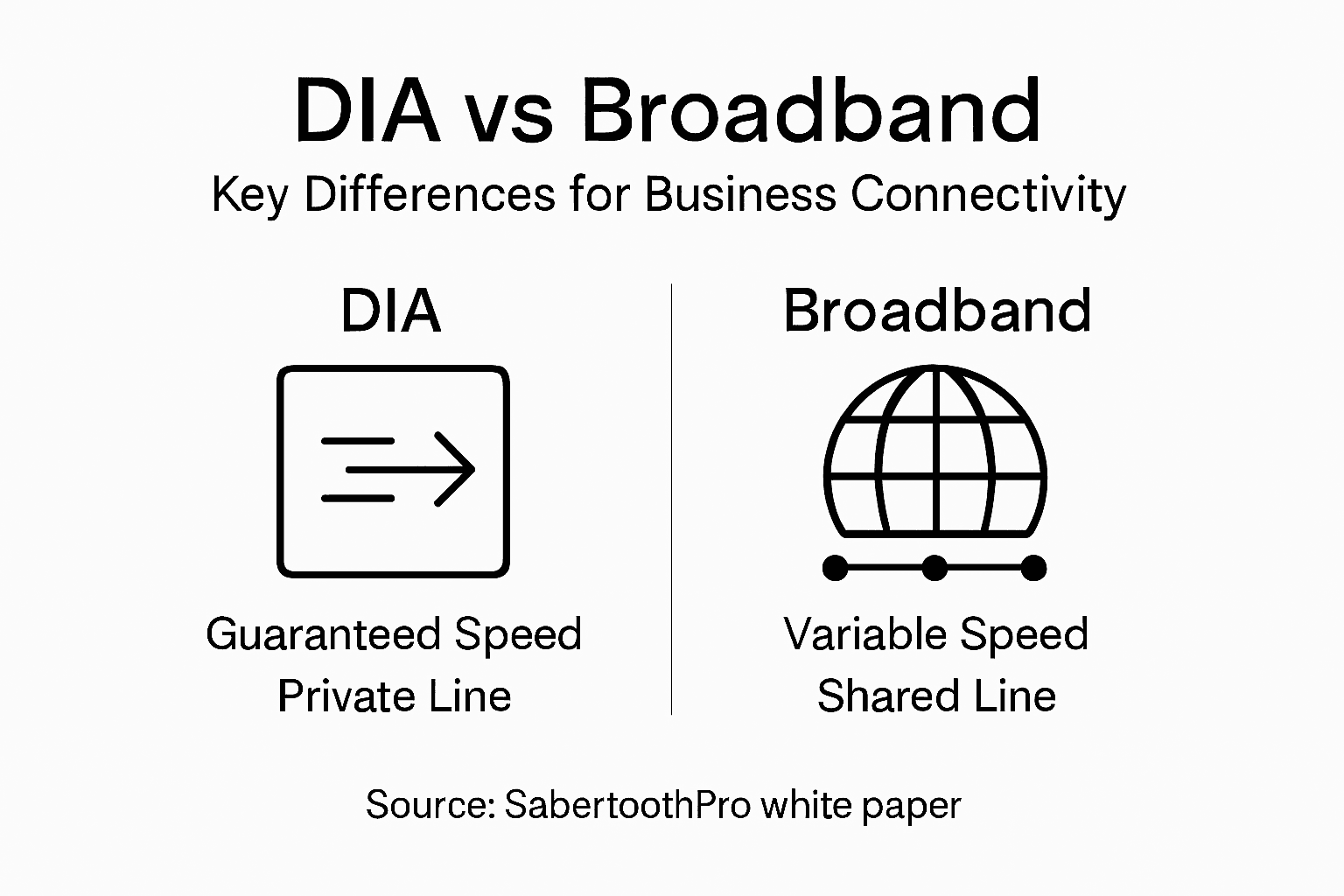
The cost structure represents another significant distinction between DIA and broadband alternatives. While broadband services appear more affordable at first glance, businesses quickly recognize the hidden expenses of unreliable connectivity. Dedicated internet access, though initially more expensive, provides tangible value through reduced operational disruptions, enhanced security protocols, and predictable network performance. Small to medium enterprises must carefully evaluate their specific connectivity requirements, considering factors such as operational complexity, data transfer volumes, remote work needs, and potential revenue losses from network inconsistencies when selecting between DIA and traditional broadband solutions.
This summary highlights critical differences between DIA and shared broadband for business evaluation:
| Aspect | Dedicated Internet Access | Shared Broadband |
|---|---|---|
| Bandwidth Allocation | Reserved, never shared | Shared with neighbors |
| Uptime Guarantee | 99.9% or higher SLA | Best effort, not guaranteed |
| Speed Symmetry | Equal upload and download | Usually download favored |
| Reliability | High, supports backups | Variable, congestion risk |
| Cost | Higher, but predictable | Lower upfront, may vary |
Pro tip: Before transitioning to Dedicated Internet Access, conduct a comprehensive network performance audit to precisely quantify your current bandwidth utilization and identify specific performance bottlenecks that dedicated connectivity could resolve.
Unlock Reliable Business Connectivity with SabertoothPro
Businesses know that consistency and speed are critical when it comes to Dedicated Internet Access and reliable connectivity. The challenge of securing symmetrical upload and download speeds with guaranteed bandwidth can impact every aspect of daily operations from cloud computing to real-time collaboration. SabertoothPro understands these pain points and offers tailored high-speed internet plans designed to meet demanding business needs without compromise.
Explore our Titan WiFi Hotspot Plans for flexible, high-performance internet solutions that can power your operations with the stability and speed your business deserves.

Don’t let lag, downtime, or bandwidth bottlenecks hinder your growth. Visit SabertoothPro.com now to discover how our reliable internet options and advanced connectivity products like Titan WiFi Devices and WiFi Extenders can optimize your network infrastructure. Secure your business’s future with connectivity built for performance and peace of mind today.
Frequently Asked Questions
What is Dedicated Internet Access (DIA)?
Dedicated Internet Access (DIA) is a premium connectivity solution providing businesses with a private, non-shared internet connection that guarantees consistent bandwidth and high-performance internet service.
How does DIA differ from shared internet connections?
DIA operates on a dedicated network, ensuring stable and predictable internet speeds, whereas shared connections may experience congestion and fluctuations in performance during peak usage times.
What are the main benefits of using DIA for my business?
DIA offers symmetrical upload and download speeds, guaranteed bandwidth, minimal latency, enhanced security, and high reliability, making it ideal for bandwidth-intensive applications like cloud computing and video conferencing.
What should I consider when choosing a type of Dedicated Internet Access?
When selecting DIA, consider factors like your bandwidth requirements, geographical availability, budget, and the specific applications your business needs to support.