


2025 Connectivity Trends: Shaping Internet Experiences

Most American consumers believe everyone will soon enjoy equal internet access, but the reality is more complex. While over 82 percent of advanced regions already have gigabit-capable networks, large gaps persist for rural and underserved communities. As new technologies like 6G and next-generation Wi-Fi promise to transform connectivity in 2025, understanding real-world progress—and separating trend from misconception—will help you make smarter choices in a rapidly evolving digital landscape.
Table of Contents
- Defining 2025 Connectivity Trends And Misconceptions
- Emerging Technologies Transforming Connectivity
- Business Use Cases: From Iot To Ucaas
- Securing Networks Amid Connectivity Growth
- Impacts On Rural, Mobile, And Enterprise Users
Key Takeaways
| Point | Details |
|---|---|
| Emerging Technologies | Advanced technologies like 6G and Generative AI will redefine connectivity, enabling faster and more adaptive network environments. |
| Digital Divide | Significant disparities in connectivity still exist, particularly in rural areas, necessitating targeted infrastructure improvements. |
| Security Challenges | As connectivity advances, organizations must implement proactive security measures to adapt to evolving digital threats. |
| Business Transformation | IoT and UCaaS are revolutionizing business communications, offering integrated solutions that enhance operational efficiency and collaboration. |
Defining 2025 Connectivity Trends and Misconceptions
Connectivity in 2025 stands at a transformative crossroads, with emerging technologies promising unprecedented digital experiences. IEEE Standards Association research highlights six major connectivity trends that will fundamentally reshape how we interact with digital infrastructure. These developments extend far beyond traditional networking, introducing sophisticated capabilities that will redefine internet accessibility and performance.
Key connectivity trends for 2025 include advanced 6G technology development, significant improvements in Wi-Fi standards, and the expansion of ultra-high-speed broadband networks. European connectivity reports reveal that gigabit-capable network coverage has already reached an estimated 82.5% in advanced regions, signaling a rapid technological evolution. These advancements are not merely incremental upgrades but represent a fundamental reimagining of digital communication infrastructure.
Here’s a comparison of major emerging connectivity technologies and their anticipated impact in 2025:
| Technology | Key Capabilities | Impact on Connectivity |
|---|---|---|
| 6G Networks | Ultra-low latency, 1Tbps+ | Extreme speed for complex apps |
| Advanced Wi-Fi (Wi-Fi 7) | Higher bandwidth, multi-link | Seamless high-density coverage |
| Hybrid Quantum Computing | Massive parallel processing | Solves complex network issues |
| Generative AI | Predictive optimization | Self-healing, smart networks |
Misconceptions about connectivity often revolve around assumptions of uniform global progress. While developed regions surge ahead with technological innovations, significant disparities remain. Rural and underserved areas continue to face substantial connectivity challenges, highlighting the need for targeted infrastructure investments. The digital divide persists, with some regions struggling to achieve basic broadband access while others prepare for next-generation network technologies.
Pro Network Strategy Tip: Research local infrastructure development plans and identify potential connectivity gaps in your community to stay ahead of emerging technological trends and make informed digital infrastructure decisions.
Pro Tech Preparation Tip: Evaluate your current devices and network equipment to ensure compatibility with emerging 6G and advanced Wi-Fi standards, preventing potential obsolescence in the rapidly evolving connectivity landscape.
Emerging Technologies Transforming Connectivity
The landscape of connectivity is undergoing a profound transformation, driven by groundbreaking technological innovations that promise to redefine our digital interactions. IEEE Standards Association research highlights the pivotal role of generative artificial intelligence and hybrid quantum computing in revolutionizing network performance and data processing capabilities. These emerging technologies are not merely incremental improvements but represent a fundamental shift in how we conceptualize and implement digital infrastructure.
Generative AI is poised to become a game-changer in connectivity, offering unprecedented capabilities in network optimization and predictive management. By leveraging advanced machine learning algorithms, these systems can dynamically adjust network parameters, predict potential bottlenecks, and self-optimize routing in real-time. Hybrid quantum computing takes this potential even further, introducing computational capabilities that can solve complex network challenges with extraordinary speed and efficiency that traditional computing architectures cannot match.

The implications of these technologies extend far beyond technical performance. They represent a paradigm shift in how we approach digital communication, enabling more intelligent, adaptive, and responsive network ecosystems. From autonomous network management to ultra-personalized user experiences, emerging technologies are breaking down traditional barriers of connectivity, creating more seamless and intuitive digital interactions. The convergence of AI, quantum computing, and advanced networking promises to unlock unprecedented levels of innovation across industries.
Pro Innovation Strategy Tip: Stay informed about emerging connectivity technologies by following reputable technology journals and attending virtual tech conferences to understand how these advancements might impact your personal and professional digital ecosystem.
Pro Tech Preparedness Tip: Invest in continuous learning and skill development in AI and quantum computing to position yourself at the forefront of the digital transformation happening in connectivity technologies.
Business Use Cases: From IoT to UCaaS
Business connectivity is experiencing a revolutionary transformation, with technologies like Internet of Things (IoT) and Unified Communications as a Service (UCaaS) driving unprecedented operational efficiency. IoT data plans are enabling organizations to deploy sophisticated network solutions that seamlessly integrate complex technological ecosystems, creating intelligent and responsive business environments.
In the realm of IoT, businesses are leveraging advanced connectivity to transform traditional operational models. Manufacturing sectors are implementing smart sensors that provide real-time equipment monitoring, while logistics companies use fleet tracking systems to optimize routes and reduce operational costs. Healthcare organizations are deploying remote patient monitoring devices, and agricultural businesses are utilizing precision farming technologies that collect and analyze environmental data with unprecedented accuracy.
Unified Communications as a Service (UCaaS) represents another critical evolution in business connectivity, offering integrated communication platforms that transcend traditional communication barriers. These solutions combine voice, video, messaging, and collaboration tools into a single, streamlined platform. By breaking down communication silos, UCaaS enables distributed teams to collaborate more effectively, regardless of geographic location. Small to medium-sized businesses particularly benefit from these technologies, as they provide enterprise-grade communication capabilities without requiring extensive infrastructure investments.
Pro Strategic Integration Tip: Conduct a comprehensive audit of your current communication and IoT infrastructure to identify potential integration opportunities and technological gaps that could be addressed by emerging connectivity solutions.
Pro Technology Adoption Tip: Develop a phased implementation strategy for new connectivity technologies, starting with pilot programs in specific departments to minimize disruption and maximize learning opportunities.
Securing Networks Amid Connectivity Growth
The evolving landscape of network connectivity demands sophisticated security strategies that go beyond traditional defensive approaches. The IEEE Standards Association emphasizes that emerging connectivity technologies require proactive, intelligent security frameworks capable of adapting to increasingly complex digital threats. Modern network security is no longer about building impenetrable walls, but creating dynamic, responsive systems that can detect, predict, and neutralize potential vulnerabilities in real-time.
Artificial intelligence and machine learning are transforming cybersecurity paradigms, enabling organizations to develop predictive threat detection mechanisms. These advanced technologies can analyze network traffic patterns, identify anomalous behaviors, and automatically implement protective measures before potential breaches occur. By leveraging AI-driven security protocols, businesses can create self-healing network infrastructures that continuously monitor and adapt to emerging cybersecurity challenges, significantly reducing response times and minimizing potential damage.
The proliferation of Internet of Things (IoT) devices and distributed network architectures has exponentially increased potential attack surfaces. Organizations must adopt comprehensive security strategies that integrate robust authentication protocols, end-to-end encryption, and zero-trust network architectures. This approach requires a holistic view of network security that encompasses device management, data protection, user authentication, and continuous monitoring across increasingly complex digital ecosystems.
Pro Security Strategy Tip: Implement a regular security audit schedule that evaluates your network’s vulnerability landscape, testing and updating protective measures at least quarterly to stay ahead of emerging threats.
Pro Technology Defense Tip: Invest in continuous employee cybersecurity training, recognizing that human awareness remains the most critical layer of network defense in an increasingly interconnected digital environment.
Impacts on Rural, Mobile, and Enterprise Users
Connectivity technologies are dramatically transforming user experiences across diverse contexts, with cloud services revolutionizing rural internet access and enabling unprecedented digital opportunities. Rural communities, traditionally marginalized by technological limitations, are experiencing a profound shift as advanced wireless technologies bridge critical infrastructure gaps. Mobile and satellite internet solutions are now providing reliable high-speed connections that were previously unimaginable in remote geographic regions.
Enterprise users are witnessing a radical transformation in workplace connectivity, driven by sophisticated mobile internet technologies that support distributed workforce models. Advanced mobile networks enable seamless communication, real-time collaboration, and robust cloud-based infrastructure that transcend traditional geographic boundaries. Small businesses and large corporations alike can now leverage high-bandwidth, low-latency connections to create dynamic, flexible work environments that were impossible just a few years ago.
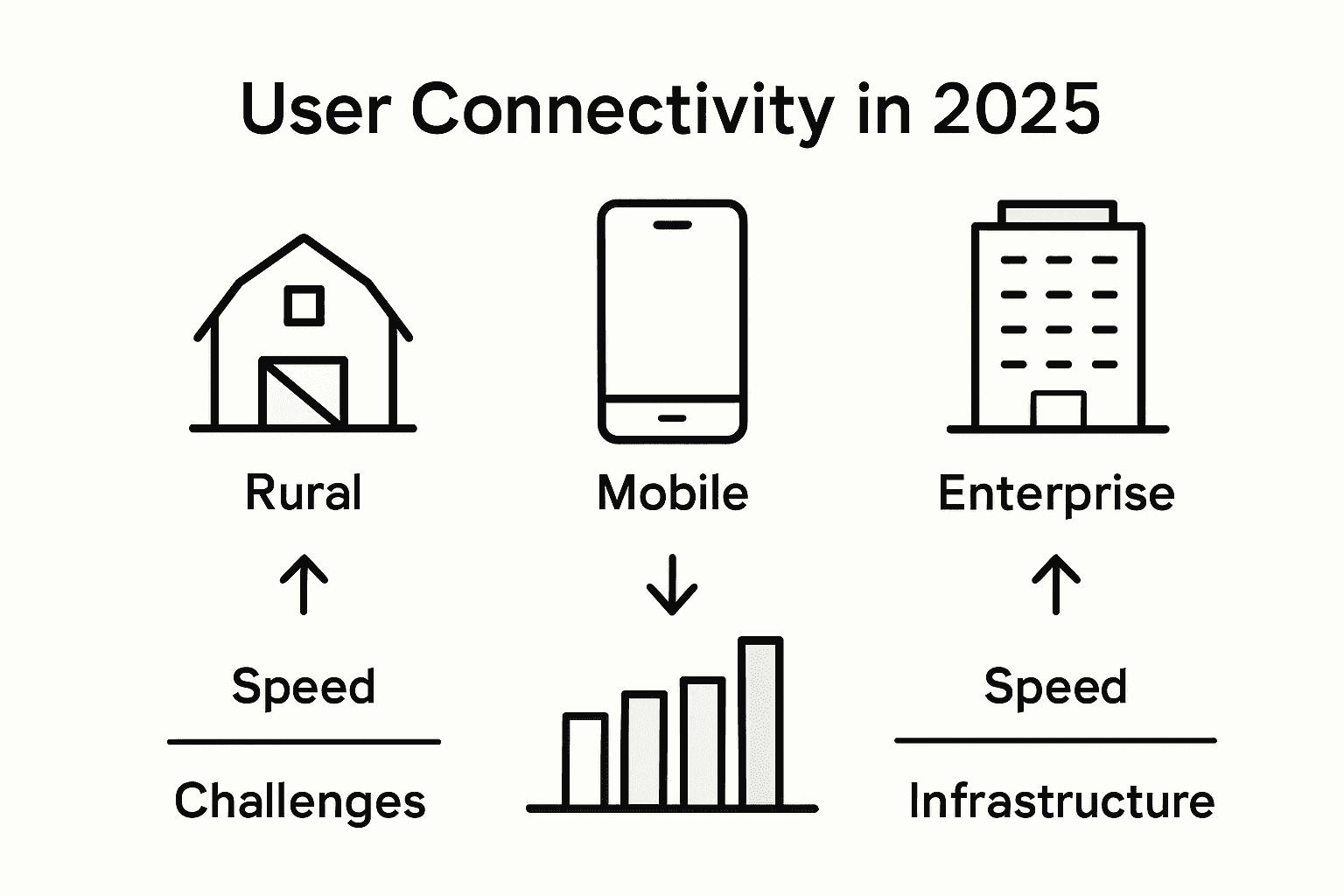
The convergence of mobile and enterprise connectivity is creating hybrid digital ecosystems that blur traditional boundaries between work and personal communication technologies. Smartphones, tablets, and portable hotspots are no longer just communication devices but comprehensive productivity platforms that integrate advanced security protocols, cloud computing capabilities, and intelligent networking technologies. This evolution represents a fundamental restructuring of how professionals interact with digital resources, enabling more agile, responsive, and intelligent communication strategies.
Below is a summary of how different user groups are affected by new connectivity technologies:
| User Group | Main Benefit | Ongoing Challenge |
|---|---|---|
| Rural Communities | Reliable high-speed internet | Infrastructure coverage gaps |
| Mobile Users | Enhanced mobility and speed | Consistent connectivity in transit |
| Enterprises | Flexible, scalable networks | Security and integration complexity |
Pro Connectivity Strategy Tip: Regularly assess your current internet infrastructure and explore emerging mobile technologies that can enhance your personal or professional digital capabilities.
Pro Digital Adaptation Tip: Invest in flexible, multi-platform connectivity solutions that can adapt to rapidly changing technological landscapes and support diverse work and communication environments.
Stay Ahead of 2025 Connectivity Challenges with SabertoothPro Solutions
As 2025 introduces advanced technologies like 6G and AI-driven networks, many face the challenge of upgrading their devices and infrastructure to keep pace with these rapid changes. The article highlights the complexity of emerging connectivity trends and warns of potential obsolescence without proactive adaptation. If you are concerned about achieving seamless high-speed internet and securing your network in this evolving landscape SabertoothPro offers tailored solutions designed to bridge connectivity gaps from rural areas to enterprise environments.
Explore our range of innovative products including high-performance wireless devices and network boosters in the Titan WiFi collection or enhance your coverage with reliable WiFi extenders engineered for modern demands.

Don’t let outdated equipment slow down your digital experience. Visit SabertoothPro.com now to discover advanced internet plans and enterprise IT services. Act now to future-proof your connectivity and unlock the full potential of 2025’s technology breakthroughs.
Frequently Asked Questions
What are the key connectivity trends expected by 2025?
The key connectivity trends for 2025 include advanced 6G technology development, improvements in Wi-Fi standards, and the expansion of ultra-high-speed broadband networks. These advancements will transform how we interact with digital infrastructure.
How will 6G technology impact internet speed and connectivity?
6G technology is expected to provide ultra-low latency and speeds exceeding 1 Tbps, enabling complex applications that require extreme speed and reliability.
What role does generative AI play in enhancing connectivity?
Generative AI optimizes network management through predictive capabilities, allowing for real-time adjustments to network parameters, enhancing efficiency, and creating smarter, self-healing networks.
What challenges do rural communities face regarding connectivity advancements?
While connectivity technologies are evolving, rural communities often struggle with infrastructure coverage gaps, which hinder their access to reliable high-speed internet, emphasizing the need for targeted investments in digital infrastructure.