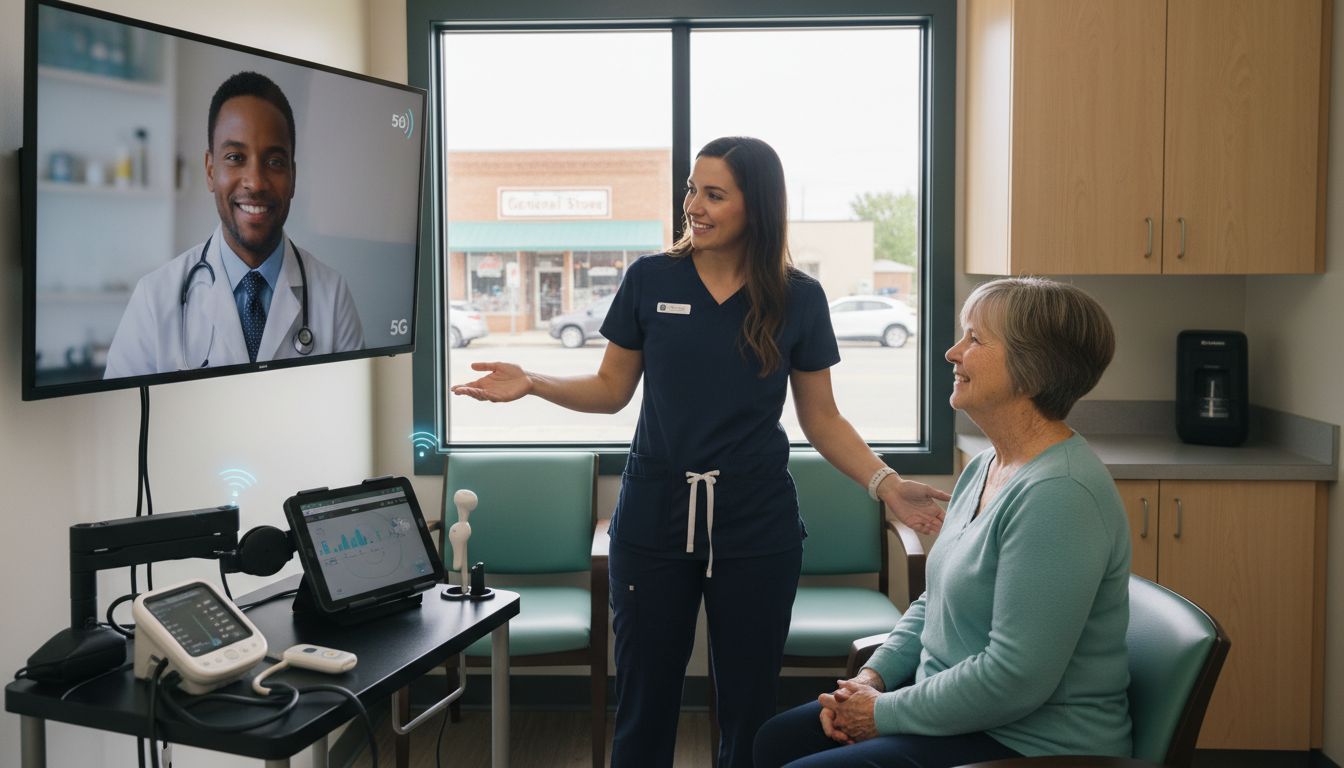


Role of 5G in Rural Areas: Complete Guide

Nearly half of rural american communities still lack reliable digital connectivity, creating barriers in everything from education to healthcare. As daily life becomes more connected, the gap between rural and urban technology access grows wider. Understanding what 5G really offers—and how it could transform rural american homes, farms, and businesses—helps clarify why high-speed wireless matters more than ever. This guide breaks down the key benefits, challenges, and choices facing rural regions on the path to 5G.
Table of Contents
- What Is 5G and Its Rural Benefits
- Expanding Coverage: How 5G Reaches Rural Areas
- Key Use Cases for 5G in Rural Communities
- Challenges and Limitations of 5G Deployment
- Comparing 5G With Other Rural Internet Solutions
Key Takeaways
| Point | Details |
|---|---|
| Rural Connectivity Enhancement | 5G technology significantly improves internet access in rural areas, offering faster speeds and better reliability compared to previous networks. |
| Economic Opportunities | The implementation of 5G can boost rural economies by enhancing precision agriculture, telemedicine, and remote work capabilities. |
| Infrastructure Challenges | High upfront costs and complex terrain present significant barriers to 5G deployment in low-population areas, necessitating government support. |
| Hybrid Solutions Recommended | A combination of 5G, satellite, and fixed wireless technologies may provide the most effective internet solution for diverse rural environments. |
What Is 5G and Its Rural Benefits
5G technology represents a revolutionary wireless network infrastructure designed to transform connectivity, particularly in rural and underserved regions. According to IJERT, this advanced network offers improved connectivity with increased speeds and reliability, which is crucial for areas traditionally lacking robust digital infrastructure.
5G operates differently from previous generations by enabling significantly faster data transmission, wider mobility support, and higher connection density. While traditional cellular networks struggled to provide consistent coverage in remote locations, 5G promises to bridge critical connectivity gaps. UNDP notes that these networks can support emerging technologies and services across various sectors.
The key rural benefits of 5G include:
- Dramatically faster internet speeds
- Enhanced mobile broadband capabilities
- Support for precision agriculture technologies
- Improved telemedicine and remote education services
- More reliable communication infrastructure
However, rural 5G deployment isn’t without challenges. Significant infrastructure investments are required, and telecom operators must carefully evaluate the economic feasibility of network expansion into less populated areas. Strategic planning and potential government incentives will be critical in making 5G accessible beyond urban centers.
For more details on rural internet options, check out our comprehensive guide on rural internet.
Expanding Coverage: How 5G Reaches Rural Areas
Expanding 5G coverage in rural areas requires strategic infrastructure deployment and innovative technological approaches. Countryside Alliance research reveals a stark digital divide, with nearly half of rural deprived areas classified as 5G not-spots compared to just 2.7% of urban communities. This disparity underscores the critical need for targeted connectivity solutions.
Small cell technology and fixed wireless access have emerged as key strategies for bridging rural connectivity gaps. These approaches allow telecom providers to extend network coverage more cost-effectively by using smaller, less expensive transmission equipment that can be strategically placed across rural landscapes. Unlike traditional large cell towers, these compact solutions can navigate challenging terrain and reach remote communities with minimal infrastructure investment.
The deployment process typically involves several strategic steps:
- Conducting comprehensive terrain mapping
- Identifying optimal signal transmission points
- Installing compact 5G transmission equipment
- Implementing advanced antenna technologies
- Developing backup connectivity options
Interestingly, the 5G Rural Dorset project demonstrates how next-generation connectivity can transform rural communities, addressing challenges in public safety, economic growth, food production, and environmental monitoring. By leveraging innovative 5G technologies, rural areas can overcome traditional connectivity limitations and unlock new economic and social opportunities.
To learn more about rural internet options, check out our guide on rural broadband.
Key Use Cases for 5G in Rural Communities
5G technology is transforming rural communities by introducing innovative solutions across multiple sectors. Mobile UK research highlights its potential to revolutionize rural life, demonstrating that 5G can reduce farming costs by 15% and increase crop yield by 13%, offering unprecedented opportunities for economic and technological advancement.
Agricultural Innovation stands out as a prime use case for 5G in rural areas. Farmers can now leverage advanced technologies like precision agriculture, using real-time data transmission for crop monitoring, automated machinery control, and environmental tracking. Smart sensors connected through 5G networks enable farmers to make data-driven decisions about irrigation, fertilization, and pest management, dramatically improving agricultural efficiency.
Healthcare represents another critical application of 5G in rural communities. RSIS International notes that 5G-powered telemedicine brings healthcare services directly to remote locations, allowing patients to:
- Consult with healthcare professionals remotely
- Receive real-time emergency medical consultations
- Access high-quality video health education sessions
- Connect with specialists without extensive travel
Beyond agriculture and healthcare, 5G enables rural economic development through enhanced remote working capabilities, tourism digital experiences, and improved business communication infrastructure. These technological advances promise to bridge historical connectivity gaps and create new opportunities for rural communities.
For additional insights into rural internet technologies, explore our guide on rural internet providers.
Challenges and Limitations of 5G Deployment
5G infrastructure deployment presents significant challenges, particularly in rural and economically disadvantaged regions. UNDP research reveals that deployment costs can potentially double for operators needing to upgrade existing networks, creating substantial financial barriers to widespread adoption.
Infrastructure investment represents the most critical challenge for 5G expansion. Telecom operators face multiple obstacles when considering rural network deployment, including:
- Extremely high upfront capital requirements
- Limited return on investment in low-population areas
- Complex terrain that increases installation difficulties
- Significant equipment and maintenance expenses
- Regulatory and spectrum allocation complexities
Technical limitations further complicate rural 5G implementation. Signal propagation becomes challenging in areas with dense forests, mountainous terrain, or significant geographical barriers. Low population density means fewer potential subscribers, making traditional business models financially unviable. This economic reality often results in rural communities being systematically overlooked during network expansion plans.
Government policies and targeted infrastructure funding could help mitigate these challenges. Strategic public-private partnerships, infrastructure sharing arrangements, and targeted subsidies might incentivize telecom providers to extend 5G coverage to underserved regions. By creating more attractive investment frameworks, policymakers can help bridge the digital connectivity divide.
Want to understand more about network technologies? Check out our guide on 5G network technology.
Comparing 5G With Other Rural Internet Solutions
Countryside Alliance research reveals a stark digital divide, with nearly half of rural areas classified as connectivity not-spots. This reality necessitates a comprehensive comparison of internet technologies to address rural connectivity challenges.
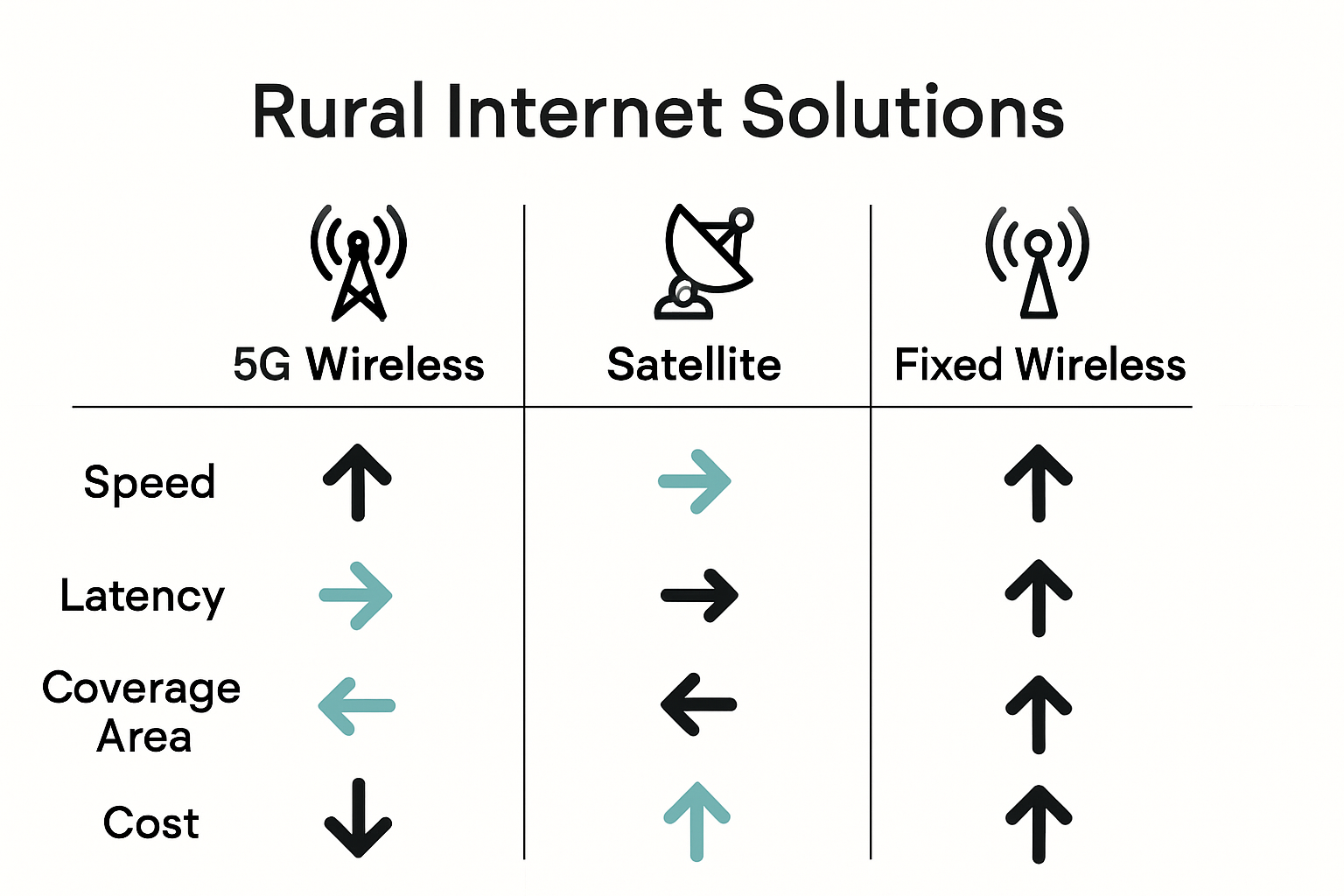
Internet Solutions Comparison:
-
5G Wireless
- Highest data transmission speeds
- Low latency
- High connection density
- Significant infrastructure investment required
-
Satellite Internet
- Widespread geographical coverage
- Lower bandwidth
- Higher latency
- More affordable initial setup
-
Fixed Wireless
- Moderate speeds
- Lower infrastructure costs
- Limited by terrain and distance
- Easier rural deployment
UNDP highlights that while 5G offers superior data speeds and connection capabilities, its high infrastructure costs make alternative solutions critically important for rural regions. The most effective approach often involves a hybrid strategy that combines multiple technologies to maximize coverage and accessibility.
Each connectivity solution presents unique advantages, with the optimal choice depending on specific local infrastructure, terrain, population density, and budget constraints.
 Rural communities must carefully evaluate their specific needs and technological limitations when selecting an internet solution.
Interested in finding the best rural internet option? Check out our guide to selecting rural internet.
Unlock Reliable 5G Connectivity for Your Rural Area Today
The challenge of expanding 5G coverage in rural communities calls for innovative and affordable solutions that bridge the digital divide. With limited infrastructure and difficult terrain, achieving fast and reliable internet often seems out of reach. Whether you need to power precision agriculture, enable telemedicine, or improve remote work capabilities, the right connectivity devices make all the difference. SabertoothPro understands these pain points and delivers cutting-edge 5G hotspots, routers, and internet plans designed specifically to overcome these hurdles.

Explore our selection of advanced Titan WiFi devices engineered for rural environments and harness the full potential of 5G technology. Don’t let connectivity challenges hold your community back. Visit SabertoothPro.com to find reliable options that ensure secure and high-speed internet access. Take the first step toward transforming your rural internet experience now with solutions supported by real tech innovation.
Frequently Asked Questions
What are the main benefits of 5G technology in rural areas?
5G technology offers several benefits in rural areas, including dramatically faster internet speeds, enhanced mobile broadband capabilities, support for precision agriculture technologies, improved telemedicine services, and more reliable communication infrastructure.
How does 5G differ from previous generations of cellular networks?
5G technology enables significantly faster data transmission, wider mobility support, and higher connection density compared to previous cellular networks, allowing for better coverage and more robust services, especially in remote locations.
What challenges are associated with deploying 5G in rural areas?
Challenges include high infrastructure investment costs, limited return on investment due to low population density, complex terrain that can hinder installation, and regulatory hurdles. These factors can make it financially challenging for telecom operators to extend 5G coverage to rural communities.
How can 5G technology improve healthcare in rural communities?
5G technology enhances healthcare in rural areas by facilitating telemedicine services, allowing patients to consult with healthcare professionals remotely, receive real-time emergency consultations, access educational sessions, and connect with specialists without extensive travel.