


What Is Rural Internet? Complete Guide for 2025

Only 48 percent of rural residents have internet access compared to 83 percent in cities, revealing a gap that affects millions of lives. Reliable online connections are no longer a luxury for small towns and remote communities—they drive education, healthcare, and economic growth. Understanding what rural internet actually means and separating truth from common myths can help families, businesses, and decision-makers make better choices about staying connected where it matters most.
Table of Contents
- Defining Rural Internet and Common Myths
- Types of Rural Internet Connections Explained
- How Rural Internet Works: Core Features
- Benefits and Challenges of Rural Connectivity
- Comparing Rural Internet to Urban Alternatives
Key Takeaways
| Point | Details |
|---|---|
| Digital Divide | Rural areas experience a significant digital divide, with only 48% having internet access compared to 83% in urban regions. |
| Connectivity Solutions | A variety of connectivity options exist for rural internet, including mobile, satellite, and fixed wireless technologies, requiring strategic choice based on specific community needs. |
| Economic Impact | Reliable internet is crucial for rural economic growth, enabling remote work, online education, and technological advancements in sectors like agriculture. |
| Collaborative Efforts | Successful rural internet deployment relies on partnerships between government, providers, and communities to address infrastructure and cost challenges effectively. |
Defining Rural Internet and Common Myths
Rural internet refers to telecommunications infrastructure and connectivity services specifically designed for less populated geographic regions where traditional broadband deployment is challenging. According to the International Telecommunication Union, there’s a significant digital divide, with only 48% of rural inhabitants having internet access compared to 83% in urban areas.
Contrary to popular misconceptions, rural internet isn’t simply about geography—it’s about solving complex connectivity challenges. Many people mistakenly believe rural areas lack technological infrastructure entirely, but the reality is far more nuanced. McKinsey highlights that rural regions are not in irreversible decline, but actively contributing to economic growth and seeking innovative connectivity solutions.
Some common myths about rural internet include:
- Rural areas don’t need high-speed internet
- Satellite is the only connectivity option
- Internet infrastructure is too expensive to develop
- Rural residents are not tech-savvy
In reality, rural communities are increasingly dependent on reliable internet for:
- Remote work opportunities
- Online education
- Telehealth services
- Agricultural technology
- Small business operations
Understanding rural internet means recognizing it’s not just about providing a connection, but creating meaningful digital access that supports community development and economic potential.
Types of Rural Internet Connections Explained
Rural internet connections are diverse and innovative, offering multiple solutions to bridge the connectivity gap in less populated areas. Wikipedia outlines several critical technologies that enable internet access in remote regions, demonstrating the complexity and adaptability of rural telecommunications infrastructure.
The primary types of rural internet connections include:
- Mobile Internet: Leveraging cellular networks to provide wireless connectivity
- Satellite Internet: Using orbiting satellites to transmit internet signals
- Fixed Wireless: Transmitting signals from ground-based towers to receiver points
- DSL and ADSL: Utilizing existing telephone lines for data transmission
- Power-line Internet: Delivering internet through electrical infrastructure
- White Space Internet: Utilizing unused television broadcast frequencies
According to research from arXiv, the effectiveness of rural internet deployment often depends on strategic investment and targeted infrastructure development. The Connect America Fund has been particularly crucial in addressing internet access inequities, highlighting the importance of government and private sector collaboration.
Each connection type offers unique advantages and challenges. Satellite internet provides widespread coverage but can suffer from latency issues, while mobile internet offers flexibility but may have data limitations. Fixed wireless provides reliable speeds in line-of-sight scenarios, and power-line internet represents an innovative use of existing infrastructure.
Choosing the right rural internet connection requires careful consideration of factors like:
- Geographic terrain
- Available infrastructure
- Budget constraints
- Required internet speeds
- Reliability expectations
The future of rural internet lies in developing hybrid solutions that combine multiple technologies to create more robust, reliable, and accessible connectivity for rural communities.
How Rural Internet Works: Core Features
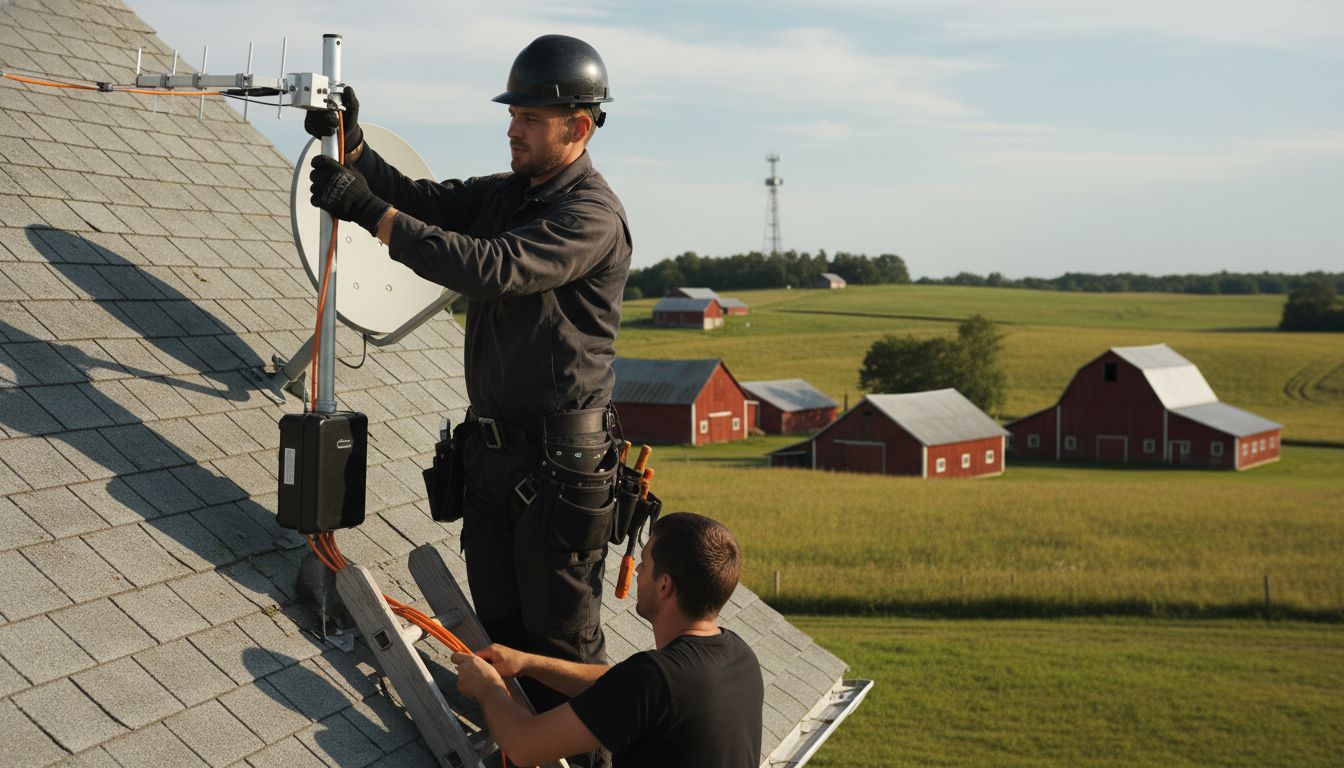
Rural internet infrastructure is a complex ecosystem of technologies designed to overcome geographical and economic challenges in connectivity. arXiv research highlights how state policies and market boundaries critically shape the construction and functionality of rural internet access, revealing that successful deployment is more than just technological implementation.
The core features of rural internet systems typically involve:
- Signal transmission across long distances
- Adaptive bandwidth management
- Resilient network architecture
- Low-latency communication protocols
- Cost-effective infrastructure solutions
At its fundamental level, rural internet works through specialized transmission methods that compensate for challenging terrain and sparse population density. Ground-based towers, satellite networks, and innovative wireless technologies create interconnected systems that bridge communication gaps. These networks must accomplish several critical objectives:
- Extend signal range beyond traditional urban infrastructure
- Maintain stable connectivity in remote locations
Signal propagation becomes the most crucial element in rural internet technology. Unlike urban networks with dense infrastructure, rural systems require sophisticated techniques like:
- Directional antennas
- Signal repeaters
- Frequency optimization
- Advanced error correction mechanisms
Economic constraints play a significant role in rural internet deployment. Providers must balance technological complexity with affordable pricing, often relying on government subsidies and innovative funding models to make connectivity viable. The result is a dynamic, adaptive system that transforms remote geographical limitations into opportunities for digital inclusion.
Benefits and Challenges of Rural Connectivity
Rural internet connectivity represents a transformative technology with profound implications for isolated communities. Academic research reveals that broadband access is not just about technology, but about fundamentally reshaping rural economic landscapes, particularly in sectors like agriculture where digital connectivity can dramatically enhance productivity and market engagement.
The key benefits of rural internet connectivity include:
- Economic opportunity expansion
- Enhanced educational access
- Improved healthcare delivery
- Agricultural technological integration
- Remote work possibilities
- Small business development
According to the U.S. House Committee on Oversight, inadequate internet access systematically undermines rural communities’ potential by creating significant barriers to education and economic advancement. The digital divide is not merely a technical challenge, but a critical socioeconomic issue that impacts generational opportunities.
However, rural connectivity isn’t without substantial challenges:
- High infrastructure deployment costs
- Geographic terrain limitations
- Lower population density
- Limited return on investment for providers
- Complex technological requirements
The most promising path forward involves collaborative approaches between government agencies, technology providers, and local communities. By treating rural internet not as a luxury but as essential infrastructure, we can create more inclusive, technologically empowered rural ecosystems that bridge historical connectivity gaps and unlock unprecedented economic and social potential.
Comparing Rural Internet to Urban Alternatives
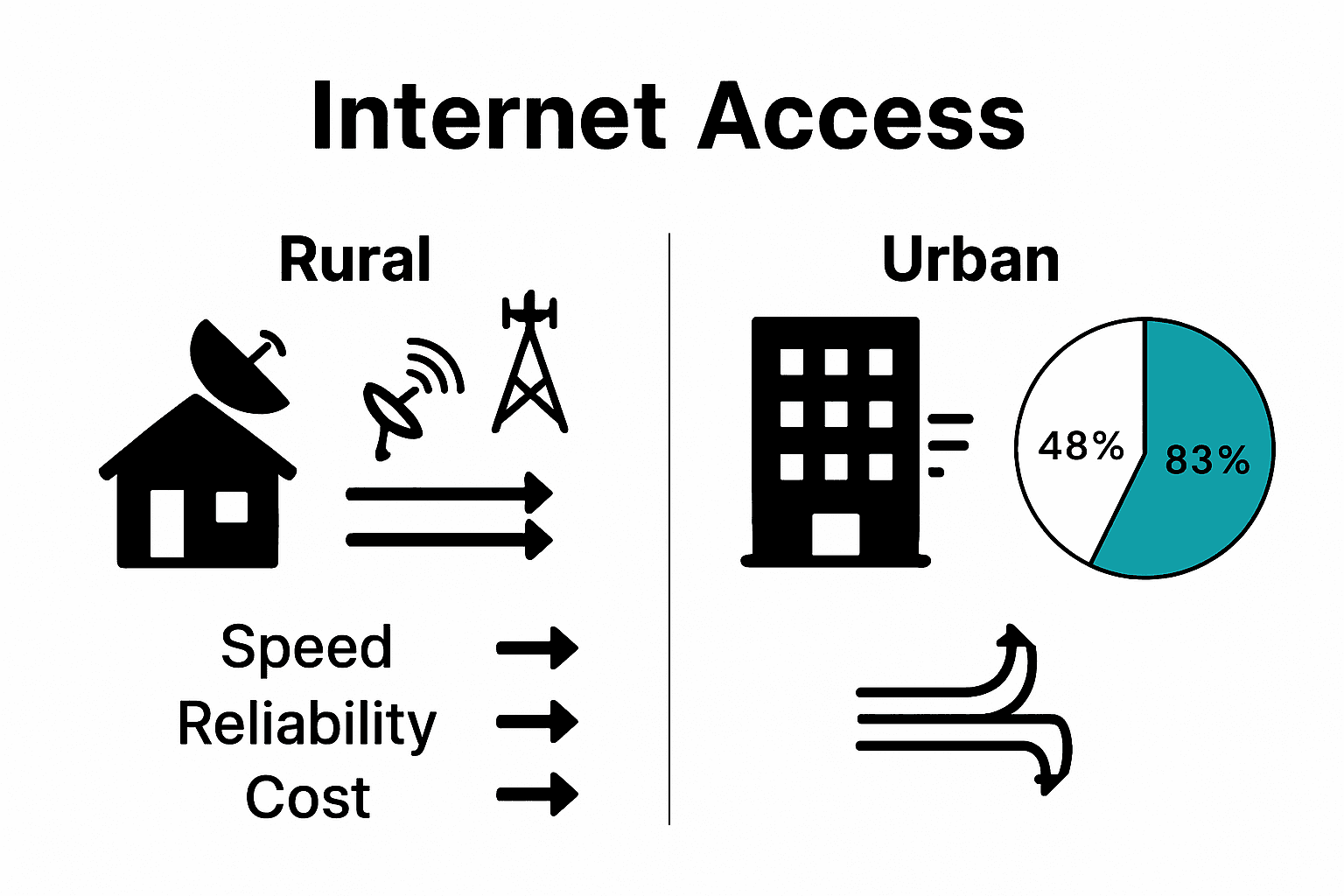
Internet connectivity reveals stark differences between urban and rural environments. International Telecommunication Union data highlights a dramatic disparity, with 83% of urban dwellers having internet access compared to just 48% in rural areas, underscoring the significant technological divide.
Key comparative aspects between rural and urban internet include:
- Connection Speed: Urban areas typically offer higher bandwidth
- Infrastructure Complexity: Urban networks are more densely configured
- Technology Availability: More advanced technologies concentrated in cities
- Cost per Megabit: Urban areas generally have lower per-unit costs
- Reliability: Urban networks experience fewer service interruptions
Rural internet solutions must overcome unique challenges that urban networks rarely encounter:
- Greater geographical distance between network nodes
- Less predictable terrain interference
- Higher per-user infrastructure investment
- More sophisticated signal transmission requirements
- Limited economic incentives for providers
While urban internet operates on established, high-density infrastructures, rural connectivity demands innovative approaches. Satellite, fixed wireless, and hybrid technologies become essential, transforming technological limitations into opportunities for connection. The future of rural internet lies not in mimicking urban models, but in developing specialized solutions that recognize and adapt to unique rural technological landscapes.
Unlock Reliable Rural Internet with SabertoothPro Solutions
Living in a rural area should never mean settling for slow or unstable internet. As the article highlights, rural connectivity faces challenges like difficult terrain and costly infrastructure that can hold back economic opportunity, remote work, and education. You deserve high-speed internet that overcomes these issues by using innovative technologies designed for rural environments.
Discover a range of powerful options with Titan WiFi devices built to extend coverage and improve signal strength where traditional solutions fall short. Combine that with our selection of WiFi extenders to reach every corner of your home or business.

Experience how SabertoothPro puts you in control of your rural internet connection today. Visit SabertoothPro.com to explore our cutting-edge products and unlock faster, more reliable internet. Take the first step toward bridging the digital divide and ensuring your community stays connected without compromise.
Frequently Asked Questions
What is rural internet?
Rural internet refers to telecommunications infrastructure and connectivity services designed for less populated areas, addressing unique challenges in providing internet access compared to urban environments.
What are the common types of rural internet connections?
Common types of rural internet connections include mobile internet, satellite internet, fixed wireless, DSL/ADSL, power-line internet, and white space internet, each with unique advantages and challenges.
What are the main benefits of rural internet connectivity?
The key benefits of rural internet connectivity include expanding economic opportunities, enhanced educational access, improved healthcare delivery, integration of agricultural technology, and opportunities for remote work and small business development.
What challenges does rural internet face compared to urban internet?
Rural internet faces challenges such as high infrastructure deployment costs, geographic terrain limitations, lower population density, limited return on investment for providers, and complex technological requirements that urban areas typically do not encounter.