


Internet in retail: 70% fewer payment failures in 2026

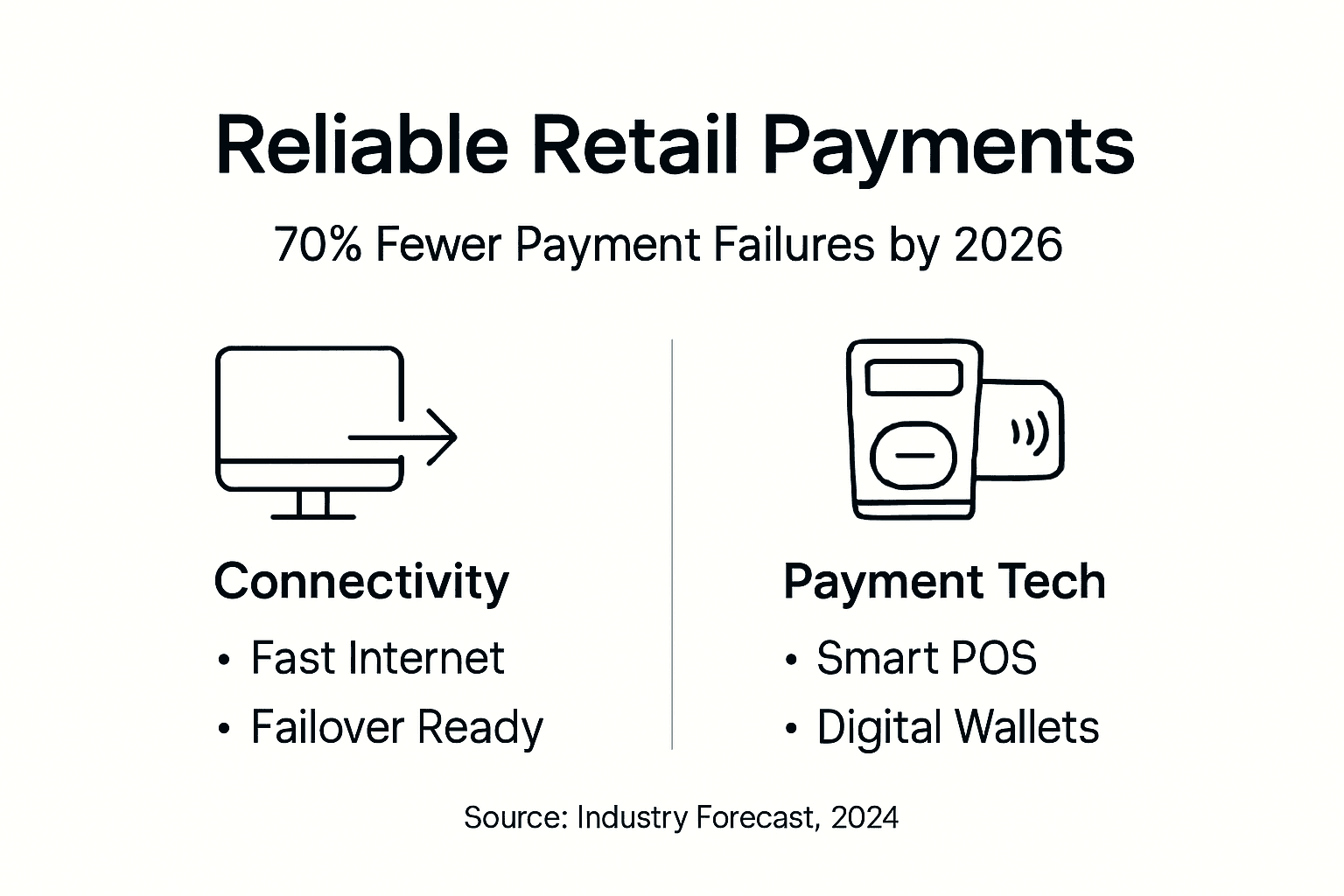
Most retailers blame faulty point of sale terminals when transactions fail, but internet instability causes nearly 70% of all retail payment failures, not hardware issues. In 2026, reliable connectivity has become the invisible infrastructure supporting every customer interaction, from seamless checkouts to personalized shopping experiences. This guide reveals how optimizing your internet strategy prevents costly downtime, enhances customer satisfaction, and transforms operations through smart technology integration.
Table of Contents
- Introduction To Internet’s Impact On Modern Retail
- Enhancing Customer Experience Through Internet-Enabled Communication
- Payment System Reliability And Internet Failover
- Integrating Iot For Operational Efficiency In Retail
- Network Optimization With Sd-Wan And Cloud Solutions
- Security Strategies For Retail Internet And Payment Systems
- Common Misconceptions About Retail Internet And Payment Reliability
- Conclusion: Practical Steps And Strategic Recommendations
- Discover Reliable Internet Solutions For Retail In The Mid-Atlantic
- Frequently Asked Questions
Key takeaways
| Point | Details |
|---|---|
| Payment reliability | Reliable internet connectivity is essential for minimizing payment system downtime in retail. |
| Customer engagement | Internet-enabled communication tools significantly enhance customer experience and engagement. |
| Operational efficiency | IoT integration via the internet boosts inventory accuracy and operational efficiency. |
| Network optimization | Adopting SD-WAN and cloud solutions optimizes network reliability and reduces costs. |
| Security protection | Zero-trust security frameworks crucially protect retail networks and customer data. |
Introduction to internet’s impact on modern retail
Your internet connection does more than enable transactions. It powers every digital touchpoint in your store, from inventory scanners to customer Wi-Fi to cloud-based analytics dashboards. Retail digital transformation relies on robust internet infrastructure to support emerging customer expectations and operations needs post COVID-19.
The pandemic accelerated changes that were already underway. Shoppers now expect seamless omnichannel experiences where online browsing informs in-store visits. Contactless payments became standard overnight. Health monitoring systems require constant connectivity. These aren’t temporary shifts but permanent fixtures of modern retail.
Recognizing internet as a strategic asset rather than a utility changes how you budget and plan. When connectivity drives revenue through faster checkouts, better inventory management, and enhanced customer engagement, it deserves the same attention as your physical infrastructure. Every dollar invested in reliable connectivity strategies returns multiples through reduced downtime and improved customer satisfaction.
Key dependencies on internet connectivity include:
- Payment processing and transaction authorization across all channels
- Real-time inventory tracking and automated reordering systems
- Customer relationship management and personalized marketing delivery
- Employee communication and task management platforms
- Security systems and video surveillance monitoring
Enhancing customer experience through internet-enabled communication
Unified communications as a service (UCaaS) transforms how your team responds to customer needs. Cloud-based phone systems, video chat, and instant messaging let staff access customer information instantly, regardless of their location in the store. When a customer asks about product availability, employees check inventory in seconds rather than minutes.
Contact center as a service (CCaaS) creates seamless omnichannel support. A customer who starts a conversation via chat can continue it in-store or by phone without repeating information. Omnichannel contact centers improve customer satisfaction by up to 30%, turning frustrated shoppers into loyal advocates.
Secure guest Wi-Fi does more than keep customers happy while they browse. It provides valuable analytics about shopping patterns and dwell times. The numbers tell a compelling story: secure Wi-Fi increases dwell time by 20% and purchase conversions by 18%. Longer visits mean more opportunities to engage and sell.
Internet-enabled communication benefits include:
- Instant access to product information and inventory across all locations
- Faster response times for customer inquiries and support requests
- Coordinated promotions and messaging across digital and physical channels
- Real-time staff scheduling adjustments based on foot traffic patterns
Pro Tip: Enable push notifications through your guest Wi-Fi portal to alert customers about flash sales or special offers while they shop, creating urgency that drives immediate purchases.
Payment system reliability and internet failover
When your internet goes down, revenue stops. Card processors cannot authorize transactions. Digital wallets fail. Even chip readers require connectivity to verify cards against fraud databases. The importance of reliable retail internet becomes painfully clear during outages that cost hundreds of dollars per minute in lost sales.

Unstable connections cause problems beyond complete outages. Intermittent drops create transaction timeouts that frustrate customers and staff. Slow speeds during peak hours lead to abandoned purchases. These partial failures are insidious because they’re harder to diagnose than complete blackouts.
Multi-technology failover solves this vulnerability by combining wired broadband with wireless 4G LTE or 5G backup connections. When your primary connection fails, traffic automatically switches to the backup within seconds. Failover internet reduces payment downtime from hours to minutes, enabling 99.999% point of sale system uptime that protects every transaction.
Failover planning essentials:
- Deploy redundant connections using different technologies (fiber plus wireless)
- Configure automatic switching with health monitoring and alerts
- Test failover monthly to verify backup connectivity works when needed
- Document failover procedures for staff to recognize and respond appropriately
Pro Tip: Choose wireless backup connections from different carriers than your primary provider to avoid correlated outages where both fail simultaneously during regional disruptions or maintenance windows.
Integrating IoT for operational efficiency in retail
Internet of Things devices generate real-time visibility into operations that were previously invisible. Smart shelves detect when products run low and trigger automatic reorders. Environmental sensors maintain optimal conditions for perishable goods. Occupancy counters inform staffing decisions based on actual foot traffic rather than estimates.
These devices require stable connectivity to function. A disconnected sensor cannot alert you to rising freezer temperatures before spoilage occurs. Inventory trackers without internet cannot update your central system, defeating their purpose. IoT integration via reliable internet boosts inventory accuracy by 30%, transforms guesswork into data-driven decisions.
The operational benefits extend beyond inventory. Smart lighting and HVAC systems reduce energy costs by adjusting automatically to occupancy. Security cameras with analytics detect suspicious behavior patterns. Maintenance sensors predict equipment failures before they occur, reducing maintenance costs by 35%.
| IoT Application | Internet Requirement | Key Benefit |
|---|---|---|
| Smart inventory tracking | Real-time data sync every 5-10 seconds | 30% accuracy improvement, 25% fewer stockouts |
| Environmental monitoring | Continuous sensor readings every 60 seconds | Prevents spoilage, ensures compliance |
| Customer analytics | Video and Wi-Fi data processing | Optimizes layouts and staffing |
| Predictive maintenance | Equipment telemetry every 5 minutes | 35% lower maintenance costs |
For deeper insights on optimizing IoT connectivity, explore strategies that ensure your devices maintain reliable connections even in challenging network environments. IBM’s research on IoT impact on retail inventory provides additional case studies and implementation frameworks.
Pro Tip: Segment IoT devices on separate network VLANs to isolate potential security vulnerabilities and ensure payment systems remain protected even if a smart device becomes compromised by malicious actors.
Network optimization with SD-WAN and cloud solutions
Software-defined wide area networking (SD-WAN) intelligently routes traffic across multiple connections based on real-time performance. If your primary circuit experiences congestion, SD-WAN automatically shifts critical payment traffic to a faster path. This dynamic optimization increases network reliability by 40% compared to traditional static routing.
Cost savings matter too. SD-WAN reduces dependence on expensive MPLS circuits by leveraging cheaper broadband and cellular connections without sacrificing reliability. The technology cuts networking costs by 25% while delivering better performance, making it attractive for multi-location retailers managing tight budgets.
Cloud colocation provides disaster recovery capabilities that on-premise servers cannot match. Your data replicates continuously to geographically distributed data centers. Hardware failures or natural disasters at one location do not interrupt operations. Cloud colocation reduces downtime by 50% and enables recovery within minutes rather than days.
| Feature | Traditional WAN | SD-WAN with Cloud |
|---|---|---|
| Network reliability | 95-97% uptime | 99.9%+ uptime (40% improvement) |
| Cost structure | High fixed MPLS costs | 25% lower with flexible bandwidth |
| Disaster recovery | Manual failover, hours | Automatic, under 5 minutes (50% faster) |
| Traffic management | Static routing rules | Dynamic, application-aware routing |
| Deployment speed | Weeks for new sites | Hours with cloud provisioning |
SD-WAN benefits for retail include:
- Prioritization of payment traffic over less critical applications
- Centralized management across all store locations from single dashboard
- Rapid deployment of new locations with minimal on-site configuration
- Seamless integration with cloud services and SaaS applications
Discover how SD-WAN benefits your specific retail environment by comparing traditional architectures with modern software-defined approaches that adapt automatically to changing network conditions.
Security strategies for retail internet and payment systems
Perimeter security assumes everything inside your network is trustworthy and everything outside is dangerous. This model fails in modern retail where employees use personal devices, IoT sensors connect directly to the internet, and cloud services blur traditional boundaries. Zero-trust architecture verifies every user and device continuously, regardless of location.
Implementing zero-trust starts with identity verification. Multi-factor authentication ensures users are who they claim to be. Device posture checks confirm endpoints meet security standards before granting access. Micro-segmentation limits lateral movement, so compromised devices cannot access payment systems. Zero-trust frameworks reduce data breaches by 60%, avoiding average losses of $3.9 million per incident.
Security operations center as a service (SOC-as-a-Service) provides 24/7 monitoring without building an internal team. Security analysts watch for suspicious patterns across your network, responding to threats before they escalate. This continuous vigilance catches attacks that automated tools miss while providing expertise most retailers cannot afford to hire full-time.
Essential security practices include:
- Encrypt all payment data in transit using TLS 1.3 or higher protocols
- Separate payment networks from guest Wi-Fi using VLAN segmentation
- Update firmware on all network devices monthly to patch vulnerabilities
- Train staff to recognize phishing attempts targeting retail employees
Pro Tip: Implement network access control (NAC) that automatically quarantines devices showing suspicious behavior, isolating potential threats before they can spread to critical payment systems or customer data repositories.
Learn comprehensive approaches to securing retail internet infrastructure that protect both customer privacy and business operations from evolving cyber threats targeting retail environments.
Common misconceptions about retail internet and payment reliability
Many retailers assume point of sale terminals cause most payment failures. The hardware gets blamed when transactions time out or cards fail to read. Reality tells a different story: 70% of payment failures originate from internet instability rather than terminal malfunctions. Replacing perfectly functional hardware wastes money without addressing root causes.
Another persistent myth claims failover internet is only necessary for large chains with hundreds of locations. Small retailers face proportionally higher risks because single-location outages represent 100% of their revenue. A three-hour internet failure during peak holiday shopping can devastate annual profits for independent stores more severely than enterprise retailers.
Security misconceptions also abound. Some believe strong firewalls alone provide adequate protection, ignoring that reliable internet infrastructure is essential for security tools to function properly. Firewalls cannot protect networks they cannot reach during connectivity outages. Integrated security requires both robust defenses and stable connectivity to maintain continuous protection.
Common false beliefs to avoid:
- “Our internet rarely goes down, so backup connections are unnecessary”
- “Wireless backup cannot handle full payment system traffic loads”
- “Cloud security is less secure than on-premise solutions”
- “IoT devices are too simple to pose serious security risks”
Conclusion: practical steps and strategic recommendations
Transforming your retail internet infrastructure requires systematic planning and phased implementation. Start with these priorities:
- Audit current connectivity by measuring actual uptime, latency, and bandwidth utilization during peak hours to establish performance baselines.
- Deploy multi-technology failover combining wired and wireless connections to eliminate single points of failure threatening payment systems.
- Implement SD-WAN to optimize traffic routing and reduce costs while improving reliability across all locations.
- Adopt zero-trust security frameworks with continuous verification replacing outdated perimeter-based approaches.
- Integrate IoT devices strategically, starting with high-value applications like inventory tracking and environmental monitoring.
- Enable SOC-as-a-Service monitoring to detect and respond to threats before they impact operations or customer data.
- Train staff on connectivity dependencies so they recognize internet issues quickly and follow documented escalation procedures.
These improvements compound over time. Better connectivity enables more IoT devices, which generate data informing smarter decisions. Enhanced security builds customer trust, encouraging adoption of digital services that require robust infrastructure. Each element reinforces others in a virtuous cycle of operational excellence.
Discover reliable internet solutions for retail in the Mid-Atlantic
Implementing these strategies requires a partner who understands retail operations and connectivity challenges unique to your region.

Sabertooth Pro delivers wireless internet provider solutions specifically designed for Mid-Atlantic retailers facing diverse connectivity demands. Our IoT connectivity solutions ensure your devices maintain reliable connections supporting inventory management, customer analytics, and operational efficiency. We provide integrated IT and IoT solutions combining secure networking, failover protection, and zero-trust security frameworks that protect payment systems and customer data. Our regional expertise means faster support response and infrastructure optimized for local conditions. Explore how our tailored solutions enhance your retail network’s performance and security in 2026.
Frequently asked questions
What causes most retail payment system failures?
Internet connectivity problems cause approximately 70% of payment failures, not hardware malfunctions. Unstable connections, insufficient bandwidth, and network congestion create transaction timeouts that appear as terminal errors.
How does failover internet work for retail locations?
Failover systems use multiple connection types (fiber, cable, wireless 4G LTE or 5G) monitored continuously. When the primary connection fails or degrades, traffic automatically switches to backup within seconds, maintaining payment system uptime.
Why is zero-trust security important for retail networks?
Traditional perimeter security fails when employees use personal devices, IoT sensors connect directly to the internet, and cloud services blur network boundaries. Zero-trust continuously verifies all users and devices, reducing breach risk by 60%.
Can small retailers benefit from SD-WAN technology?
Yes, SD-WAN scales to businesses of all sizes. Single-location retailers gain reliability improvements and cost savings by intelligently routing traffic across multiple internet connections while simplifying network management.
How does guest Wi-Fi improve retail sales?
Secure guest Wi-Fi increases customer dwell time by 20% and purchase conversions by 18% by keeping shoppers engaged while providing valuable analytics about shopping patterns and preferences that inform merchandising decisions.