


SD-WAN vs Traditional WAN: Impact on Modern Networks

Managing a network across multiple locations often means long waits for upgrades and high costs that drain your budget. For IT managers in Mid-Atlantic businesses, choosing between traditional WAN and SD-WAN can reshape how efficiently and reliably your team connects every office. Understanding the fundamental shift from hardware-centric networks to software-defined solutions will help you evaluate which approach supports your goals for cost savings, performance, and future readiness.
Table of Contents
- SD-WAN And Traditional WAN Explained
- Key Architecture And Technology Differences
- Comparing Costs, Performance, And Reliability
- Real-World Use Cases And Industry Adoption
- Transitioning To SD-WAN: Challenges And Tips
Key Takeaways
| Point | Details |
|---|---|
| Difference in Architecture | Traditional WAN relies on hardware, while SD-WAN uses software to enhance flexibility and management. |
| Cost Efficiency | SD-WAN significantly reduces network costs by leveraging existing internet connections instead of expensive MPLS circuits. |
| Performance and Agility | SD-WAN offers improved performance through intelligent routing and automatic failover, ensuring higher reliability and better resource utilization. |
| Phased Migration Approach | Transitioning to SD-WAN should be done in phases, starting with less critical applications to minimize risk and ensure proper testing. |
SD-WAN and Traditional WAN Explained
Your network infrastructure is the backbone of everything your business does. Understanding the difference between traditional WAN and SD-WAN is crucial when deciding how to modernize your connectivity strategy.
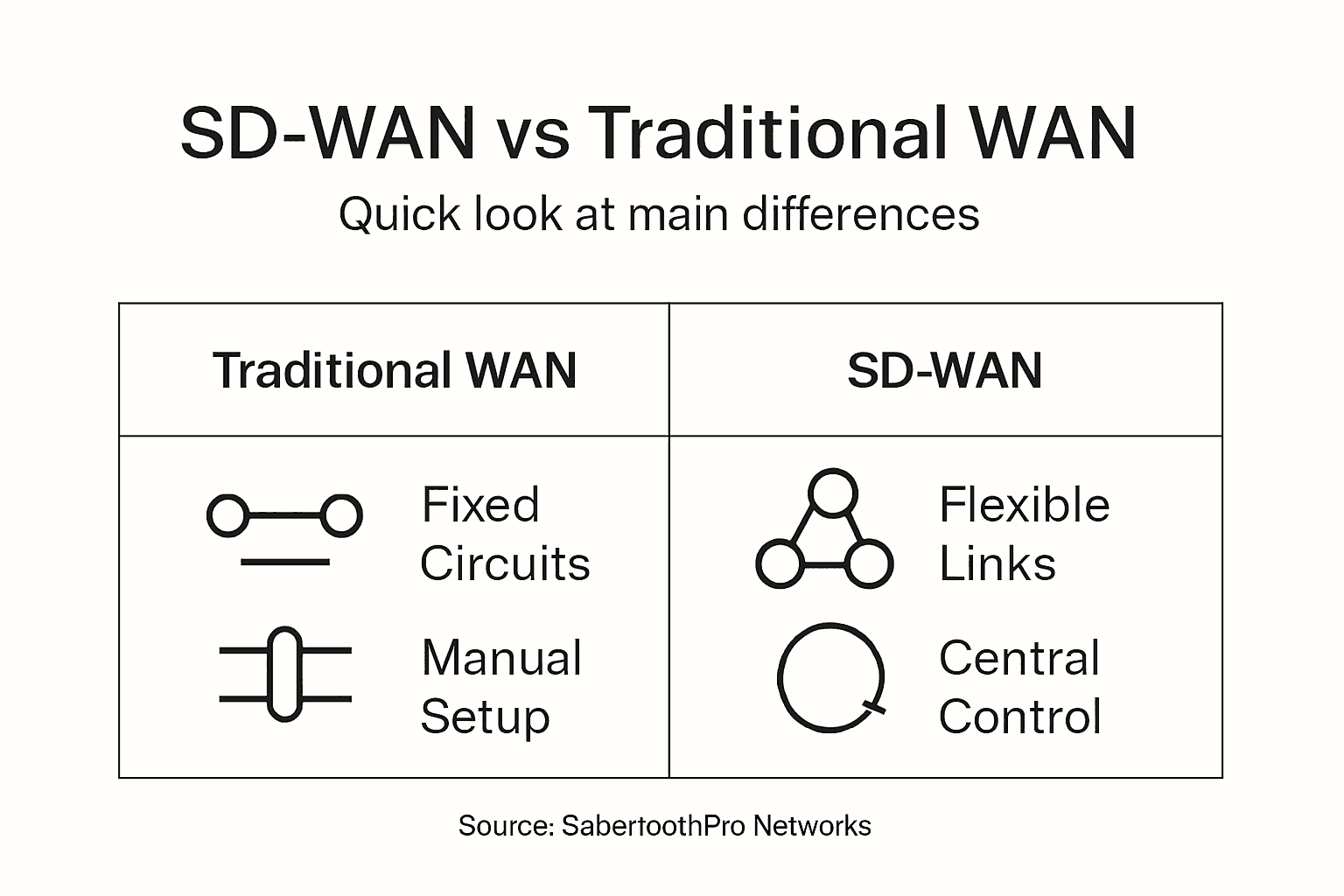
Traditional WAN relies on hardware-centric architecture with fixed circuits like MPLS to connect your branch offices and remote locations back to headquarters. This approach has served businesses for decades, offering predictable performance and established security protocols.
However, traditional WAN comes with real constraints. You’re locked into expensive, long-term contracts with carriers. Setup takes months. Adding new locations or increasing bandwidth means capital expenditure and lengthy implementation timelines.
SD-WAN turns this model on its head by using software to control network connectivity and management instead of depending solely on physical hardware. This fundamental shift unlocks significant advantages for growing businesses.
Here’s how they differ in practical terms:
- Traditional WAN: Hardware devices, fixed MPLS circuits, high costs, slow deployment
- SD-WAN: Software-defined control, multiple connection types (MPLS, LTE, broadband), cost-effective, rapid scaling
SD-WAN combines different connection types into a single unified network. Your traffic can use MPLS when you need guaranteed performance, standard broadband for cost savings, or LTE for failover protection. The software makes intelligent routing decisions in real-time.
Understanding the differences between traditional WAN and SD-WAN helps you evaluate which approach fits your business growth. Traditional WAN excels when you need maximum stability for mission-critical applications. SD-WAN shines when you need flexibility, lower costs, and cloud-ready infrastructure.
For Mid-Atlantic businesses expanding operations or migrating to cloud platforms, SD-WAN typically delivers faster ROI. Your existing broadband connections become useful network assets instead of secondary options. You reduce carrier dependency and gain control over your network traffic.
SD-WAN lets you leverage existing internet connections while maintaining performance standards that traditional WAN provided—but at a fraction of the cost.
The choice isn’t about which technology is “better.” It’s about matching your network architecture to your business objectives. If you’re managing multiple locations, supporting remote workers, or scaling cloud adoption, SD-WAN addresses these needs more efficiently than traditional WAN infrastructure.
Here is a side-by-side summary of core differences between Traditional WAN and SD-WAN:
| Aspect | Traditional WAN | SD-WAN |
|---|---|---|
| Primary Design | Hardware-centric, fixed circuits | Software-controlled, dynamic connections |
| Typical Connections | MPLS, dedicated leased lines | MPLS, broadband, LTE, mixed transport |
| Management Approach | Manual, location by location | Centralized, cloud-based dashboard |
| Scalability | Slow, requires new hardware | Rapid, add virtual or physical devices |
| Cloud Compatibility | Limited, designed for data centers | Natively supports cloud applications |
Pro tip: Start by auditing your current WAN usage patterns. Identify which applications demand guaranteed performance and which can tolerate variable latency. This data-driven approach helps you build an SD-WAN strategy that balances reliability with cost optimization from day one.
Key Architecture and Technology Differences
The technical foundation separating traditional WAN from SD-WAN is fundamental to understanding why organizations are making the switch. These architectures operate on completely different principles.
Traditional WAN depends on physical hardware and leased lines deployed at each location. A network engineer manually configures routers, firewalls, and switches to control traffic flow. When you need bandwidth changes or policy updates, someone must physically access the equipment or work through time-consuming vendor procedures.

This hardware-centric design creates bottlenecks. Each device requires separate management, configuration, and troubleshooting. Your options are limited to whatever connections your location’s carrier offers—typically MPLS or expensive dedicated circuits.
SD-WAN fundamentally reorganizes how networks operate by separating the control plane from data plane. Think of it as decoupling the “brain” from the “muscle” of your network.
The control plane handles policy decisions and traffic management centrally. One dashboard controls policies across all locations simultaneously. The data plane handles actual packet forwarding at branch offices without needing constant direction.
Here’s what this separation means practically:
- Control Plane: Centralized software manages policies, monitors performance, and makes routing decisions
- Data Plane: Edge devices at branches execute forwarding instructions and encrypt traffic
- Edge Devices: Deployed at each location to enforce policies and maintain cloud connectivity
- Real-Time Adjustments: Network automatically reroutes traffic based on performance metrics and application requirements
SD-WAN edge devices sit at your branch offices and cloud sites. They apply security policies, encrypt traffic, and determine which connection type (broadband, MPLS, or LTE) handles each application. If broadband fails, traffic automatically shifts to LTE without manual intervention.
Traditional WAN requires manual failover configuration. SD-WAN handles it automatically because the software continuously monitors connection health.
SD-WAN’s separation of control and data planes lets you manage your entire network from one location instead of configuring each site individually.
Another critical difference: SD-WAN architecture supports seamless cloud connectivity while traditional WAN was designed for data center-centric networks. As your business migrates applications to cloud platforms, SD-WAN adapts automatically. Traditional WAN forces you to maintain expensive MPLS circuits that now carry less traffic.
For your Mid-Atlantic operations, this architectural difference translates directly to operational efficiency. You reduce dependence on expensive leased lines. You gain visibility into application performance. You make network changes without scheduling technician visits.
Pro tip: When evaluating SD-WAN vendors, ask how their control plane handles policy conflicts across multiple locations. A robust architecture prevents cascade failures where one branch’s misconfiguration affects the entire network.
Comparing Costs, Performance, and Reliability
When your IT budget tightens, network spending becomes a critical focal point. The cost differences between traditional WAN and SD-WAN are substantial enough to reshape your entire infrastructure strategy.
Traditional WAN costs are relentless and predictable. MPLS circuits run $500-$2,000 monthly per branch depending on bandwidth and location. Add dedicated hardware, maintenance contracts, and technician visits, and your annual networking bill climbs quickly. A mid-sized business with 10 branches easily spends $150,000+ yearly on traditional WAN infrastructure.
SD-WAN leverages your existing broadband connections, which cost 60-70% less than MPLS. That same 10-branch network might run $40,000-$60,000 annually. You’re using the same internet pipes already installed at most locations.
Here’s where the cost advantage becomes tangible:
- Circuit Costs: Traditional WAN requires dedicated MPLS per location; SD-WAN uses multiple connection types
- Hardware: Traditional WAN needs expensive routers and appliances; SD-WAN edge devices are software-based
- Management: Traditional WAN demands multiple vendors and manual configuration; SD-WAN centralizes everything
- Scaling: Adding branches costs thousands per location traditionally; SD-WAN costs decrease with scale
Performance improvements are where SD-WAN truly separates itself. Traditional WAN sends all traffic through a central hub, creating inefficiency. If your New York branch needs data from your Virginia office, packets travel through headquarters first.
SD-WAN uses dynamic path selection and traffic optimization to route traffic intelligently. Critical applications (VoIP, video conferencing) use reliable MPLS. Less sensitive traffic flows over cheaper broadband. The system continuously monitors connection quality and shifts traffic in real-time.
Your users notice immediate differences: faster application response times, smoother video calls, and reduced latency during peak hours.
Reliability might seem like traditional WAN’s strength, but SD-WAN matches or exceeds it. Traditional WAN depends on single MPLS circuits. One circuit failure means branch outages until technicians restore service—sometimes days for rural locations.
SD-WAN provides automatic failover and load balancing across multiple links. When broadband fails, traffic automatically shifts to LTE without user intervention. Multiple connection types mean your network stays online even during carrier outages.
SD-WAN delivers traditional WAN reliability at a fraction of the cost by using multiple connections instead of betting everything on one circuit.
For Mid-Atlantic businesses, this matters. A manufacturing facility in Pennsylvania needs network uptime, not excuses. SD-WAN’s automated failover keeps operations running while your IT team handles other priorities.
The math is clear: lower costs, better performance, and equal or superior reliability. Traditional WAN made sense when broadband wasn’t reliable and cloud didn’t exist. Neither is true anymore.
Pro tip: Calculate your true cost of ownership by including circuit costs, hardware maintenance, vendor management, and downtime expenses. Most organizations discover SD-WAN payback occurs within 18-24 months, making the business case almost automatic.
Real-World Use Cases and Industry Adoption
SD-WAN has moved beyond promising technology into mainstream adoption across industries. Understanding how organizations like yours are deploying it helps clarify what’s possible for your business.
Enterprise technology companies lead SD-WAN adoption. Google’s infrastructure demonstrates why. Their decentralized SDN architecture embeds control logic directly into routers across globally distributed data centers. This approach improves routing convergence and resilience far beyond what traditional WAN could deliver.
Google’s deployment shows the ultimate destination: networks that think locally but act globally. For your organization, this means the same architecture principles apply at smaller scale.
Government agencies are adopting SD-WAN aggressively. The California Department of Technology deployed SD-WAN to support secure cloud access and enterprise applications across their organization. They achieved cost reduction, increased agility, and eliminated vendor lock-in through transport independence.
Government adoption matters because these organizations prioritize security and reliability above all else. If government can trust SD-WAN with sensitive operations, so can you.
Common adoption patterns across industries:
- Financial Services: Multiple branch offices requiring instant failover and PCI-DSS compliance
- Retail Chains: Hundreds of store locations needing POS reliability and consistent customer experience
- Manufacturing: Distributed facilities requiring real-time production data and supply chain visibility
- Healthcare: Multiple clinics and hospitals needing HIPAA-compliant, reliable connectivity
- Transportation: Regional offices with mobility requirements and field worker connectivity
Your specific use cases likely include several of these. Mid-Atlantic businesses frequently operate multiple branch offices, remote locations, and cloud-dependent applications.
SD-WAN adoption accelerates when organizations face specific pain points. Remote workers scattered across territories need reliable connectivity regardless of location. Branch offices supporting customer transactions cannot tolerate downtime. Cloud migrations require networks flexible enough to handle multiple services simultaneously.
These aren’t future problems—they’re current reality for most growing businesses.
Organizations adopting SD-WAN report faster deployments, easier scaling, and reduced dependence on expensive carrier relationships within their first year.
Industry analysts report 40-60% of enterprises now use or plan to deploy SD-WAN within two years. The momentum reflects a simple truth: modern networks must support cloud, mobile, and distributed workforces in ways traditional WAN simply cannot.
For your Mid-Atlantic operations, this means SD-WAN is no longer cutting-edge—it’s becoming standard. Waiting too long means falling behind competitors who’ve already captured the cost and agility advantages.
Consider these real-world business outcomes enabled by SD-WAN:
| Business Goal | Traditional WAN Limitation | SD-WAN Solution |
|---|---|---|
| Rapid branch deployment | Weeks/months to provision MPLS | Sites live in days using broadband |
| Cloud migration support | Costly upgrade for direct cloud access | Seamless, policy-driven traffic flow |
| Improved operational agility | Multiple vendors, complex contracts | Single central management portal |
| High uptime for remote sites | Single-circuit outage risk | Automatic failover across links |
Your specific situation might involve supporting remote workers across Pennsylvania, Maryland, and Virginia. You might need to connect multiple warehouses to cloud inventory systems. You might be preparing for a data center migration. These are precisely the scenarios where SD-WAN delivers maximum value.
Pro tip: Start by mapping which applications and locations would benefit most from SD-WAN. Often, one region or critical application is the perfect pilot program to demonstrate value before full deployment across your organization.
Transitioning to SD-WAN: Challenges and Tips
Moving to SD-WAN isn’t a flip-the-switch migration. Your network runs your business, which means mistakes during transition can cost real money and disrupt operations. Understanding the challenges upfront helps you plan accordingly.
Planning is everything. Before touching your network, you need to understand your current WAN design, identify which applications are most critical, and determine your migration timeline. Rushing this phase causes problems downstream.
Start by documenting your existing setup: which circuits serve which locations, what applications depend on MPLS reliability, and which branches could tolerate temporary service changes during migration.
Security continuity matters more than speed. Your traditional WAN likely has specific security policies protecting sensitive data. SD-WAN manages security differently through centralized policy enforcement, which is more flexible but requires careful configuration. Moving too fast risks exposing traffic or misconfiguring encryption.
Managing diverse network environments adds complexity. Your Pennsylvania office might have good broadband options while your Maryland location has limited connectivity. Each location requires different SD-WAN configuration approaches.
Key migration challenges you’ll face:
- Legacy Equipment: Older routers and firewalls may not integrate cleanly with SD-WAN edge devices
- Application Testing: Critical apps need validation on SD-WAN before you commit fully
- Staff Training: Your team needs to understand new management workflows and centralized control
- Carrier Coordination: Managing existing MPLS contracts while adding new connectivity types
- Performance Validation: Ensuring SD-WAN delivers promised speed improvements during testing
Phased migration reduces risk dramatically. Instead of converting all branches simultaneously, move them in waves. Start with a single location or specific applications that are less critical. This approach lets you identify issues before they affect your entire network.
Hybrid deployments work well initially. Keep some branches on traditional WAN while others run SD-WAN. You maintain backup options if something goes wrong.
Here’s what successful transitions share:
- Conduct thorough testing at one location first
- Document configuration and security policies before migration
- Schedule changes during low-traffic windows
- Train your IT staff on SD-WAN management tools
- Maintain traditional WAN circuits during transition
- Monitor performance metrics continuously
- Plan for rollback procedures if needed
Phased migration with thorough testing and staff training prevents the majority of SD-WAN transition problems that organizations experience.
Effective SD-WAN implementation requires comprehensive planning including software-defined networking understanding and careful migration strategy. Your team needs both technical knowledge and realistic timelines.
For Mid-Atlantic businesses with distributed operations, consider this timeline: planning phase (2-4 weeks), pilot location (4-6 weeks), second wave (6-8 weeks), full deployment (ongoing). Rushing compressed this to 6-8 weeks total risks failures that cost more time than a proper rollout.
Pro tip: Select your first SD-WAN pilot location based on IT staff availability and application complexity, not just geography. Choose a location where your best technical person can oversee testing and troubleshooting before rolling out to more critical sites.
Unlock the Full Potential of Your Network with SabertoothPro
The article highlights the challenges businesses face when relying on traditional WAN solutions such as high costs, slow deployment, and limited flexibility. If your Mid-Atlantic business struggles with scaling operations, improving cloud compatibility, or reducing expensive MPLS dependency, you know how frustrating and costly these issues can be. SabertoothPro understands these pain points and offers tailored enterprise IT solutions including advanced SD-WAN implementations, high-speed broadband, and secure cloud integration designed to modernize your digital infrastructure.

Discover how SabertoothPro can transform your network with cost-effective, reliable connectivity that keeps your business agile and secure. Visit SabertoothPro today and explore our IT/IoT Stack Solutions and expert consulting to start your stress-free transition from traditional WAN to SD-WAN. Don’t wait to gain faster deployments, improved network performance, and seamless scalability tailored to your business needs.
Frequently Asked Questions
What are the main differences between SD-WAN and Traditional WAN?
SD-WAN uses software to manage network connectivity and can utilize multiple connection types such as MPLS, broadband, and LTE, while Traditional WAN relies on hardware and fixed MPLS circuits. This results in SD-WAN being more flexible, cost-effective, and quicker to deploy compared to Traditional WAN.
How does SD-WAN improve network performance compared to Traditional WAN?
SD-WAN enhances network performance through dynamic path selection and intelligent routing, allowing critical applications to use preferred connections for quality while routing less sensitive traffic efficiently. This leads to faster application response times and reduced latency.
What are the cost implications of switching from Traditional WAN to SD-WAN?
Switching to SD-WAN can significantly lower your networking costs by utilizing existing broadband connections, which can be 60-70% cheaper than MPLS circuits used in Traditional WAN. This transition can lead to substantial savings, especially for organizations with multiple branches.
What challenges should organizations prepare for when migrating to SD-WAN?
Organizations should plan carefully for various challenges including managing legacy equipment, ensuring security continuity during the transition, conducting thorough application testing, and training staff on new SD-WAN management tools. A phased migration strategy can help mitigate risks.