


Reliable Connectivity for Business Success in 2026

A single hour of internet downtime can cost an american retail business over $10,000 in lost sales and productivity. For CIOs and IT Directors across the Mid-Atlantic region, this risk is top of mind. Dependable connectivity is now central to optimizing daily operations, safeguarding data, and delivering seamless customer experiences. This guide reveals proven strategies and advanced technologies helping mid-sized retailers stay connected and competitive, even when facing unexpected challenges.
Table of Contents
- What Reliable Connectivity Means For Business
- Leading Connectivity Types And Technologies
- Integrating Security And Scalability Solutions
- Key Applications In Retail And Operations
- Financial Impacts And Cost Optimization Strategies
- Common Pitfalls And Ensuring Business Continuity
Key Takeaways
| Point | Details |
|---|---|
| Reliable Connectivity is Crucial | Businesses must ensure consistent, high-speed internet to maintain operational efficiency and competitive advantage. |
| Multi-Layered Connectivity Solutions | Implementing redundant pathways and advanced routing technologies is essential for business continuity and resilience. |
| Integrating Security with Connectivity | A comprehensive approach to security and scalability protects against cyber threats while enabling flexibility as technology evolves. |
| Cost Optimization is Key | Viewing network infrastructure as a strategic asset can lead to significant efficiency improvements and cost reductions over time. |
What Reliable Connectivity Means For Business
In the digital landscape of 2026, reliable connectivity is the backbone of business performance and competitive advantage. Modern organizations require internet infrastructure that delivers consistent, high-speed connections without interruption. High-speed internet connectivity has become fundamental for maintaining operational efficiency, enabling communication, and supporting critical business technologies.
Reliable connectivity encompasses more than just internet speed. It includes network stability, low latency, robust security protocols, and seamless failover mechanisms. Businesses depend on uninterrupted digital communication for customer interactions, remote work, cloud services, data transfers, and real-time collaboration. A single connectivity disruption can translate into significant financial losses, damaged reputation, and missed opportunities.
For mid-sized businesses in the Mid-Atlantic region, connectivity reliability means having multiple redundant network pathways, advanced routing technologies, and proactive monitoring systems. This ensures that if one network path experiences issues, alternative routes can immediately take over, maintaining business continuity. Advanced connectivity solutions now integrate intelligent failover mechanisms, automatic bandwidth optimization, and sophisticated security protocols to protect against potential disruptions.
Pro tip: Conduct a comprehensive connectivity audit every six months to identify potential vulnerabilities and ensure your network infrastructure remains resilient and adaptive to emerging technological challenges.
Leading Connectivity Types And Technologies
The landscape of business connectivity is rapidly transforming, with emerging technologies redefining how organizations maintain digital infrastructure. Wi-Fi 8 technology represents a significant leap forward, designed specifically to support complex AI workloads with deterministic low latency and intelligent load management. This next-generation wireless technology goes beyond traditional networking, enabling businesses to handle increasingly sophisticated digital operations.

Modern connectivity solutions now encompass multiple technologies, each serving unique business requirements. Fiber optic networks continue to provide unparalleled speed and reliability for core infrastructure, while 5G and emerging 6G wireless technologies offer unprecedented mobility and bandwidth. Satellite-enabled Wi-Fi is expanding connectivity into remote regions, breaking traditional geographic limitations and providing robust internet access for distributed businesses. Cloud-based networking solutions further complement these technologies, offering scalable and flexible connectivity options that can adapt to changing organizational needs.
Enterprise connectivity in 2026 demands a multi-layered approach that integrates various technologies seamlessly. This includes redundant network paths, advanced security protocols, and intelligent routing mechanisms that can dynamically adjust to changing bandwidth requirements. Software-defined networking (SDN) and network function virtualization (NFV) are becoming standard practices, allowing businesses to create more agile, responsive, and cost-effective network infrastructures that can quickly scale and reconfigure based on real-time demands.
Pro tip: Develop a comprehensive connectivity strategy that integrates multiple network technologies, ensuring redundancy, scalability, and the ability to quickly adapt to emerging technological trends.
Here’s a comparison of leading business connectivity technologies and their key strengths:
| Technology | Main Benefit | Typical Use Case |
|---|---|---|
| Fiber Optic Network | Ultra-high speed and stability | Critical data and cloud access |
| 5G/6G Wireless | High mobility and bandwidth | Field operations, remote teams |
| Wi-Fi 8 | Low latency, smart management | AI workloads, advanced offices |
| Satellite Wi-Fi | Remote area coverage | Rural facilities, mobile fleets |
| Cloud Networking | Scalability and flexibility | Growing or dynamic businesses |
Integrating Security And Scalability Solutions
As businesses continue to expand their digital footprint, cybersecurity improvements have become critical for sustainable growth and operational resilience. The increasing complexity of digital infrastructure demands a holistic approach that seamlessly integrates robust security protocols with scalable network architectures. Modern enterprises must develop comprehensive strategies that protect against evolving cyber threats while maintaining the flexibility to adapt to rapidly changing technological landscapes.
The proliferation of Internet of Things (IoT) devices has dramatically expanded potential vulnerability points, requiring sophisticated multi-layered security frameworks. Next-generation security solutions now incorporate advanced threat detection mechanisms, including artificial intelligence-driven monitoring, real-time anomaly identification, and adaptive protection strategies. Zero-trust network architectures have emerged as a fundamental approach, implementing stringent authentication protocols that verify every network access attempt, regardless of its origin or perceived trustworthiness.
Scalability demands more than just technological solutions. Organizations must develop agile security infrastructures that can dynamically adjust to changing business requirements. This involves implementing flexible cloud-based security platforms, comprehensive identity management systems, and intelligent network segmentation techniques. Software-defined perimeter technologies and advanced encryption methods enable businesses to create secure, adaptable network environments that can quickly scale up or down while maintaining robust protection against potential cyber risks.
Pro tip: Conduct quarterly comprehensive security assessments and implement a continuous monitoring strategy that integrates automated threat detection with human expertise to maintain a proactive cybersecurity posture.
Key Applications In Retail And Operations
The retail and operations landscape is undergoing a transformative shift, driven by advanced Wi-Fi technologies that enable unprecedented levels of automation and customer engagement. Modern connectivity solutions are revolutionizing how businesses interact with customers, manage inventory, and optimize operational efficiency. Intelligent network infrastructures now support complex ecosystems of interconnected devices, robotics, and immersive technologies that were once considered futuristic.
Augmented reality (AR) and virtual reality (VR) technologies are becoming integral to retail experiences, allowing customers to interact with products in entirely new ways. Smart Point of Sale (POS) systems now integrate real-time inventory tracking, personalized marketing insights, and seamless payment experiences. Robotic systems powered by advanced connectivity can manage warehouse operations, conduct inventory checks, and even assist with customer service, dramatically reducing operational costs and improving accuracy.
Logistics and supply chain management have been particularly transformed by these technological advancements. Satellite-enabled connectivity extends operational reach into remote locations, providing real-time tracking, predictive maintenance, and intelligent routing for transportation and distribution networks. IoT sensors embedded throughout the supply chain enable granular monitoring of environmental conditions, product movement, and potential disruptions, allowing businesses to make data-driven decisions with unprecedented precision and speed.
Pro tip: Invest in modular connectivity infrastructure that can seamlessly integrate emerging technologies, ensuring your retail and operational systems remain adaptable and future-ready.
Financial Impacts And Cost Optimization Strategies
Businesses are increasingly recognizing the critical role of cost optimization strategies in maintaining competitive advantage. Modern connectivity solutions offer unprecedented opportunities to reduce operational expenses while simultaneously improving technological capabilities. Strategic investments in scalable, energy-efficient technologies can dramatically lower long-term infrastructure costs, enabling organizations to redirect resources toward innovation and growth.
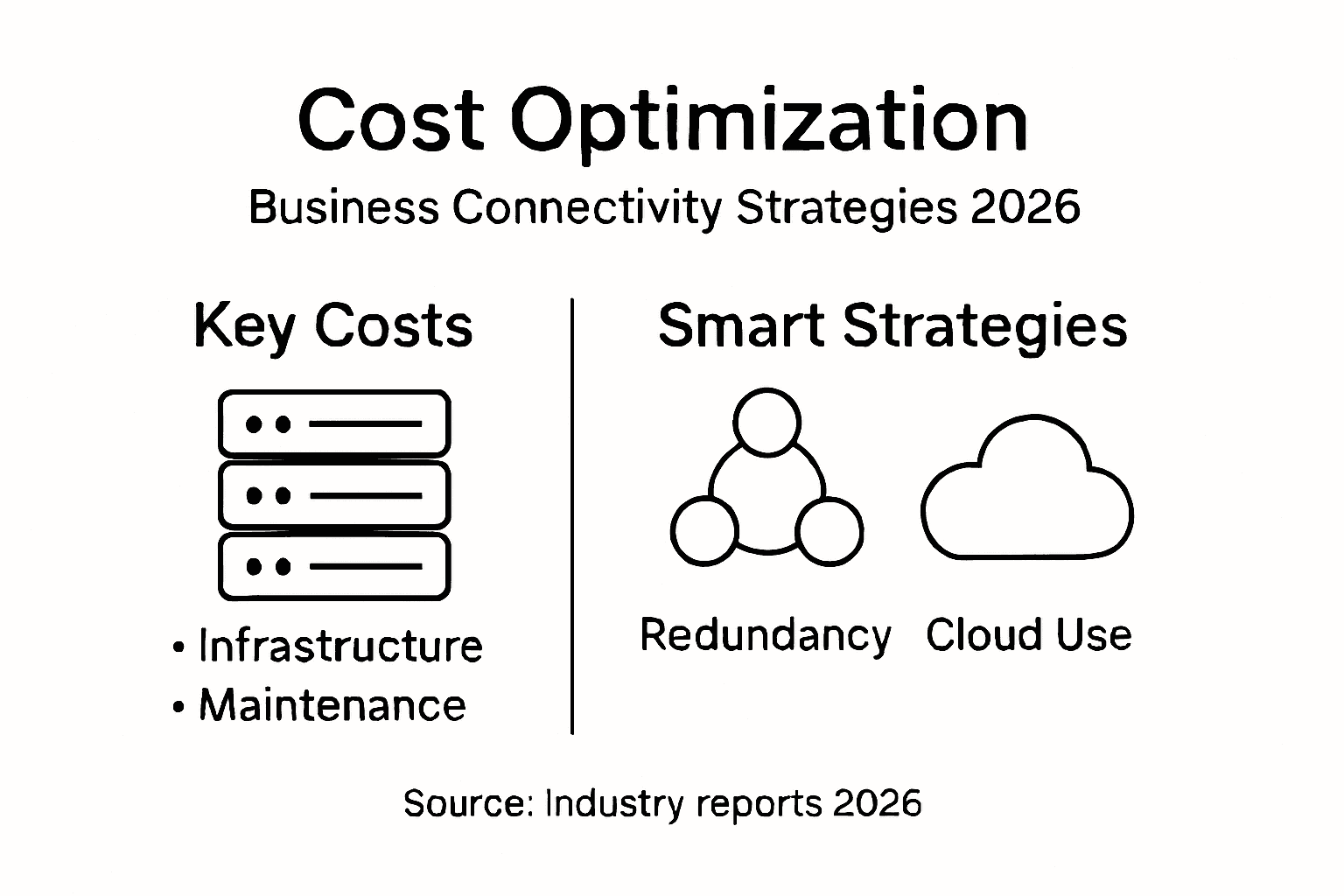
The financial calculus of connectivity investments has fundamentally transformed. Smart organizations now view network infrastructure not as an expense, but as a strategic asset that directly impacts productivity and revenue generation. Advanced technologies like software-defined networking, cloud-based systems, and intelligent bandwidth management allow businesses to implement flexible, pay-as-you-grow models that align technological capabilities with actual operational requirements. This approach minimizes upfront capital expenditures while providing the agility to scale resources precisely when needed.
Government initiatives are playing a significant role in supporting infrastructure expansion, particularly in underserved regions. These programs are creating opportunities for businesses to access advanced connectivity solutions at reduced costs, effectively lowering the economic barriers to technological adoption. By leveraging these initiatives, mid-sized companies can implement robust network infrastructures that were previously accessible only to large enterprises, thereby leveling the competitive landscape and enabling more equitable technological advancement.
Pro tip: Conduct a comprehensive total cost of ownership analysis for your connectivity infrastructure, factoring in potential productivity gains, reduced downtime, and scalability opportunities.
Common Pitfalls And Ensuring Business Continuity
Businesses face significant risks when they fail to implement comprehensive connectivity continuity strategies. Over-reliance on a single internet connection creates dangerous vulnerabilities that can completely halt operations during network failures. Modern organizations must develop multi-layered connectivity approaches that provide robust failover mechanisms, ensuring uninterrupted communication and operational capabilities even during unexpected technical disruptions.
The most common pitfalls in connectivity planning include inadequate redundancy, poor network design, and insufficient disaster recovery protocols. Mid-sized businesses often underestimate the potential financial impact of network downtime, which can result in substantial revenue losses, damaged customer relationships, and compromised operational efficiency. Advanced connectivity strategies now incorporate intelligent routing technologies, multiple internet service providers, and sophisticated backup systems that can automatically switch network paths within milliseconds of detecting a potential failure.
Effective business continuity requires a holistic approach that goes beyond simple technological solutions. Organizations must develop comprehensive risk assessment frameworks that identify potential connectivity vulnerabilities, create detailed mitigation strategies, and implement regular testing protocols. This involves not just technological infrastructure, but also training employees on emergency communication procedures, maintaining updated contact lists, and establishing clear protocols for maintaining critical business functions during potential network disruptions.
The following table summarizes key business risks of poor connectivity planning and how to address them:
| Risk | Potential Impact | Mitigation Approach |
|---|---|---|
| No redundancy | Complete network outages | Use multiple connection paths |
| Weak disaster plan | Extended downtime, lost sales | Implement regular recovery drills |
| Single provider | Provider-specific disruptions | Contract with backup ISPs |
| Lack of testing | Unprepared for real incidents | Schedule quarterly continuity tests |
Pro tip: Develop a comprehensive connectivity continuity plan that includes multiple internet providers, automatic failover mechanisms, and quarterly disaster recovery simulations to ensure operational resilience.
Secure Your Business Future with Reliable Connectivity Solutions
In today’s fast-paced digital world, uninterrupted network performance and robust connectivity are no longer optional. The article highlights critical challenges such as connectivity disruptions, lack of redundancy, and evolving cybersecurity threats that can damage your business reputation and halt operations. If your goal is to achieve scalable, secure, and multi-layered connectivity that powers efficiency, supports advanced IoT deployments, and ensures business continuity — you need solutions designed for tomorrow’s demands.
At SabertoothPro.com, we understand these exact pain points and deliver tailor-made technology stacks for businesses ready to thrive in 2026 and beyond. Our Titan WiFi hotspot plans provide high-speed, reliable internet that integrates advanced failover and security features keeping your operations online no matter what. Pair that with our powerful Titan WiFi devices for stable and scalable network infrastructure designed for evolving workplace needs.

Don’t let connectivity issues threaten your growth or customer trust. Explore the future of seamless business internet with SabertoothPro today. Visit SabertoothPro.com to secure your network with innovative solutions that protect, optimize, and empower your business now.
Frequently Asked Questions
What does reliable connectivity mean for businesses?
Reliable connectivity refers to a consistent and high-speed internet connection that ensures operational efficiency, communication, and support for critical technologies without interruption.
How can businesses ensure network reliability in 2026?
Businesses can ensure network reliability by implementing multiple redundant network pathways, advanced routing technologies, and proactive monitoring systems to maintain business continuity during outages.
What are the key technologies for modern business connectivity?
Key technologies include fiber optic networks for speed, 5G/6G wireless for mobility, Wi-Fi 8 for low latency, satellite-enabled Wi-Fi for remote areas, and cloud networking for scalability and flexibility.
How do scalability and security integrate into business connectivity solutions?
Scalability and security are integrated through adaptable infrastructures that utilize cloud-based security platforms, intelligent network segmentation, and advanced threat detection to protect against cyber risks while accommodating growing business needs.