


Trends in Internet Technology 2025: Impact on Connectivity and Security

Nearly 16 percent of American adults remain smartphone dependent without reliable home broadband access, revealing gaps that directly affect business connectivity and opportunity. For IT leaders in Mid-Atlantic organizations, understanding the rapidly shifting internet technology environment goes beyond headline trends. This article sheds light on the American technology advances, connectivity shifts, and security frameworks shaping tomorrow’s digital infrastructure, giving your business practical insight for more secure, seamless operations in 2025.
Table of Contents
- Defining Internet Technology Trends 2025
- Key Innovations: AI, Edge, And 5G
- IoT And Mobile-Driven Connectivity Shifts
- Evolving Security: Zero Trust And Post-Quantum
- Digital Divide, Adoption, And Cost Factors
- Practical Impacts For Mid-Atlantic Businesses
Key Takeaways
| Point | Details |
|---|---|
| Emerging Technologies | Artificial Intelligence, Edge Computing, and 5G are converging to enhance connectivity and create responsive digital ecosystems. |
| Cybersecurity Evolution | Zero Trust Security and post-quantum cryptography are essential for safeguarding against advanced cyber threats. |
| IoT Growth | Exponential growth in IoT connectivity will transform business operations and require strategic integration with mobile technologies. |
| Addressing the Digital Divide | A multi-faceted approach is needed to bridge gaps in internet access and technology training for underserved communities. |
Defining Internet Technology Trends 2025
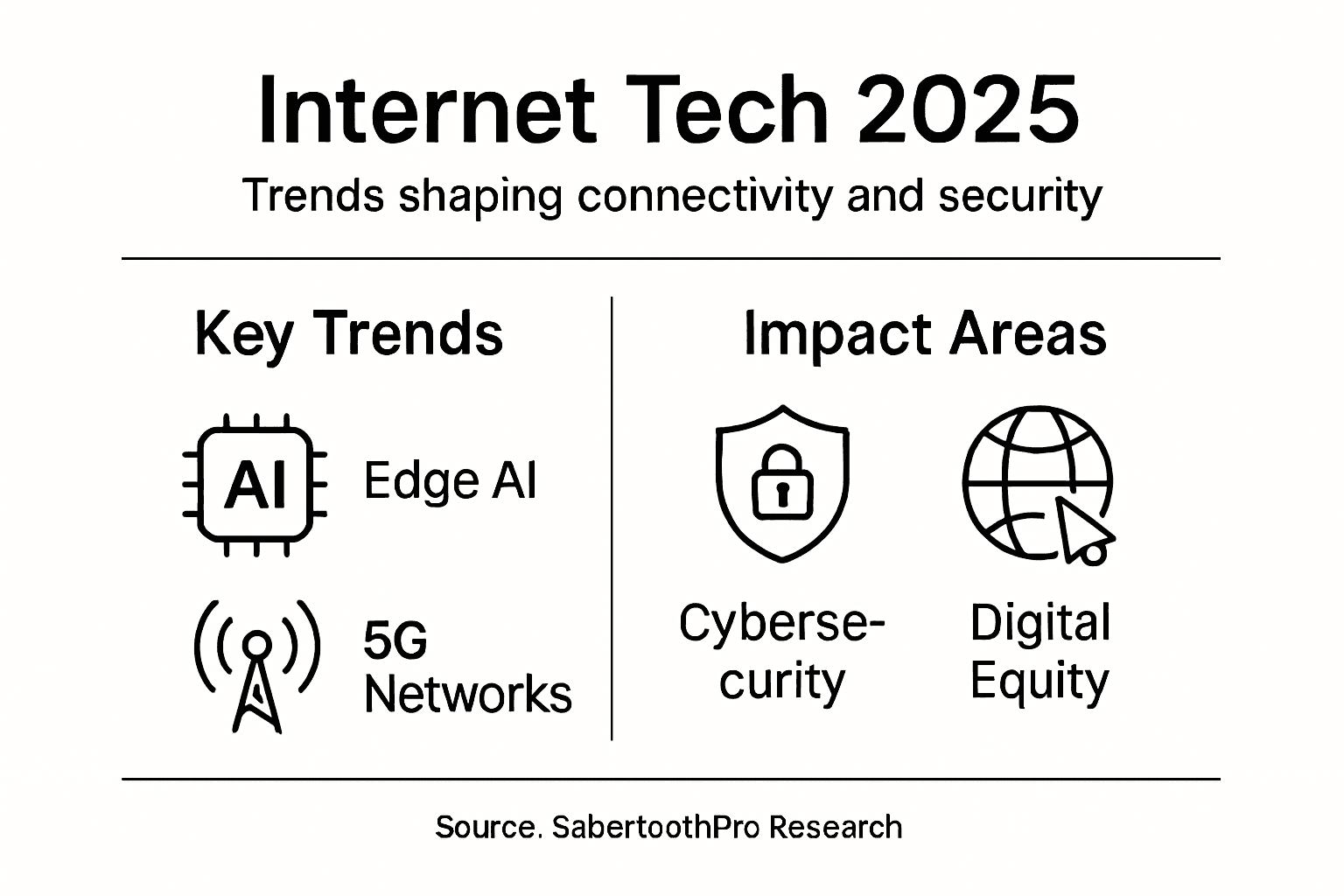
The landscape of internet technology is rapidly transforming, driven by unprecedented innovations that promise to reshape connectivity and digital infrastructure. McKinsey’s Technology Trends Outlook highlights 13 strategic frontier technologies that will fundamentally alter how businesses and consumers interact with digital ecosystems. These emerging trends represent more than incremental improvements - they signal a profound technological revolution.
At the core of these developments are several key technological domains. Artificial Intelligence continues to be a foundational amplifier, accelerating innovation across industries and creating new opportunities for intelligent connectivity. Cloud and edge computing are expanding, enabling more distributed and responsive network architectures. Semiconductor innovations are pushing computational boundaries, while advanced cybersecurity frameworks are becoming increasingly sophisticated in protecting digital interactions.
The practical implications of these trends are substantial. Statista’s tech trend analysis indicates a significant shift from technological hype to widespread enterprise adoption, particularly in areas like 5G integration, AI-powered services, and intelligent networking solutions. Businesses can expect more seamless, secure, and intelligent connectivity that adapts in real time to changing technological requirements. The convergence of these technologies suggests we are moving toward a more integrated, responsive digital infrastructure that can support increasingly complex technological ecosystems.
Here’s a comparison of how major digital technology trends impact connectivity and business outcomes:
| Trend | Primary Benefit | Key Business Impact | Challenges |
|---|---|---|---|
| Artificial Intelligence | Enhanced decision making | Accelerates automation | Data privacy concerns |
| Edge Computing | Real-time processing | Improves latency-sensitive apps | Complex deployment |
| 5G Networks | Faster, stable connections | Enables smart devices growth | Infrastructure cost |
| IoT Expansion | Massive device integration | Creates smarter workflows | Security vulnerabilities |
| Post-Quantum Security | Stronger encryption | Protects future data integrity | Migration complexity |
Pro tip: Invest time in understanding emerging technological trends and assess how they might specifically impact your organization’s digital strategy and infrastructure needs.
Key Innovations: AI, Edge, and 5G
The convergence of artificial intelligence, edge computing, and 5G networks represents a transformative technological frontier that promises to revolutionize digital infrastructure. National Science Foundation research highlights how these technologies are positioning the United States at the forefront of global technological innovation, creating unprecedented opportunities for intelligent, responsive digital ecosystems.
Artificial Intelligence is emerging as the primary catalyst for technological transformation. Edge AI technologies are enabling real-time, decentralized computing capabilities that dramatically reduce latency and enhance privacy. Edge AI technology reports suggest that advanced techniques like federated learning and neuromorphic computing will allow devices to process complex algorithms locally, minimizing cloud dependency and improving computational efficiency. This shift represents a fundamental reimagining of how intelligent systems interact and make decisions.
The integration of 5G networks further amplifies these technological capabilities, providing the high-bandwidth, low-latency infrastructure necessary to support sophisticated AI and edge computing applications. These networks will enable everything from autonomous vehicle systems and smart city infrastructure to advanced industrial IoT deployments. The synergy between AI, edge computing, and 5G creates a robust technological ecosystem that can adapt, learn, and respond with unprecedented speed and intelligence.

Pro tip: Develop a strategic roadmap for integrating AI, edge computing, and 5G technologies into your organization’s digital infrastructure to stay competitive in the rapidly evolving technological landscape.
IoT and Mobile-Driven Connectivity Shifts
The Internet of Things (IoT) is poised to undergo a transformative evolution by 2025, with exponential device connectivity expected to surpass 17 billion interconnected devices. This unprecedented scale of connectivity will fundamentally reshape how businesses, industries, and consumers interact with digital technologies, creating increasingly intelligent and responsive technological ecosystems.
Mobile networks are driving this transformation, with 5G-Advanced technologies and emerging wireless standards like 5G RedCap enabling more sophisticated IoT deployments. These advanced networks provide the critical infrastructure necessary for low-latency, high-bandwidth communication, supporting complex applications in smart manufacturing, healthcare, urban infrastructure, and industrial automation. The integration of artificial intelligence with these networks will further enhance predictive capabilities, enabling devices to make intelligent, real-time decisions with minimal human intervention.
The convergence of IoT, mobile technologies, and advanced connectivity is creating hybrid wireless ecosystems that prioritize security, efficiency, and scalability. Emerging technologies like digital twins, satellite integration, and edge computing are expanding the potential of IoT beyond traditional boundaries. These innovations will enable more comprehensive global device coverage, more resilient communication networks, and more intelligent system interactions across diverse technological platforms.
Pro tip: Develop a comprehensive IoT strategy that integrates emerging mobile technologies, prioritizes cybersecurity, and allows for flexible, scalable device management.
Evolving Security: Zero Trust and Post-Quantum
The cybersecurity landscape is undergoing a fundamental transformation, with quantum-resistant security frameworks emerging as a critical defense against next-generation cyber threats. The convergence of Zero Trust Security (ZTS) and post-quantum cryptographic techniques represents a sophisticated approach to protecting digital infrastructure in an era of increasingly complex technological challenges.
Zero Trust Security fundamentally reimagines traditional network security by adopting a principle of continuous verification and least privilege access. Unlike legacy security models that assumed trust within internal networks, this approach requires constant authentication and micro-segmentation. Organizations are implementing comprehensive security strategies that integrate granular access controls, real-time monitoring, and adaptive authentication mechanisms. This dynamic framework ensures that every access request is thoroughly validated, regardless of its origin or the user’s previous network interactions.
Post-quantum cryptographic techniques are becoming essential as quantum computing threatens to undermine existing encryption methodologies. Quantum-resilient architectures are being developed to protect critical infrastructure against potential quantum-powered cyber attacks. These advanced cryptographic systems utilize complex mathematical algorithms designed to resist decryption attempts from both classical and quantum computing platforms. By proactively developing hybrid security models that combine traditional and quantum-resistant encryption, organizations can create more robust and future-proof digital defense mechanisms.
Pro tip: Conduct a comprehensive security audit to identify potential quantum vulnerabilities and develop a phased migration strategy toward Zero Trust and post-quantum cryptographic frameworks.
Digital Divide, Adoption, and Cost Factors
Smartphone and internet access disparities continue to challenge technological equity in the United States, revealing complex socioeconomic barriers that prevent comprehensive digital inclusion. Approximately 16 percent of Americans remain ‘smartphone dependent,’ lacking reliable home broadband access, which significantly impacts their ability to participate fully in digital society. These disparities extend beyond simple connectivity, affecting critical areas such as education, employment opportunities, healthcare access, and civic engagement.
The digital divide is not merely a technological issue but a multifaceted social challenge rooted in affordability, infrastructure, and digital literacy. Low-income households, rural communities, and minority populations experience disproportionate barriers to meaningful internet access. The cost of high-speed internet, coupled with limited infrastructure in remote areas, creates substantial obstacles for individuals seeking to bridge technological gaps. Moreover, the lack of affordable devices and comprehensive digital skills training further exacerbates these challenges, preventing many Americans from accessing essential online resources and opportunities.
Addressing these disparities requires a comprehensive, multilayered approach that combines federal and state interventions, private sector innovations, and community-driven digital inclusion initiatives. Potential strategies include subsidized internet programs, community technology centers, expanded broadband infrastructure in underserved regions, and targeted digital literacy training. By recognizing the profound impact of technological access on individual and community development, stakeholders can work toward creating more equitable digital ecosystems that empower all Americans to participate in the digital economy.
The table below summarizes strategies to address digital divide barriers for U.S. communities:
| Barrier | Recommended Strategy | Potential Outcome |
|---|---|---|
| Broadband cost | Subsidized internet programs | Increased access for low-income groups |
| Device affordability | Community tech centers | More equitable device distribution |
| Digital literacy | Skills training initiatives | Greater workforce participation |
| Rural infrastructure | Expanded network investment | Improved rural connectivity |
Pro tip: Explore available government and nonprofit digital inclusion programs in your community to understand local resources for affordable internet access and technology training.
Practical Impacts for Mid-Atlantic Businesses
Mid-Atlantic business technology trends reveal a complex landscape of strategic technological adaptation, where employers are balancing cautious investment with innovative digital transformation. Businesses in Delaware, Maryland, and New Jersey are experiencing unprecedented opportunities to leverage advanced connectivity, artificial intelligence, and enhanced cybersecurity frameworks to maintain competitive advantage in an increasingly digital marketplace.
The region’s technological evolution is characterized by strategic investments in workforce digital skills and infrastructure modernization. Companies are prioritizing AI integration, cybersecurity enhancement, and advanced 5G connectivity to drive operational efficiency and create more responsive business models. This approach requires comprehensive digital skills training, allowing employees to adapt to rapidly changing technological ecosystems and leverage new tools effectively. The emphasis is on creating agile, technologically empowered workforces that can quickly respond to emerging digital challenges.
Understanding the nuanced technological landscape is critical for Mid-Atlantic businesses seeking sustainable growth. Broadband and connectivity developments are enabling more sophisticated cloud computing, Internet of Things (IoT) applications, and remote work capabilities. However, businesses must also recognize and address potential digital divide challenges, ensuring that technological advancements create inclusive opportunities for all workforce segments and do not inadvertently create new barriers to participation.
Pro tip: Develop a comprehensive digital skills training program that aligns with emerging technological trends and addresses potential skill gaps within your organization.
Stay Ahead of Connectivity and Security Challenges with SabertoothPro Solutions
The rapid shifts in internet technology demand solutions that can keep pace with evolving connectivity needs and complex security threats such as Zero Trust and post-quantum cryptography. Businesses must address challenges like real-time processing, secure IoT device management, and adapting to 5G infrastructure to avoid falling behind. SabertoothPro understands these critical pain points and offers cutting-edge, reliable internet and enterprise IT solutions tailored for emerging digital ecosystems.
Whether you need high-speed residential or rural internet, robust network security, or scalable IoT connectivity, our Titan WiFi collection provides devices and plans designed for speed and reliability. 
Empower your organization with forward-thinking infrastructure and security frameworks today. Explore our flexible wireless solutions and advanced IT services to build a responsive, secure network that supports your AI, edge computing, and IoT ambitions. Visit SabertoothPro.com now and take the first step toward future-proof connectivity.
Frequently Asked Questions
What are the key internet technology trends expected for 2025?
The key trends include advancements in Artificial Intelligence, Edge Computing, 5G networks, the Internet of Things (IoT), and evolving cybersecurity frameworks like Zero Trust and post-quantum encryption. Together, these technologies will enhance connectivity and security.
How will Artificial Intelligence impact business operations by 2025?
Artificial Intelligence is set to enhance decision making and accelerate automation, leading to improved operational efficiency and the creation of intelligent services tailored to consumer needs.
What challenges might businesses face when integrating Edge Computing?
Businesses may encounter complex deployment scenarios, as Edge Computing requires specialized architecture and management to enable real-time processing and reduce latency in applications.
Why is addressing the digital divide important for technology adoption?
Addressing the digital divide is crucial because it ensures equitable access to digital technologies, enabling all individuals to participate in the digital economy and benefit from advancements such as AI and IoT.