


Private LTE Explained: Secure Connectivity for Enterprises

Reliable wireless connectivity is often the missing link in achieving seamless operations across demanding American enterprise environments. For IT decision-makers in the Mid-Atlantic region, the complexity of supporting growing digital transformation efforts makes reliance on standard public networks feel restrictive and uncertain. With private LTE, organizations gain secure, dedicated wireless infrastructure that addresses unique operational needs and supports tomorrow’s mission-critical applications with confidence and control.
Table of Contents
- What Is Private LTE and How It Works
- Private LTE Variations and Deployment Models
- Key Features and Security Advantages
- Enterprise Use Cases and Spectrum Choices
- Costs, Compliance, and Wi-Fi Comparisons
Key Takeaways
| Point | Details |
|---|---|
| Private LTE Provides Enhanced Control | Organizations benefit from a dedicated network that delivers custom solutions tailored to specific operational needs. |
| Security is a Major Advantage | Private LTE networks feature advanced security protocols that protect sensitive data and ensure network integrity. |
| Flexible Deployment Models Exist | Enterprises can choose from standalone, hybrid, or shared spectrum options based on their connectivity requirements. |
| Cost Analysis is Crucial | Consider not just initial investments, but also long-term operational efficiencies and compliance support when choosing between private LTE and Wi-Fi. |
What Is Private LTE and How It Works
Private LTE represents a dedicated wireless network designed specifically for enterprise environments, offering secure and controlled connectivity beyond traditional public cellular networks. Unlike standard mobile networks, private LTE provides organizations complete autonomy over their communication infrastructure, enabling businesses to build customized wireless solutions tailored to their unique operational requirements.
Long-Term Evolution (LTE)) technology serves as the foundation for private networks, delivering robust wireless broadband capabilities with enhanced speed, reliability, and security. Private LTE networks operate on dedicated spectrum, which means enterprises can create isolated communication channels that prevent external interference and minimize potential cybersecurity risks.
The core architecture of private LTE involves several critical components that distinguish it from standard cellular networks. These include dedicated spectrum allocation, localized base stations, specialized core network infrastructure, and granular access controls. Enterprises can deploy these networks across various scenarios - from manufacturing facilities and logistics centers to healthcare campuses and educational institutions - providing consistent, high-performance wireless connectivity with enterprise-grade security protocols.
Private LTE networks offer significant advantages over traditional wireless solutions, including lower latency, higher bandwidth, and superior reliability. By implementing these networks, organizations can support mission-critical applications, Internet of Things (IoT) devices, and real-time communication systems with unprecedented performance and control.
Pro tip: When evaluating private LTE solutions, prioritize vendors who offer flexible spectrum options and robust security configurations tailored to your specific industry requirements.
Private LTE Variations and Deployment Models
Private LTE networks encompass diverse deployment models that offer enterprises flexible connectivity solutions tailored to their specific operational needs. These variations range from fully dedicated networks to hybrid configurations that strategically combine public and private infrastructure. LTE network design demonstrates remarkable adaptability across different spectrum allocation strategies and architectural approaches.
Enterprises can choose from several key deployment models, including standalone private networks, hybrid configurations, and shared spectrum implementations. Standalone private LTE networks provide the highest level of control, featuring dedicated hardware, exclusive spectrum allocation, and complete infrastructure management within the organization. Hybrid models, by contrast, integrate public cellular infrastructure with private network elements, offering a more cost-effective approach for businesses with variable connectivity requirements.
Spectrum allocation represents a critical consideration in private LTE deployment. Organizations can leverage licensed, shared (such as Citizens Broadband Radio Service or CBRS), or unlicensed spectrum bands depending on regulatory frameworks and specific operational demands. Network deployment scenarios include macro, micro, pico, and femtocell configurations, each providing unique advantages for different enterprise environments - from expansive industrial campuses to compact office settings.
The selection of a private LTE deployment model depends on multiple factors, including geographic coverage needs, budget constraints, security requirements, and the complexity of mission-critical applications. Enterprises must carefully evaluate their specific communication infrastructure demands to determine the most appropriate network architecture that balances performance, reliability, and cost-effectiveness.
Here’s a concise overview comparing key factors that influence private LTE deployment decisions:
| Factor | Impact on Deployment | Example Consideration |
|---|---|---|
| Spectrum Choice | Determines coverage and interference | Licensed vs. CBRS spectrum |
| Security Needs | Drives access control design | Sensitive data handling |
| Budget | Influences infrastructure size | Upfront investment limits |
| Application Type | Dictates bandwidth and latency | Real-time analytics needs |
Pro tip: Conduct a comprehensive network assessment and pilot testing before full-scale private LTE implementation to validate performance and identify potential optimization opportunities.
Key Features and Security Advantages
Private LTE networks deliver robust security capabilities that distinguish them from traditional public cellular infrastructure, providing enterprises with unprecedented control over their communication ecosystem. Security frameworks incorporate multiple layers of protection designed to safeguard sensitive organizational data and ensure comprehensive network integrity.

The core security advantages of private LTE include advanced authentication mechanisms, granular access controls, and end-to-end encryption protocols. Enterprises benefit from dedicated infrastructure that enables strict network isolation, preventing unauthorized access and minimizing potential vulnerability points. 3GPP standards define comprehensive security protocols that private LTE implementations leverage, including mutual authentication processes that verify both user and network identities before establishing any communication channel.
Key features of private LTE security architectures encompass several critical capabilities. These include domain-specific security controls, encrypted communication channels, sophisticated key management systems, and real-time threat monitoring. Organizations can implement enterprise-specific policies that dynamically adjust network access, segment critical communication pathways, and provide granular visibility into network traffic patterns, enabling proactive security management.
Private LTE networks also offer superior performance in protecting mission-critical applications and sensitive data transmission. By maintaining complete control over network infrastructure, enterprises can implement advanced security measures such as zero-trust network architectures, precise user authentication, and comprehensive data encryption that exceed standard public network security capabilities.
Pro tip: Regularly conduct comprehensive security audits and penetration testing to validate and continuously improve your private LTE network’s defensive capabilities.
Enterprise Use Cases and Spectrum Choices
Private LTE networks have emerged as transformative solutions across diverse enterprise environments, enabling sophisticated connectivity strategies tailored to specific industry requirements. Enterprise use cases span critical sectors including industrial automation, real-time operational analytics, predictive maintenance, and mobile workforce connectivity, demonstrating the technology’s remarkable versatility.
Spectrum selection represents a crucial strategic decision for organizations implementing private LTE networks. Enterprises can choose from multiple spectrum access models, each offering unique advantages: licensed bands provide guaranteed performance and dedicated resources, shared spectrum like Citizens Broadband Radio Service (CBRS) enable flexible licensing, and unlicensed bands deliver cost-effective local coverage solutions. Spectrum allocation strategies prioritize regulatory compliance, interference management, and operational performance to optimize network effectiveness.
Different industry verticals leverage private LTE networks with distinct implementation approaches. Manufacturing environments utilize these networks for machine-to-machine communication and real-time process monitoring. Logistics companies deploy private LTE to track fleet operations and manage mobile workforce connectivity. Healthcare institutions implement these networks to support secure medical device communications and patient monitoring systems, ensuring robust, low-latency connectivity across complex facility infrastructures.
The selection of an appropriate private LTE spectrum and deployment model requires careful analysis of organizational requirements, regulatory constraints, and performance objectives. Enterprises must evaluate factors such as geographical coverage needs, budget limitations, security requirements, and the specific bandwidth demands of mission-critical applications to design an optimal private LTE network strategy.
Pro tip: Conduct a comprehensive spectrum availability assessment and consult with wireless networking experts to identify the most suitable spectrum options for your specific enterprise environment.
Costs, Compliance, and Wi-Fi Comparisons
Enterprises navigating wireless connectivity solutions face complex decisions when comparing private LTE and traditional Wi-Fi technologies. Spectrum usage strategies reveal fundamental differences in performance, security, and operational costs that significantly impact technology selection for organizational networks.
Private LTE offers substantial advantages over standard Wi-Fi, particularly in mission-critical environments requiring consistent performance and robust security. While Wi-Fi operates in unlicensed spectrum with lower initial infrastructure costs, private LTE provides superior quality of service, enhanced mobility management, and more predictable network behavior. The higher upfront investment in private LTE translates to greater long-term reliability and control, especially for industries with stringent compliance requirements such as healthcare, manufacturing, and financial services.
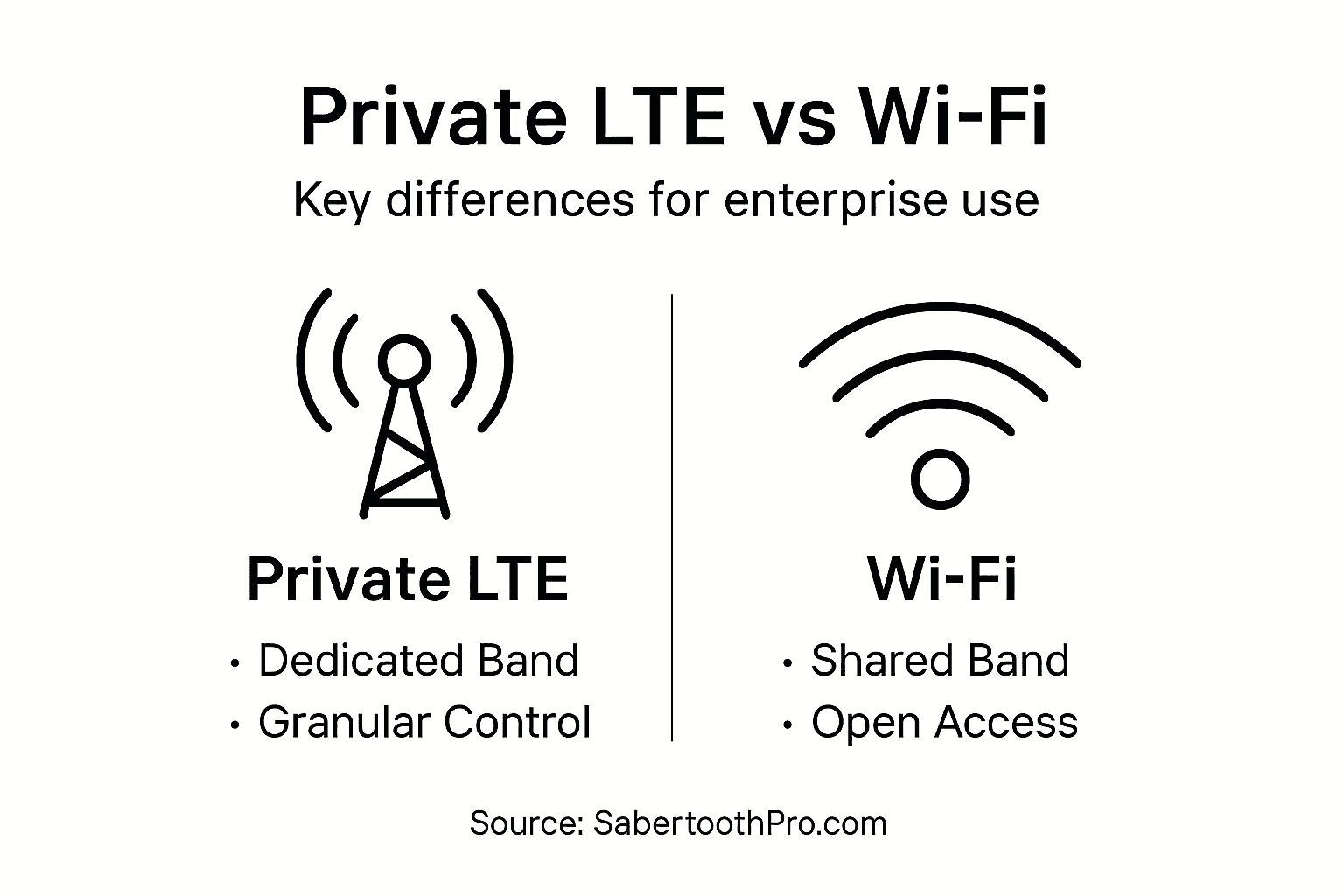
Compliance considerations play a crucial role in technology selection. Private LTE networks enable more granular access controls, dedicated spectrum management, and enhanced security protocols that align with strict regulatory frameworks. Enterprises can implement precise authentication mechanisms, encrypt communication channels, and maintain comprehensive audit trails - capabilities that standard Wi-Fi networks struggle to deliver consistently. This makes private LTE particularly attractive for organizations operating in heavily regulated industries where data protection and network integrity are paramount.
Cost analysis for private LTE extends beyond initial infrastructure expenses, encompassing long-term operational efficiency, reduced downtime, and improved workforce productivity. While the initial investment may appear higher compared to traditional Wi-Fi, the strategic benefits of dedicated, secure, and high-performance connectivity can provide significant return on investment for enterprises with complex communication requirements.
This table highlights differences between private LTE and Wi-Fi in enterprise scenarios:
| Attribute | Private LTE | Wi-Fi |
|---|---|---|
| Coverage Range | Large areas, seamless handoff | Limited to access point zone |
| Security Level | Carrier-grade, highly controlled | Basic encryption, less granularity |
| Initial Cost | Higher startup expense | Lower initial investment |
| Compliance Support | Suited for regulated industries | Challenging in regulated settings |
Pro tip: Conduct a comprehensive total cost of ownership analysis that considers not just infrastructure costs, but potential productivity gains and risk mitigation when evaluating private LTE versus traditional wireless solutions.
Enhance Your Enterprise Connectivity with Private LTE Solutions
Private LTE networks offer enterprises complete control, high security, and reliable wireless connectivity tailored to demanding operational needs like low latency and mission-critical applications. If secure spectrum management and superior performance are your priorities, SabertoothPro.com has the technology and expertise to support your private LTE journey. We understand the challenges of deploying dedicated infrastructure and managing diverse devices and applications with precision.
Explore our range of high-speed LTE and 5G hotspot plans, routers, and IoT connectivity options designed for scalable enterprise solutions. Whether you need secure network access for manufacturing floors or mobile workforce connectivity for logistics, our solutions deliver carrier-grade reliability integrated with advanced security frameworks.
Unlock better control over your network with our Titan WiFi Hotspot Plans and discover exclusive offers in our Special Promotion page today.

Ready to transform your enterprise communications with secure private LTE? Visit SabertoothPro.com now to consult with our experts and find tailored connectivity solutions that empower your business operations.
Frequently Asked Questions
What is Private LTE?
Private LTE is a dedicated wireless network for enterprises that offers secure and controlled connectivity, operating independently from public cellular networks. It allows organizations to customize their wireless solutions to meet specific operational needs.
How does Private LTE enhance security compared to traditional Wi-Fi?
Private LTE provides advanced security features, including dedicated infrastructure, end-to-end encryption, and granular access controls that ensure secure communication and protect sensitive data in enterprise environments.
What are the deployment models for Private LTE networks?
Private LTE networks can be deployed as standalone private networks, hybrid configurations combining public and private elements, or through shared spectrum implementations, each catering to different operational requirements and budget considerations.
How do Private LTE networks compare to traditional Wi-Fi in terms of performance?
Private LTE networks offer superior performance with larger coverage areas, enhanced mobility management, and more predictable network behavior, making them ideal for mission-critical applications, unlike traditional Wi-Fi, which tends to be limited to access point zones.