


Remote Connectivity: Why It Matters for IT Managers

Nearly 40 percent of the American workforce now connects remotely for at least part of the week, changing how teams collaborate and share information. For IT managers across the Mid-Atlantic, reliable remote connectivity is vital for keeping hybrid teams productive and secure. This guide unpacks the facts and common misconceptions about remote connectivity, outlining solutions that help your organization thrive while empowering your team to work seamlessly wherever they are.
Table of Contents
- Defining Remote Connectivity And Common Myths
- Key Technologies Behind Remote Connectivity
- Variations: VPN, Cloud Access, IoT Solutions
- Real-World Applications In Hybrid Work
- Security Risks And Compliance Challenges
- Cost Implications And Avoidable Pitfalls
Key Takeaways
| Point | Details |
|---|---|
| Remote Connectivity Is Essential | Modern businesses increasingly rely on remote connectivity for effective communication and collaboration across distributed teams. |
| Myths About Remote Work Persist | Common misconceptions suggest remote work diminishes productivity and security; however, structured solutions can enhance both. |
| Critical Technologies Include VPN and Cloud Solutions | Organizations should implement VPNs and cloud platforms to ensure secure, scalable, and efficient remote work environments. |
| Security Risks Require Proactive Management | Robust security measures and compliance with industry regulations are vital to safeguarding organizational data in remote settings. |
Defining Remote Connectivity and Common Myths
Remote connectivity represents the technological infrastructure enabling digital communication and collaboration across different physical locations. At its core, remote connectivity allows professionals to access systems, share resources, and work effectively without being physically present in a traditional office environment. The concept has rapidly transformed from a niche capability to a mainstream business strategy, particularly accelerated by recent global workforce shifts.
Contrary to popular misconceptions, remote connectivity is not simply about video conferencing or email access. Modern remote work infrastructure involves sophisticated technological ecosystems that support seamless communication, data security, and collaborative productivity. Research indicates that approximately 40% of US employees now work remotely at least part-time, demonstrating the substantial evolution of workplace technologies and connectivity strategies.
Common myths about remote connectivity persist, despite substantial evidence challenging these assumptions. Many IT managers incorrectly believe that remote work inherently compromises security, reduces productivity, or creates insurmountable technical challenges. However, structured remote connectivity solutions can actually enhance organizational flexibility, employee satisfaction, and operational efficiency. Implementing robust virtual private networks (VPNs), multi-factor authentication, and cloud-based collaboration tools can create secure, responsive work environments that transcend physical boundaries.
Pro tip: Conduct a comprehensive audit of your current remote connectivity infrastructure at least twice annually to identify potential security vulnerabilities and technological gaps.
Key Technologies Behind Remote Connectivity
Remote connectivity relies on a sophisticated ecosystem of technological solutions that enable seamless digital communication and secure data transmission. Virtual Private Networks (VPNs) serve as a foundational technology, creating encrypted tunnels that allow secure access to organizational networks from remote locations. These networks protect sensitive information by masking IP addresses and establishing secure communication channels between distributed workforce members.
Cloud computing platforms represent another critical technology driving remote connectivity. Ubiquitous edge-to-cloud technologies enable organizations to create flexible, scalable infrastructure that supports distributed workforce requirements. Modern cloud solutions provide real-time collaboration tools, data storage, and computational resources that can be accessed from anywhere with internet connectivity, transforming traditional workplace boundaries.
Additional key technologies include endpoint security solutions, multi-factor authentication, and unified communication platforms. These technologies work together to create comprehensive remote connectivity frameworks that address critical challenges such as data protection, identity verification, and seamless communication. Advanced networking technologies like software-defined networking (SDN) and zero-trust security models further enhance the reliability and security of remote work infrastructures.
Pro tip: Implement a comprehensive remote connectivity strategy that integrates multiple technological layers, ensuring redundancy and maintaining consistent security protocols across all access points.
Variations: VPN, Cloud Access, IoT Solutions
Remote connectivity technologies offer diverse approaches to solving organizational communication and data access challenges. Virtual Private Networks (VPNs) create secure encrypted connections that enable employees to access corporate networks safely from remote locations. VPN technologies specifically focus on establishing secure communication tunnels over public internet infrastructure, protecting sensitive data transmission by masking user identities and encrypting network traffic.
Cloud access solutions represent a complementary approach to remote connectivity, providing on-demand computational resources and collaborative platforms. Unlike traditional VPNs, cloud solutions offer scalable infrastructure that allows businesses to access applications, storage, and computing power from anywhere with internet connectivity. These platforms support distributed workforce models by enabling real-time collaboration, document sharing, and seamless communication across geographic boundaries.
Internet of Things (IoT) solutions introduce another dimension to remote connectivity, focusing on interconnected devices that can be monitored and controlled remotely. IoT technologies enable organizations to collect data, automate processes, and manage infrastructure from centralized control centers. These solutions are particularly valuable in industries requiring real-time monitoring, such as manufacturing, logistics, and healthcare, where remote sensing and control can significantly improve operational efficiency and decision-making.
Pro tip: Evaluate your organization’s specific remote connectivity needs by conducting a comprehensive assessment of security requirements, scalability, and integration capabilities across VPN, cloud, and IoT technologies.
Here’s a comparison of major remote connectivity technologies and their primary organizational benefits:
| Technology | Main Function | Business Impact | Common Use Cases |
|---|---|---|---|
| VPN | Secure network tunneling | Enhances data privacy | Finance, Corporate IT |
| Cloud Platforms | Resource and data access | Enables collaboration | Software, Education |
| IoT Solutions | Device management remotely | Improves automation and insight | Manufacturing, Healthcare |
| Unified Platforms | Integrate communications | Simplifies workflow | Hybrid and remote teams |
Real-World Applications in Hybrid Work
Hybrid work models have dramatically transformed organizational communication strategies, requiring sophisticated remote connectivity solutions that seamlessly bridge physical and digital workspaces. Hybrid work arrangements fundamentally change collaboration patterns by integrating flexible work technologies that support distributed team interactions. Modern organizations now rely on advanced communication platforms that enable employees to transition effortlessly between home and office environments.
Technological infrastructure plays a crucial role in supporting hybrid work models. Video conferencing systems, cloud-based collaboration tools, and secure virtual private networks have become essential components of enterprise connectivity strategies. These technologies enable real-time communication, document sharing, and collaborative workflows that maintain productivity regardless of physical location. Businesses are increasingly investing in robust digital ecosystems that support seamless information exchange and maintain team cohesion across diverse work environments.

Industries ranging from technology and finance to healthcare and education are implementing innovative remote connectivity solutions to support hybrid workforce models. Organizations are developing comprehensive strategies that balance synchronous and asynchronous communication methods, leveraging technologies that provide flexibility without compromising operational efficiency. These approaches typically involve creating adaptable communication protocols, implementing secure access mechanisms, and developing performance metrics that assess productivity across distributed work environments.
Pro tip: Develop a comprehensive remote connectivity strategy that includes regular technology audits, employee training programs, and scalable infrastructure to support evolving hybrid work requirements.
Security Risks and Compliance Challenges
Remote connectivity introduces complex cybersecurity challenges that require comprehensive and proactive management strategies. Cybersecurity risks have dramatically expanded with remote work, creating unprecedented vulnerabilities across distributed organizational networks. The rapid transition to remote and hybrid work models has significantly increased potential attack surfaces, compelling IT managers to reimagine traditional security frameworks.
Endpoint protection has emerged as a critical concern in remote connectivity environments. Employees accessing corporate systems from diverse networks and personal devices create multiple potential security breaches. Sophisticated phishing attempts, unsecured Wi-Fi networks, and inadequate authentication protocols pose significant risks to organizational data integrity. Advanced security measures such as multi-factor authentication, comprehensive endpoint monitoring, and zero-trust security architectures have become essential defensive strategies against evolving cyber threats.
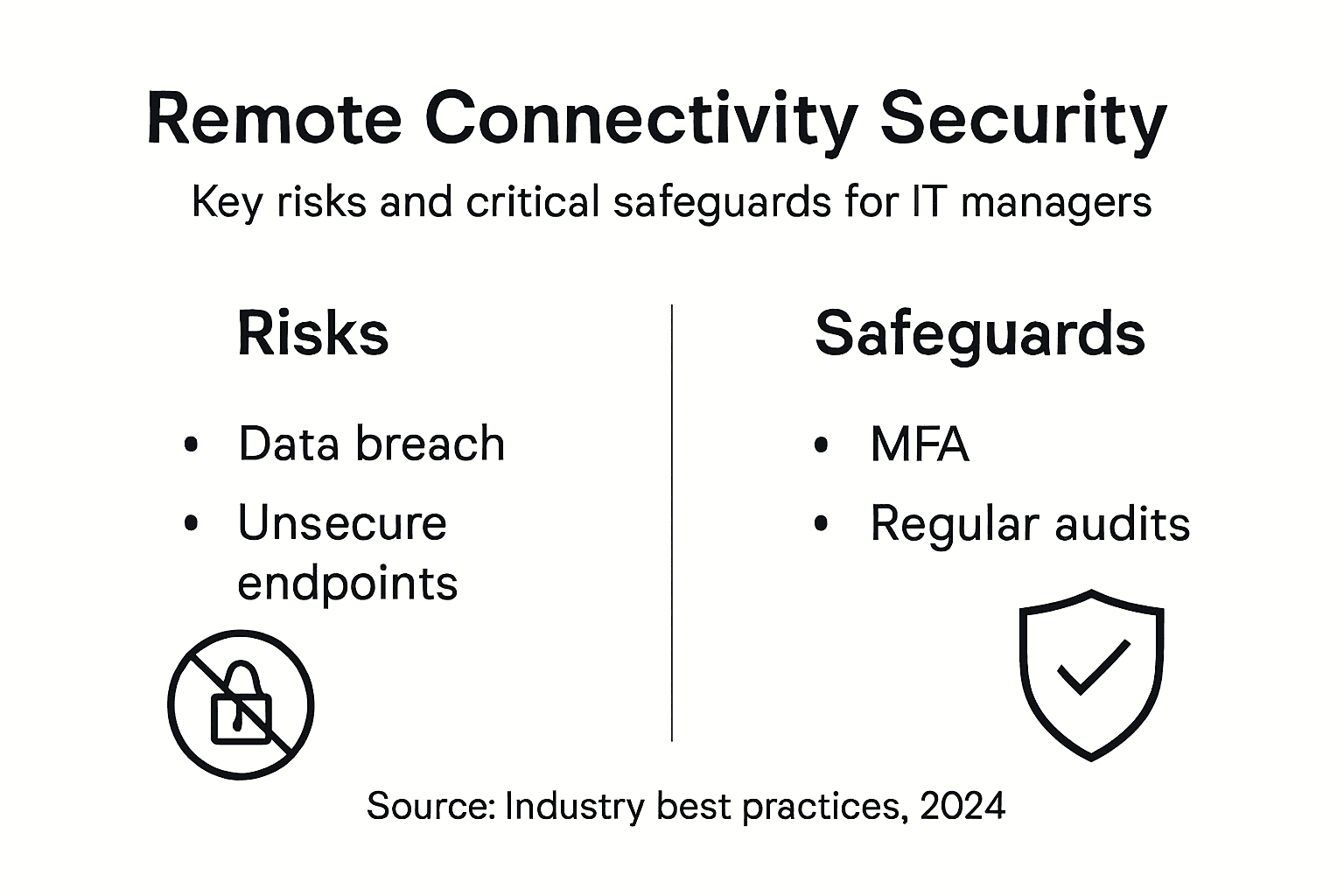
Regulatory compliance represents another complex dimension of remote connectivity security. Different industries face unique regulatory requirements that mandate specific data protection standards, encryption protocols, and access control mechanisms. Organizations must develop adaptive security frameworks that not only protect against external threats but also ensure compliance with sector-specific regulations like HIPAA in healthcare, PCI-DSS in financial services, and GDPR for international operations. This requires ongoing employee training, robust technological infrastructure, and continuous security assessments to maintain both operational efficiency and regulatory adherence.
Pro tip: Implement a comprehensive security awareness training program that educates employees about emerging cyber risks, reinforces best practices for remote work, and creates a culture of proactive security consciousness.
The following table summarizes key security and compliance concerns for remote connectivity environments:
| Security Concern | Compliance Challenge | Best Practice Recommendation |
|---|---|---|
| Endpoint protection | Data privacy regulations | Continuous monitoring |
| Authentication flaws | User identity protocols | Multi-factor authentication |
| Unsecured networks | Industry-specific standards | Zero-trust architecture |
| Phishing threats | International compliance | Routine staff training |
Cost Implications and Avoidable Pitfalls
Remote connectivity investments require strategic financial planning to balance technological infrastructure costs with potential organizational benefits. Remote work cost dynamics present complex financial challenges, necessitating comprehensive analysis of direct and indirect expenses associated with implementing robust digital communication systems. Organizations must carefully evaluate technology investments, infrastructure modifications, and ongoing operational expenses to maximize return on investment.
Technology infrastructure costs represent a significant consideration for IT managers implementing remote connectivity solutions. Initial investments include hardware procurement, software licensing, secure network infrastructure, and comprehensive cybersecurity systems. Beyond direct technology expenses, organizations must factor in additional costs such as employee training, ongoing technical support, and potential productivity adaptation periods. Hidden expenses like reduced collaboration efficiency, increased communication complexity, and potential security vulnerabilities can significantly impact overall financial outcomes.
Avoidable pitfalls in remote connectivity implementation often stem from inadequate planning and incomplete understanding of organizational requirements. Common mistakes include over-investing in unnecessary technologies, failing to establish clear communication protocols, and neglecting comprehensive employee training programs. Successful remote connectivity strategies require holistic approaches that balance technological capabilities with human performance factors, ensuring that investments translate into tangible productivity improvements and operational efficiencies.
Pro tip: Conduct a comprehensive cost-benefit analysis that includes both quantitative financial metrics and qualitative performance indicators before implementing large-scale remote connectivity infrastructure.
Empower Your IT Strategy with Reliable Remote Connectivity Solutions
Managing remote connectivity challenges demands more than just software. IT managers must secure networks, ensure seamless communication, and maintain productivity across all locations. The article highlights critical pain points such as data privacy, endpoint security, and scalable infrastructure to support hybrid work models. SabertoothPro offers powerful tools including high-speed internet plans, secure Titan WiFi solutions, and advanced network extensions through our WiFi extenders. These technologies help you build a resilient remote connectivity environment that aligns with zero-trust frameworks and multi-factor authentication principles.

Ready to eliminate security risks and boost operational efficiency in your remote work infrastructure? Visit SabertoothPro.com today for trusted wireless internet devices and enterprise IT services designed to elevate your organization’s connectivity. Secure your success now by exploring our innovative solutions tailored for hybrid and distributed teams.
Frequently Asked Questions
What is remote connectivity and why is it important for IT managers?
Remote connectivity refers to the technology that enables digital communication and collaboration across different locations. For IT managers, it is crucial because it allows employees to securely access systems and resources while working remotely, thus enhancing flexibility, employee satisfaction, and operational efficiency.
What technologies are commonly used for remote connectivity?
Key technologies for remote connectivity include Virtual Private Networks (VPNs), cloud computing platforms, endpoint security solutions, multi-factor authentication, and unified communication platforms. These technologies ensure secure data transmission, facilitate collaboration, and protect sensitive information.
How can remote connectivity improve a company’s security posture?
Remote connectivity can enhance a company’s security by implementing robust solutions like multi-factor authentication and secure VPNs. These measures create secure access points and ensure that data is transmitted safely, reducing the risk of cyber threats, especially in remote work environments.
What are the cost implications of implementing remote connectivity?
Implementing remote connectivity involves costs for hardware, software, secure networks, and cybersecurity systems. Additionally, organizations must account for training and support expenses. A comprehensive cost-benefit analysis can help balance these costs against the operational benefits of enhanced remote work capabilities.