


Why Choose Enterprise Wi-Fi for Modern Businesses

Most American organizations underestimate how much reliable Wi-Fi impacts productivity, yet over half of network outages in mid-sized enterprises are traced back to outdated wireless solutions. As IT directors in the Mid-Atlantic region face rising demands for secure connectivity, the need for robust enterprise Wi-Fi has never been clearer. Explore the essential distinctions and common myths holding your business back from seamless, scalable, and truly dependable wireless infrastructure.
Table of Contents
- Enterprise Wi-Fi Defined And Common Misconceptions
- Types Of Business Wi-Fi Deployments Explained
- Key Features: Security, Scalability, And Reliability
- Core Business Applications And Real-World Use Cases
- Cost, Risks, And Common Pitfalls To Consider
- Comparing Enterprise Wi-Fi With Consumer Alternatives
Key Takeaways
| Point | Details |
|---|---|
| Enterprise Wi-Fi | Designed for organizations, offering robust security and scalability beyond consumer-grade networks. |
| Advanced Security | Utilizes multi-layered security protocols like WPA3 and centralized authentication to protect sensitive data. |
| Deployment Options | Various deployment strategies such as centralized, cloud-managed, and mesh networks cater to specific business needs. |
| Cost and Management | Organizations must consider ongoing management, security upgrades, and potential risks during budgeting. |
Enterprise Wi-Fi Defined and Common Misconceptions
Enterprise Wi-Fi represents a sophisticated wireless networking solution designed specifically for organizational environments, far beyond the basic connectivity found in home networks. Unlike consumer-grade wireless setups, enterprise Wi-Fi leverages advanced IEEE 802.11 wireless standards to deliver robust, secure, and scalable network infrastructure for businesses.
At its core, enterprise Wi-Fi distinguishes itself through advanced authentication and security mechanisms. While residential networks typically rely on pre-shared passwords, enterprise networks utilize IEEE 802.1X authentication, which provides individual user verification through centralized RADIUS servers. This approach means each user receives unique encryption credentials, dramatically reducing unauthorized access risks and creating granular network control mechanisms.
Common misconceptions about enterprise Wi-Fi often revolve around perceived complexity and cost. Many business leaders mistakenly believe that advanced wireless networks are prohibitively expensive or require extensive technical expertise. In reality, modern enterprise Wi-Fi solutions offer intuitive management interfaces, automated configuration tools, and modular scaling options that make implementation surprisingly straightforward. These networks support critical business functions by providing:
- Seamless device connectivity across multiple locations
- Robust security protocols
- High-bandwidth performance for data-intensive applications
- Centralized network management
- Dynamic user access controls
Pro tip: Before implementing an enterprise Wi-Fi solution, conduct a comprehensive network assessment to understand your specific bandwidth, security, and scalability requirements.
Types of Business Wi-Fi Deployments Explained
Businesses today have multiple options for wireless network deployment, each tailored to specific organizational needs and infrastructure requirements. Enterprise Wi-Fi deployments encompass a range of sophisticated networking strategies designed to address unique connectivity challenges across diverse business environments.
The primary types of business Wi-Fi deployments include centralized managed networks, cloud-managed solutions, distributed access point systems, and mesh network architectures. Centralized managed networks feature a core controller that coordinates multiple access points, providing comprehensive network oversight and uniform security policies. Cloud-managed solutions offer remote configuration and monitoring capabilities, allowing IT teams to manage network infrastructure from anywhere with internet access.
Industrial and specialized business sectors require more complex wireless deployment strategies. Mesh networks have become particularly valuable in environments with challenging physical layouts, enabling seamless connectivity across expansive or obstructed spaces. These networks create multiple interconnected access points that dynamically route network traffic, ensuring consistent signal strength and coverage. Different deployment types offer unique advantages:
- Centralized Managed Networks
- Centralized control and policy enforcement
- High security standards
- Uniform configuration across multiple locations
- Cloud-Managed Solutions
- Remote management capabilities
- Scalable infrastructure
- Real-time performance monitoring
- Mesh Networks
- Flexible coverage in complex environments
- Self-healing network capabilities
- Minimal infrastructure requirements
Pro tip: Conduct a comprehensive site survey before selecting your Wi-Fi deployment strategy to ensure optimal network performance and coverage for your specific business environment.
Here’s a comparison of common business Wi-Fi deployment types, highlighting their main strengths and best-use scenarios:
| Deployment Type | Key Strength | Suitable For |
|---|---|---|
| Centralized Managed | Unified network oversight | Multi-site corporations |
| Cloud-Managed | Remote administration | Distributed workforces |
| Mesh Network | Adaptive coverage | Warehouses, complex layouts |
| Distributed AP System | Localized performance boost | Dense office environments |
Key Features: Security, Scalability, and Reliability
Enterprise Wi-Fi networks represent far more than simple internet connectivity, with advanced security protocols that protect critical business infrastructure from evolving digital threats. Modern wireless networks must balance three fundamental requirements: robust security, exceptional scalability, and uninterrupted reliability.

Security in enterprise environments goes beyond basic password protection. Multi-factor authentication and advanced encryption standards like WPA3 create multiple layers of network defense. Sophisticated wireless intrusion detection systems continuously monitor network traffic, identifying and mitigating potential security breaches in real-time. These comprehensive security mechanisms ensure that sensitive business data remains protected across diverse and complex network architectures.
Scalability and reliability are equally critical for enterprise Wi-Fi deployments. Intelligent network designs incorporate dynamic load balancing and adaptive resource allocation, enabling businesses to support increasing device counts without compromising performance. Key scalability strategies include:
- Intelligent access point coordination
- Dynamic bandwidth allocation
- Automated network optimization
- Seamless device onboarding
- Centralized management interfaces
Reliability is achieved through redundant network configurations, proactive monitoring, and rapid response mechanisms. Enterprise-grade networks implement automatic failover protocols, ensuring continuous connectivity even during hardware failures or unexpected network disruptions.
Pro tip: Implement regular security audits and network performance assessments to identify and address potential vulnerabilities before they become critical issues.
The table below summarizes how enterprise Wi-Fi delivers value across security, scalability, and reliability:
| Feature | How It Works | Business Value |
|---|---|---|
| Security | Multi-factor authentication, WPA3 | Protects data, controls user access |
| Scalability | Dynamic resource allocation | Adapts to growing device demands |
| Reliability | Redundant paths, failover protocols | Maintains connectivity, minimizes downtime |
Core Business Applications and Real-World Use Cases
Enterprise Wi-Fi has transformed how businesses operate across multiple industries, enabling sophisticated digital communication strategies that support complex organizational needs. Modern wireless networks have become critical infrastructure, powering everything from collaborative work environments to advanced technological applications.
Different industry sectors leverage enterprise Wi-Fi in unique and innovative ways. In healthcare, wireless networks support critical medical device connectivity, enabling real-time patient monitoring and seamless electronic health record management. Manufacturing environments utilize industrial wireless networks to connect IoT sensors, track production processes, and optimize machinery performance. Retail businesses deploy enterprise Wi-Fi to enhance customer experiences through location-based services, mobile point-of-sale systems, and advanced inventory tracking technologies.
The most transformative business applications of enterprise Wi-Fi include:
- Hybrid Work Environments
- Seamless video conferencing
- Cloud-based collaboration tools
- Secure remote access
- IoT and Smart Device Integration
- Real-time sensor monitoring
- Automated system controls
- Performance analytics
- Enhanced Mobile Workforce Solutions
- Location-independent connectivity
- Secure mobile device management
- Flexible work arrangements
Beyond traditional connectivity, enterprise Wi-Fi supports emerging technologies like augmented reality (AR) and virtual reality (VR) training programs, enabling immersive learning experiences and complex simulation environments that were previously impossible. These advanced wireless networks provide the bandwidth, low latency, and reliability necessary for cutting-edge business innovations.
Pro tip: Conduct periodic technology assessments to ensure your enterprise Wi-Fi infrastructure can support emerging digital transformation initiatives and evolving business needs.
Cost, Risks, and Common Pitfalls to Consider
Enterprise Wi-Fi deployments require comprehensive financial and security planning, with organizations needing to carefully evaluate potential network vulnerabilities before implementation. The total cost of ownership extends far beyond initial hardware investments, encompassing ongoing management, security, and potential risk mitigation expenses.
Infrastructure costs represent a significant investment, including access point hardware, network controllers, management software, and professional installation services. Beyond these direct expenses, businesses must budget for continuous security upgrades, staff training, and periodic network assessments. Organizations frequently underestimate the complexity of maintaining a secure, high-performance wireless network, which can lead to unexpected financial burdens and potential security compromises.
The most critical risks and potential pitfalls in enterprise Wi-Fi deployments include:
- Security Vulnerabilities
- Unauthorized network access
- Data interception risks
- Potential malware propagation
- Configuration Challenges
- Misconfigured access points
- Inadequate authentication protocols
- Inconsistent security policies
- Ongoing Management Issues
- Neglecting software updates
- Limited intrusion detection
- Insufficient network monitoring
Complex wireless networks demand robust security strategies that go beyond basic protection mechanisms. Enterprises must implement multi-layered security approaches, including advanced encryption, comprehensive access controls, and continuous threat monitoring. This requires not just technological investment, but also developing internal expertise and maintaining a proactive security culture.
Pro tip: Develop a comprehensive Wi-Fi security budget that includes not just initial hardware costs, but ongoing training, security assessments, and potential incident response planning.
Comparing Enterprise Wi-Fi with Consumer Alternatives
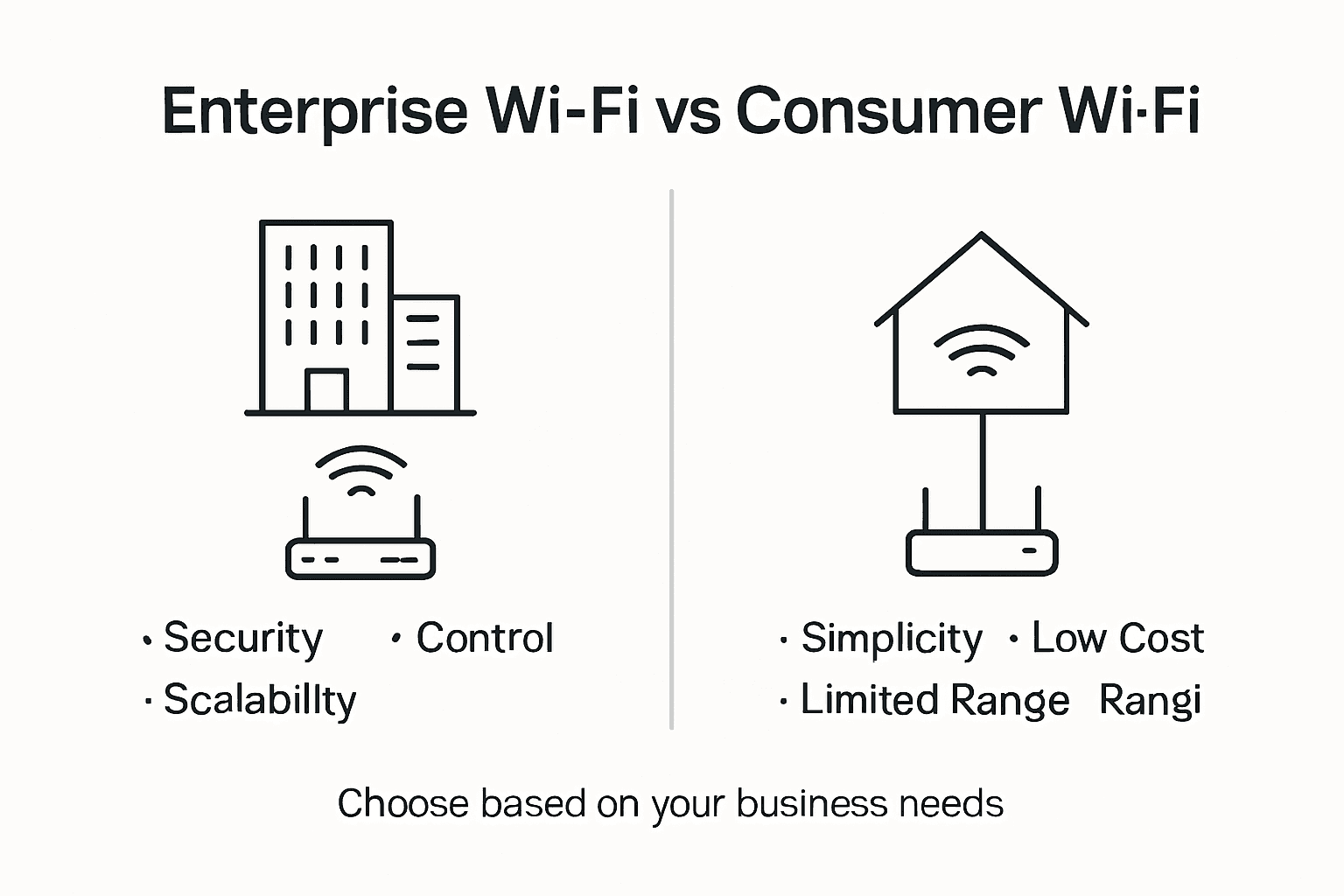
The landscape of wireless networking fundamentally shifts when comparing enterprise-grade solutions with consumer alternatives, revealing stark differences in performance, security, and scalability. While home networks serve basic connectivity needs, enterprise Wi-Fi represents a sophisticated technological ecosystem designed for complex organizational requirements.
Security architecture represents the most significant differentiator between consumer and enterprise wireless networks. Consumer Wi-Fi typically relies on simple pre-shared passwords and basic encryption, leaving networks vulnerable to unauthorized access. Enterprise solutions, by contrast, implement multi-layered authentication protocols such as WPA3-Enterprise, which provide individual user verification, dynamic encryption, and granular access controls that protect sensitive organizational data.
Key comparison points between enterprise and consumer Wi-Fi include:
- Performance Capabilities
- Enterprise: High-density device support
- Consumer: Limited device handling
- Security Mechanisms
- Enterprise: Centralized management
- Consumer: Basic password protection
- Network Management
- Enterprise: Advanced monitoring tools
- Consumer: Basic configuration interfaces
- Scalability
- Enterprise: Seamless expansion
- Consumer: Limited growth potential
Beyond technical specifications, enterprise Wi-Fi solutions offer comprehensive management platforms that enable IT administrators to monitor network performance, detect potential security threats, and maintain consistent connectivity across diverse organizational environments. These advanced capabilities ensure business continuity, protect critical infrastructure, and support increasingly complex digital workplace requirements.
Pro tip: Conduct a thorough assessment of your organization’s specific networking needs before selecting between consumer and enterprise Wi-Fi solutions to ensure optimal performance and security.
Elevate Your Business Connectivity with Enterprise Wi-Fi Solutions
Modern businesses face the challenge of securing, scaling, and managing complex wireless networks that support high-density device environments and sensitive data transmissions. The article highlights the need for robust security protocols like multi-factor authentication and WPA3, scalable architecture with dynamic resource allocation, and reliable network infrastructures that ensure seamless operation. Your business goals likely include protecting critical data, enabling flexible work arrangements, and optimizing network performance across multiple locations.
At SabertoothPro, we understand these challenges and offer tailored solutions that align perfectly with enterprise Wi-Fi demands. Explore our Titan WiFi collection featuring high-performance routers designed for secure, scalable connectivity. For extending coverage in complex environments, check out our WiFi extenders to ensure flawless network availability. Combine these with our flexible Titan WiFi hotspot plans for reliable internet access wherever your business takes you. Discover how to transform your wireless infrastructure by visiting SabertoothPro.com and powering enterprise-grade connectivity with confidence.

Don’t let connectivity bottlenecks or security risks hold your business back. Act now to implement enterprise Wi-Fi solutions designed for modern demands and unlock your workforce’s full potential. Visit SabertoothPro to find the perfect network devices and plans that drive business growth and resilience today.
Frequently Asked Questions
What is enterprise Wi-Fi and how does it differ from consumer Wi-Fi?
Enterprise Wi-Fi is a sophisticated wireless networking solution designed for organizational environments, focusing on advanced security, scalability, and reliability. Unlike consumer Wi-Fi, which typically uses simple password protection, enterprise Wi-Fi employs individual user authentication and more robust security measures, providing better protection for sensitive data.
Why should businesses invest in enterprise Wi-Fi solutions?
Businesses should invest in enterprise Wi-Fi solutions because they offer enhanced security, seamless scalability, and improved reliability, ensuring efficient operation for complex organizational needs. This is crucial for supporting mobile workforces, IoT devices, and critical applications in a secure manner.
What are the main types of enterprise Wi-Fi deployments?
The primary types of enterprise Wi-Fi deployments include centralized managed networks, cloud-managed solutions, distributed access point systems, and mesh networks. Each type is tailored to specific business needs, providing unique benefits in terms of coverage, management, and performance.
How can I ensure the security of my enterprise Wi-Fi network?
To ensure the security of your enterprise Wi-Fi network, implement multi-factor authentication, use advanced encryption standards like WPA3, conduct regular security audits, and continuously monitor network traffic for potential threats. Establishing a proactive security strategy is vital for protecting sensitive business information.