


What Is 5G Internet? Complete Guide for 2025

Nearly 60 percent of american households now access the internet from multiple devices at once, putting ever greater demands on network speed and reliability. As digital life becomes essential for everything from work to entertainment, the leap to 5G internet means more than just faster downloads. This new technology stands to reshape daily routines, business operations, and even the core infrastructure of society by offering lightning-fast connections and ultra-responsive service.
Table of Contents
- Defining 5G Internet and Key Benefits
- How 5G Technology Works in Practice
- Major Types of 5G Networks Compared
- Real-World 5G Applications and Use Cases
- Evaluating Costs, Limitations, and Alternatives
Key Takeaways
| Point | Details |
|---|---|
| 5G Internet Revolutionizes Connectivity | 5G technology provides significantly faster speeds and lower latency, transforming sectors like healthcare and transportation. |
| Advanced Network Capabilities | 5G supports new applications such as autonomous vehicles and smart cities through its advanced network architecture. |
| Multiple Frequency Bands | The use of low, mid, and high-band frequencies allows for tailored solutions depending on coverage and speed requirements. |
| Cost and Complexity of Deployment | Implementing 5G infrastructure requires substantial investment and planning, particularly for high-density areas. |
Defining 5G Internet and Key Benefits
5G internet represents the latest generation of cellular network technology, delivering unprecedented connectivity and performance capabilities that are set to transform how we interact with digital infrastructure. Unlike previous generations, 5G offers dramatically enhanced speed, reduced latency, and expanded network capacity that enables sophisticated technological innovations.
At its core, 5G utilizes higher-frequency radio waves and distributed wireless access points to create a more responsive and intelligent network ecosystem. The technology operates across multiple spectrum bands, allowing for unprecedented data transmission speeds that can reach up to 20 gigabits per second - approximately 100 times faster than traditional 4G networks. These capabilities unlock transformative potential across multiple sectors:
- Enhanced Mobile Broadband: Enables seamless streaming, gaming, and high-definition video conferencing
- Massive Machine-Type Communications: Supports exponential growth in Internet of Things (IoT) device connectivity
- Ultra-Reliable Low-Latency Communications: Facilitates real-time applications like autonomous vehicles and remote medical procedures
The technological leap represented by 5G extends far beyond mere speed improvements. By supporting advanced network technologies, 5G creates an intelligent infrastructure capable of dynamically managing complex, interconnected digital environments. This means smarter cities, more responsive healthcare systems, and unprecedented levels of industrial automation - all powered by a network that can instantaneously adapt to changing technological demands.
How 5G Technology Works in Practice
5G technology represents a sophisticated network architecture that fundamentally transforms wireless communication through advanced technical design. Network infrastructure leverages multiple frequency bands to create a dynamic, responsive connectivity ecosystem that adapts instantly to user demands.
At its core, 5G operates through a complex cellular network comprising two primary components: the Radio Access Network (RAN) and the Core Network. The RAN connects devices via specialized base stations called gNodeBs, which utilize massive MIMO (Multiple Input Multiple Output) antenna technologies to dramatically increase network capacity and signal reliability. These advanced base stations can simultaneously communicate with multiple devices, creating a more efficient and responsive wireless environment.
The technical brilliance of 5G lies in its spectrum flexibility. The network operates across three distinct radio frequency bands - low, mid, and high - each serving unique communication requirements:
- Low-Band: Provides extensive coverage with slower speeds
- Mid-Band: Balances speed and coverage effectively
- High-Band (mmWave): Delivers ultra-fast speeds with limited range
This multi-layered approach allows 5G to support an unprecedented number of connected devices while maintaining exceptional performance. The cloud-based Core Network enables advanced features like network slicing, which permits telecommunications providers to create virtualized network segments optimized for specific use cases - from industrial IoT applications to real-time medical monitoring. By bringing data processing closer to end-users through edge computing, 5G dramatically reduces latency and creates a more responsive digital infrastructure that can support emerging technologies like autonomous vehicles, augmented reality, and smart city systems.
Major Types of 5G Networks Compared
5G network types represent a sophisticated technological ecosystem designed to deliver unprecedented wireless connectivity across diverse environments. Network configurations offer strategic performance options that enable organizations and consumers to select optimal communication solutions tailored to specific requirements.

5G networks fundamentally operate across three distinct frequency bands, each delivering unique performance characteristics. The low-band spectrum provides extensive geographic coverage with moderate data speeds, making it ideal for rural and suburban deployments. Mid-band frequencies strike an impressive balance between transmission speed and signal reach, emerging as the most versatile network configuration. High-band millimeter wave technology represents the pinnacle of 5G performance, delivering extraordinary data speeds but requiring dense infrastructure and line-of-sight transmission.
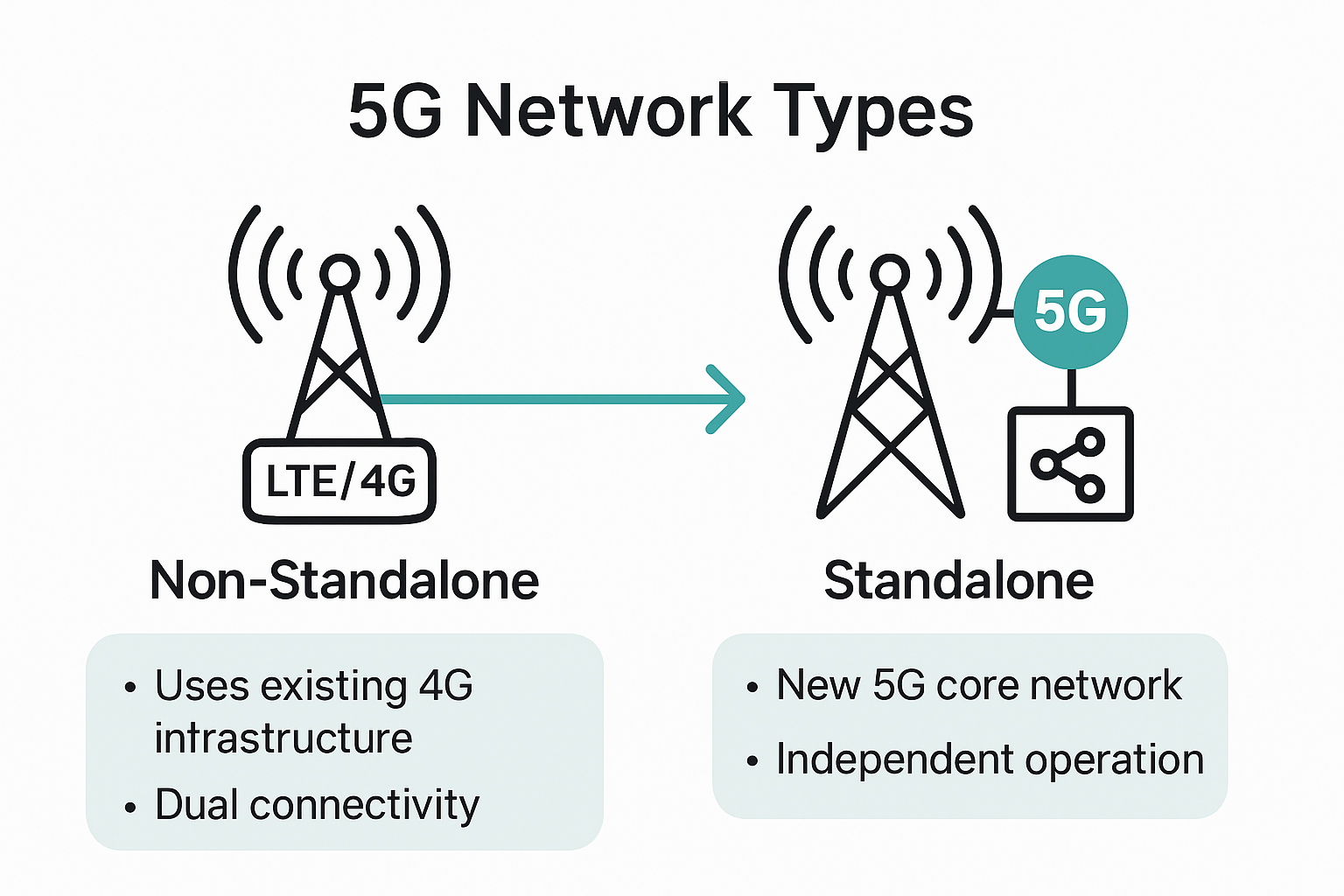
The network architecture itself is characterized by two primary operational modes:
- Non-Standalone (NSA): Leverages existing 4G infrastructure
- Standalone (SA): Utilizes entirely new 5G core network
Non-standalone networks represent an evolutionary approach, allowing telecommunications providers to gradually transition their infrastructure while maintaining existing investments. Standalone networks, conversely, unlock the full potential of 5G technology, enabling advanced features like network slicing, ultra-low latency communication, and more granular network management. The choice between these modes depends on specific organizational requirements, existing infrastructure, and strategic connectivity goals.
Real-World 5G Applications and Use Cases
5G technology is revolutionizing industries by enabling transformative applications that were previously impossible or impractical. Mobile internet capabilities are expanding beyond traditional communication, creating innovative solutions across multiple sectors.
5G’s most profound impact is evident in healthcare, where the technology supports groundbreaking telemedicine services. High-speed, low-latency networks enable remote surgical procedures, real-time patient monitoring, and rapid transmission of complex medical imaging data. Emergency services benefit from instantaneous video streaming and precise location tracking, dramatically improving response times and coordination during critical situations.
Beyond healthcare, 5G powers next-generation technological innovations:
- Autonomous Vehicles: Enables real-time navigation and communication
- Smart Cities: Supports advanced urban infrastructure management
- Industrial IoT: Facilitates precise machine-to-machine communication
- Immersive Media: Delivers seamless augmented and virtual reality experiences
The industrial landscape is experiencing radical transformation through 5G’s capabilities. Manufacturing facilities can implement sophisticated robotics and predictive maintenance systems with unprecedented precision. Public infrastructure like traffic management, utility monitoring, and security surveillance become exponentially more intelligent and responsive. This technological leap represents more than incremental improvement - it signals a fundamental reimagining of how interconnected systems can operate with remarkable efficiency and intelligence.
Evaluating Costs, Limitations, and Alternatives
5G network deployment represents a complex technological investment with significant financial and infrastructural challenges. Wireless internet options require careful assessment of performance, cost-effectiveness, and practical implementation strategies.
5G infrastructure demands substantial upfront investment, particularly for high-frequency millimeter wave networks that require dense small cell installations. These networks necessitate extensive hardware deployment, with each small cell requiring precise positioning to maintain signal integrity. The infrastructure costs can be prohibitively expensive for rural and less populated regions, creating significant barriers to widespread adoption.
Key limitations of 5G technology include:
- Infrastructure Complexity: Requires extensive network of small cell towers
- High Deployment Costs: Significant investment in hardware and installation
- Signal Limitations: Reduced penetration through physical obstacles
- Device Compatibility: Requires specialized 5G-enabled hardware
Alternative connectivity solutions remain critical for organizations and consumers unable to immediately transition to 5G. Existing 4G LTE networks continue to provide reliable coverage, while emerging technologies like advanced Wi-Fi 6 and satellite internet offer complementary connectivity options. The technological ecosystem demands flexible approaches that balance cutting-edge performance with practical, cost-effective implementation strategies.
Unlock the Full Potential of 5G with SabertoothPro
Understanding 5G Internet is the first step toward overcoming connectivity challenges like high latency, limited coverage, and infrastructure complexity. Whether you struggle with unreliable rural internet or need the speed and low latency 5G offers for your business, you deserve solutions that deliver on the promises of this revolutionary technology. Since 5G works best with the right devices and network configurations, having access to cutting-edge hardware is key to experience true ultra-fast speeds and seamless connectivity.
Discover our curated collection of reliable Titan WiFi devices designed specifically for high-speed 5G and 4G internet access wherever you are.

Don’t let your internet hold you back in 2025. Act now to get ahead with devices engineered for advanced wireless technology and explore solutions tailored for rural, mobile, or enterprise needs. Visit SabertoothPro.com today to browse exclusive offers including our special promotions and boost your connectivity with powerful WiFi extenders. Experience the reliable, fast internet your lifestyle or business demands.
Frequently Asked Questions
What are the main benefits of 5G internet?
5G internet offers enhanced mobile broadband, massive machine-type communications, and ultra-reliable low-latency communications, enabling seamless streaming, increased IoT connectivity, and real-time applications such as autonomous vehicles and remote medical procedures.
How does 5G technology work?
5G technology operates through a complex cellular network composed of the Radio Access Network (RAN) and Core Network. It uses multiple frequency bands (low, mid, high) and advanced antenna technologies to provide high-speed, low-latency connectivity that adapts to user demands.
What are the types of 5G networks?
There are two primary types of 5G networks: Non-Standalone (NSA), which utilizes existing 4G infrastructure, and Standalone (SA), which relies entirely on new 5G core network. NSA allows for a gradual transition, while SA fully unlocks 5G’s capabilities.
What are the limitations of 5G technology?
Despite its advantages, 5G technology faces limitations such as high deployment costs, infrastructure complexity requiring dense networks of small cell towers, signal limitations due to physical obstacles, and the need for specialized 5G-enabled hardware.