


Internet Trends in 2025: Shaping Healthcare and Retail

Reliable internet is quickly becoming the backbone of every healthcare clinic and retail store across the Mid-Atlantic, not just a line item in your technology budget. By 2025, experts predict the Internet will be as ubiquitous as electricity, deeply woven into patient care, product delivery, and operational decision-making. For IT leaders, understanding the latest internet trends means knowing which innovations—AI, IoT, cloud, 5G, and hybrid connectivity—will most impact your infrastructure and help future-proof your organization.
Table of Contents
- Defining Internet Trends for 2025
- Major Innovations in Connectivity Solutions
- AI, IoT, and Cloud Transformations
- Security and Privacy Challenges Ahead
- Addressing Rural and Mobile Internet Needs
Key Takeaways
| Point | Details |
|---|---|
| Internet Transformation | By 2025, the internet will be deeply integrated into healthcare and retail, necessitating a rethink of infrastructure. |
| Emphasis on Convergence | The integration of immersive computing, IoT devices, and AI will reshape operational dynamics across sectors. |
| Connectivity Innovations | 5G and hybrid networks will enhance communication reliability, supporting critical healthcare and retail functionalities. |
| Security Priorities | Organizations must adopt a zero-trust approach and strengthen data privacy measures to combat increasing cyber threats. |
Defining Internet Trends for 2025
Internet trends in 2025 represent a fundamental shift in how connectivity operates across industries. Rather than isolated technological upgrades, these trends reflect a comprehensive evolution where the internet becomes as essential as electricity itself. Experts predict that by 2025, the Internet will be ubiquitous, deeply embedded into the daily operations of healthcare systems, retail environments, and every sector in between. For Mid-Atlantic healthcare and retail decision-makers, this transformation means rethinking infrastructure from the ground up. The trends shaping 2025 aren’t abstract concepts anymore—they’re concrete realities your organization needs to prepare for today.
The core internet trends defining 2025 center on three interconnected pillars: immersive ambient computing environments, proliferation of IoT devices and smart sensors, and AI-enhanced cloud integration. In healthcare settings, this means patient monitoring systems that operate seamlessly in the background, medical devices communicating in real time, and cloud platforms that analyze patient data instantly. For retail operations, immersive environments translate to personalized shopping experiences powered by IoT sensors tracking inventory and customer behavior, while AI processes this data to optimize pricing, staffing, and supply chains. 2025 connectivity trends will reshape how businesses operate fundamentally. The World Bank’s Digital Progress and Trends Report 2025 emphasizes that AI foundations are strengthening across sectors, which directly impacts how your organization manages network security, data processing, and customer interactions.
What makes 2025 distinctive is the convergence of these trends creating compounding effects. A healthcare facility no longer chooses between investing in IoT monitoring or AI diagnostics—both operate as integrated parts of the same ecosystem. Retail locations cannot optimize customer experience through smart sensors alone; they need secure, reliable connectivity to process that data and act on insights instantly. This convergence demands robust infrastructure that handles exponential data growth, maintains security across distributed systems, and ensures zero downtime for critical operations. Your connectivity solution in 2025 must support mobile-first operations, enable secure omnichannel communication, and scale intelligently as your organization grows.
Pro tip: Audit your current network infrastructure now against 2025 standards—identify gaps in IoT readiness, cloud integration capability, and security frameworks so you can prioritize upgrades before connectivity demands accelerate.
Here’s a summary of how key 2025 internet trends impact healthcare and retail sectors:
| Trend | Healthcare Impact | Retail Impact |
|---|---|---|
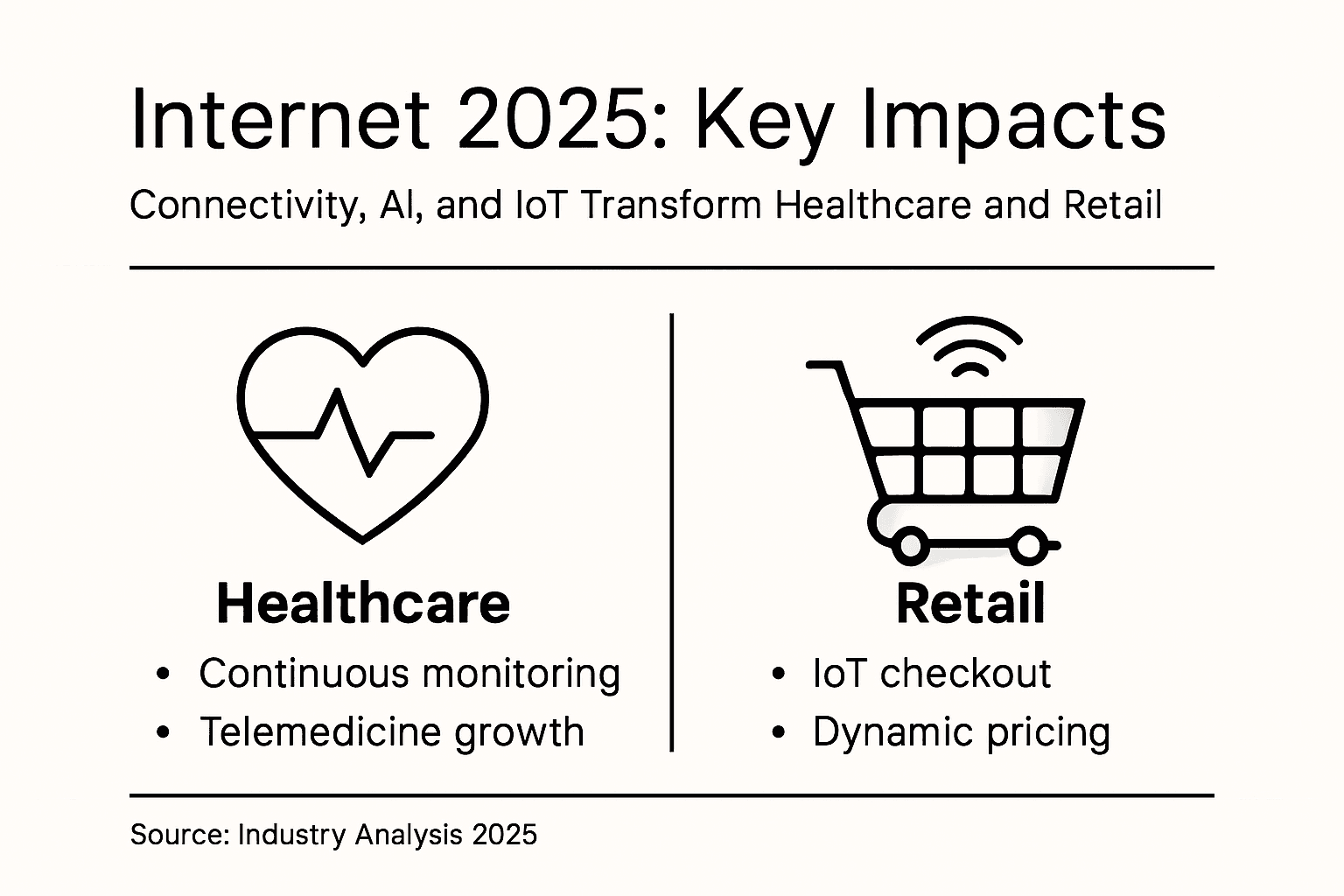
| Immersive ambient computing | Continuous patient monitoring automation | Personalized in-store experiences |
| IoT devices & smart sensors | Real-time medical device communication | Inventory tracking and customer behavior data |
| AI-enhanced cloud integration | Instant analytics for diagnoses and records | Dynamic pricing and workforce optimization |
| Mobile-first connectivity | Remote patient care and field operations | Streamlined omnichannel customer interaction |
Major Innovations in Connectivity Solutions
Connectivity innovations in 2025 go far beyond faster speeds. The real transformation involves fundamental architecture changes that enable healthcare and retail organizations to operate with unprecedented reliability and intelligence. The shift toward integrated terrestrial and non-terrestrial networks means your organization can leverage satellite and aerial platforms alongside traditional ground infrastructure. This hybrid approach eliminates dead zones, ensures redundancy during outages, and creates seamless coverage whether a patient is in a rural clinic or a retail location is managing peak traffic. For Mid-Atlantic healthcare systems managing distributed facilities across varied topography, this innovation solves a critical problem: consistent connectivity across your entire service area. Retail operations benefit similarly, enabling real-time inventory sync and customer experience features across all locations without connectivity gaps.
The most impactful innovation for your sector is how 5G enables reliable communication essential for telemedicine and remote monitoring. In healthcare, this means cardiologists can monitor post-surgery patients in real time from anywhere, diagnostic imaging transfers instantly without compression artifacts, and operating rooms can coordinate with specialists globally without delay. Retail environments transform through ultra-low latency connections that enable dynamic pricing systems, instant inventory visibility across stores, and omnichannel customer experiences powered by AI analytics. But connectivity is just the foundation. The real innovation is what happens when 5G combines with IoT sensors, edge computing, and cloud platforms. Your retail locations can process customer behavior data at point of sale instantly. Your healthcare facilities can aggregate patient data from wearables, medical devices, and electronic health records into actionable insights within seconds, not hours.

These innovations also reshape business models and competitive dynamics. Traditional connectivity providers now compete with emerging players offering specialized solutions for healthcare and retail verticals. This competition drives innovation faster and creates opportunities to negotiate better service terms tailored to your specific needs. Policy frameworks are adapting too, with emphasis on spectrum management and regulatory flexibility that enables new network configurations to deploy faster. What this means practically: your organization has more choices, more flexible deployment options, and solutions designed specifically for healthcare security requirements or retail scale demands. Mobile-first connectivity strategies are becoming standard rather than optional, reflecting how distributed operations and hybrid work models dominate 2025.
Pro tip: Evaluate your current connectivity stack against these innovations by mapping which systems truly need 5G latency versus which can operate on reliable broadband, then prioritize 5G investments where patient care or real-time retail operations depend on it most.
AI, IoT, and Cloud Transformations
The convergence of AI, IoT, and cloud computing represents the most fundamental shift in how healthcare and retail organizations will operate in 2025. These three technologies don’t work in isolation—they create a synergistic ecosystem where each amplifies the others’ effectiveness. IoT devices collect granular, real-time data from patient monitors, point-of-sale systems, and inventory sensors. Cloud infrastructure stores and manages this exponential data growth without requiring massive on-site servers. AI then processes this data to uncover patterns, predict outcomes, and automate decisions that would be impossible for humans to manage at scale. For Mid-Atlantic healthcare facilities, this means diagnostic support that catches conditions earlier. For retail operations, it means inventory optimization that reduces waste and improves customer availability.
In healthcare specifically, AI technologies improve diagnoses and patient monitoring, addressing gaps in access to specialized care. A rural clinic can now leverage AI diagnostic assistance when local specialists aren’t available, improving patient outcomes while reducing unnecessary referrals. IoT wearables and connected medical devices transmit continuous patient data—heart rate variability, blood pressure trends, medication adherence—directly to cloud systems where AI algorithms flag concerning patterns before they become emergencies. Hospital operations transform too. Staff scheduling algorithms predict patient volume and adjust staffing in real time. Supply chain AI optimizes pharmaceutical inventory, preventing both stockouts of critical medications and waste from expired stock. Retail healthcare services benefit similarly through AI enabling personalized customer engagement and improved service delivery, particularly in specialized areas like optical care where AI assists with prescription analysis and frame selection recommendations.
Retail environments see equally dramatic transformations. Cloud-based point-of-sale systems integrated with IoT sensors track inventory at the shelf level, automatically triggering orders when stock drops below thresholds. AI analyzes customer purchase patterns, browsing behavior, and demographic data to personalize promotions and product placement. Dynamic pricing algorithms adjust in real time based on demand, competitor pricing, and inventory levels, optimizing revenue while maintaining competitiveness. The backend benefits too: AI-driven workforce management predicts busy periods, internet technology trends enable seamless data integration across locations, and cloud computing eliminates costly infrastructure at each store. What once required expensive on-premise hardware now operates through scalable cloud services that grow with your business.
The critical infrastructure requirement here is connectivity that supports this data flow reliably. Your network must handle IoT device streams, cloud synchronization, and AI processing with consistent latency and zero downtime. Retail locations can’t afford point-of-sale failures during peak hours. Healthcare facilities can’t tolerate delays in patient monitoring data transmission. This is why the innovations discussed earlier—5G, hybrid networks, and edge computing—matter so fundamentally to realizing these AI, IoT, and cloud benefits.
Pro tip: Start by identifying one high-impact workflow in your organization where AI could reduce manual work or improve outcomes, ensure your IoT sensors collect the necessary data for that workflow, then pilot the AI solution with a subset of your cloud infrastructure before scaling across your entire operation.
Security and Privacy Challenges Ahead
The more connected your healthcare and retail operations become, the more vulnerable they are to security threats and privacy breaches. This creates a paradox: the technologies enabling transformation in 2025 simultaneously create new attack surfaces that criminals actively exploit. Healthcare faces particular pressure because patient data represents the most valuable commodity on the dark web. A single patient record sells for more than a stolen credit card because it includes medical history, insurance information, Social Security numbers, and biometric data. Retail operations face different but equally serious threats: point-of-sale breaches exposing payment card data, inventory system compromises disrupting supply chains, and customer data theft damaging brand trust. The fundamental challenge is that health data privacy faces critical threats from unregulated digital technologies as commercial surveillance and data profiling by technology companies compromise sensitive information. Weak privacy laws create compliance gaps where organizations don’t even know what protections they legally require.
Cybersecurity risks escalate dramatically as healthcare systems interconnect devices, cloud platforms, and AI systems. Cybersecurity threats include ransomware, supply chain attacks, and AI-enhanced phishing that specifically target healthcare vulnerabilities. A ransomware attack on a hospital’s connected medical devices doesn’t just encrypt files, it can disrupt patient care, delay surgeries, and potentially endanger lives. Supply chain attacks are particularly insidious because they compromise the vendors and contractors your organization trusts. A criminal gains access through a third-party software provider, then moves laterally into your core systems. AI-enhanced phishing uses machine learning to craft emails so personalized and convincing that even security-conscious staff fall for them. Your retail operations face similar sophisticated attacks targeting payment systems, customer databases, and inventory management platforms.
The intersection of AI and privacy creates a unique challenge. Your organization may need to train AI models on patient data or customer behavior to gain competitive advantages, but doing so creates privacy risks if that data isn’t properly anonymized or encrypted. Edge computing helps by processing sensitive data locally rather than transmitting it to cloud servers, but edge devices themselves become attack targets. Network segmentation becomes critical, ensuring that a compromise in one system doesn’t cascade across your entire infrastructure. Secure WiFi networks are fundamental because retail locations and healthcare facilities increasingly rely on wireless connectivity for medical devices, point-of-sale systems, and employee access.
Three immediate actions strengthen your security posture. First, conduct a data inventory identifying what sensitive information your organization collects, stores, and transmits. Second, implement zero-trust security architecture assuming every access request is suspicious until verified. Third, establish incident response protocols specific to your industry so when breaches occur, you respond rapidly with clear procedures. Healthcare organizations must ensure HIPAA compliance across all systems. Retail operations must implement PCI-DSS standards for payment processing. Both sectors must address the gap between what privacy laws require and what emerging technologies enable.
Pro tip: Treat your IoT devices and cloud connections with the same security rigor as your core systems, ensuring that every connected device has strong authentication, encryption in transit, and regular security updates, because attackers target the weakest link in your chain.
Addressing Rural and Mobile Internet Needs
Rural healthcare and retail operations across the Mid-Atlantic face a connectivity crisis that urban areas have largely solved. A patient in a rural clinic cannot access telemedicine if broadband doesn’t reach the building. A retail location in a remote area cannot sync inventory in real time if wireless connectivity is unreliable. The digital divide isn’t abstract anymore, it directly impacts patient outcomes and business competitiveness. Bridging this gap requires understanding that rural connectivity demands different solutions than urban deployments. Bridging the rural digital divide requires fixed, mobile, satellite, and hybrid networks tailored to local geography and economics. There’s no one-size-fits-all answer. A valley surrounded by mountains might need satellite connectivity combined with localized wireless networks. A sparsely populated region might rely on mobile hotspots and fixed wireless access rather than traditional fiber infrastructure.
For rural healthcare specifically, the transformation is dramatic when broadband reaches clinics. Telehealth services overcome distance and provider shortages through telecommunications and health IT systems, enabling rural patients to access specialists without traveling hours. A patient with cardiac concerns in a remote clinic can now have a real-time video consultation with a cardiologist 200 miles away, with ECG data transmitted instantly for analysis. Rural hospitals can participate in network care models where specialists at regional medical centers provide remote guidance for complex cases. Pathology slides can be digitized and reviewed remotely. Imaging studies can be analyzed by specialists anywhere. The barrier isn’t medical capability anymore, it’s connectivity reliability. Mobile connectivity for rural healthcare enables ambulances to transmit patient data to receiving hospitals before arrival, enabling faster treatment. Field clinics serving agricultural workers can document patient encounters on mobile devices and sync securely to central systems.
Retail operations in rural areas face similar connectivity demands but with different constraints. A rural pharmacy or clinic retailer needs point-of-sale systems that work when broadband dips. Mobile solutions using local caching and eventual synchronization keep operations running even during connectivity interruptions. Inventory management requires mobile devices with offline capability so staff can track stock regardless of network status. Customer engagement through local WiFi hotspots becomes important for rural retail locations trying to compete with online shopping. The economics are different too. Installing fiber to a rural retail location might cost 10 times more per location than urban deployment. Wireless solutions become more cost-effective, but they require backup systems for reliability.
Three connectivity approaches are maturing for rural deployment. Fixed wireless access uses ground-based towers with line-of-sight transmission to buildings, providing broadband speeds cheaper to deploy than fiber. Satellite internet has evolved dramatically with low-orbit constellations offering latency suitable for most healthcare and retail applications. Hybrid networks combine multiple technologies for redundancy, ensuring that if one connection fails, backup connectivity maintains operations. For organizations with multiple rural locations, evaluating all three options against your specific geography and requirements makes sense.
Pro tip: For rural healthcare and retail locations, implement backup connectivity using a different technology than your primary connection, such as satellite backup for fixed wireless primary, ensuring patient care and retail operations continue if your main connection fails.
Below is a comparison of rural connectivity approaches in 2025 for healthcare and retail organizations:
| Connectivity Approach | Strengths | Typical Use Case | Limitation |
|---|---|---|---|
| Fixed wireless access | Affordable and reliable broadband speeds | Clinics, stores near service towers | Needs clear line-of-sight |
| Satellite internet | Broad reach in remote areas | Mountain valleys, isolated towns | Potential latency issues |
| Hybrid network solution | Redundant connection for reliability | Facilities needing backup options | Cost and complexity |
Prepare Your Healthcare and Retail Networks for the Internet of 2025
As the article highlights, the future of connectivity demands robust, secure, and seamless integration of IoT devices, AI-enhanced cloud systems, and mobile-first strategies. If your healthcare or retail operations are struggling with inconsistent coverage, security vulnerabilities, or outdated infrastructure unable to support real-time data flows, you are facing the very challenges the Internet trends of 2025 aim to solve. From ensuring zero downtime for critical patient monitoring to enabling dynamic pricing through smart retail sensors, the right connectivity solutions can transform risk into opportunity.
Discover how SabertoothPro’s Titan WiFi products deliver reliable 4G LTE and 5G hotspots designed specifically for healthcare and retail environments requiring constant, secure internet access. Our scalable IoT connectivity and enterprise-grade network security protect sensitive data while supporting your cloud and AI-driven workflows.

Take control of your network’s future now by exploring our special promotions and securing the cutting-edge connectivity your organization needs. Visit SabertoothPro.com today to find tailored solutions that keep you ahead of 2025’s internet revolution.
Frequently Asked Questions
What are the key internet trends shaping healthcare in 2025?
The key trends include immersive ambient computing for continuous patient monitoring, IoT devices facilitating real-time medical communication, AI-enhanced cloud integration for instant data analysis, and secure mobile-first connectivity for remote patient care.
How will AI impact retail operations by 2025?
AI will significantly enhance retail operations by providing dynamic pricing based on customer behavior, optimizing inventory management through real-time data processing, and personalizing customer engagement via targeted promotions and product recommendations.
What challenges do healthcare organizations face in ensuring data security by 2025?
Healthcare organizations face challenges such as ransomware attacks, supply chain vulnerabilities, and the need to comply with privacy laws while integrating AI and IoT technologies, which creates new attack surfaces for cyber threats.
What type of connectivity solutions are necessary for rural retail operations?
Rural retail operations require reliable connectivity solutions such as fixed wireless access for broadband, satellite internet for remote areas, and hybrid networks to ensure consistent operations even during outages.