


SD-WAN vs VPN explained: choosing the best solution

Many IT managers assume VPNs and SD-WAN serve identical purposes in securing network connectivity. This misconception leads to costly misalignments between business needs and deployed technology. While both solutions address secure data transmission, they differ fundamentally in architecture, scalability, and performance optimization. Understanding these distinctions empowers you to select the right infrastructure for your organization’s growth trajectory. This guide clarifies what separates SD-WAN from VPN technology, examines their respective strengths and limitations, and provides decision frameworks tailored for small to medium businesses navigating modern network requirements.
Table of Contents
- Key takeaways
- Understanding VPN: traditional network security explained
- Exploring SD-WAN: modern network connectivity redefined
- Comparing SD-WAN and VPN: which fits your business?
- Implementing your choice: practical steps for deploying SD-WAN or VPN
- How Sabertooth Pro supports your network decisions
- What are the main differences between SD-WAN and VPN?
Key Takeaways
| Point | Details |
|---|---|
| VPN limitations | VPNs secure remote connections but become less flexible as networks grow. |
| Centralized management and path optimization | SD WAN provides centralized control, real time path selection, and improved performance for cloud applications. |
| Cloud performance gains | SD WAN enhances cloud application performance and reduces latency compared with traditional VPNs. |
| Decision depends on size | The right solution depends on business size, security posture, and application requirements. |
| Agility and admin efficiency | For organizations prioritizing agility and cloud adoption, SD WAN often outperforms VPNs in performance and ease of management. |
Understanding VPN: traditional network security explained
Virtual Private Networks have anchored business security strategies for decades. VPNs establish encrypted tunnels to protect data across public networks, creating secure pathways between remote users and corporate resources. This encryption shields sensitive information from interception, making VPNs essential for organizations handling confidential data.
Three primary VPN deployment models serve different business scenarios:
- Site-to-site VPNs connect entire office networks, creating persistent encrypted links between locations
- Remote access VPNs enable individual employees to securely reach company systems from any location
- Client-based VPNs install software on user devices, establishing on-demand encrypted connections
VPN technology offers compelling advantages for specific use cases. Strong encryption protocols like AES-256 provide military-grade data protection. Nearly universal platform support means VPNs work across Windows, macOS, Linux, iOS, and Android devices without compatibility headaches. For small teams with limited IT budgets, VPN solutions deliver robust security at relatively low cost. A single VPN server can support dozens of remote workers without requiring expensive infrastructure investments.
However, VPNs carry inherent limitations that become apparent as networks scale. Static routing forces all traffic through predetermined paths regardless of current network conditions. If your primary VPN link experiences congestion, performance degrades across all connected users with no automatic failover. This rigidity contrasts sharply with modern application demands. Latency issues frequently plague VPN connections, particularly when routing traffic through distant servers before reaching cloud applications. A sales team accessing CRM software might experience frustrating delays as data travels from their location to the VPN gateway, then back out to the cloud platform.
Pro Tip: When evaluating VPN performance, test actual application response times rather than raw bandwidth speeds. A connection showing 100 Mbps throughput may still deliver poor user experience if latency exceeds 150 milliseconds.
Traditional VPNs shine in specific scenarios. Remote workers connecting from coffee shops or airports benefit from business VPN security insights that protect against public Wi-Fi vulnerabilities. Small organizations with straightforward network topologies can implement VPNs quickly without extensive technical expertise. Branch offices requiring basic secure connectivity to headquarters find site-to-site VPNs adequate for file sharing and internal communications.
Exploring SD-WAN: modern network connectivity redefined
Software-Defined Wide Area Networking represents a paradigm shift in how businesses architect connectivity. Rather than relying on fixed hardware configurations, SD-WAN dynamically selects optimal paths to improve reliability and bandwidth efficiency. This software-centric approach transforms network management from manual, site-by-site configuration to centralized policy orchestration.
SD-WAN’s architecture delivers capabilities impossible with traditional networking:
- Centralized control through cloud-based management consoles that configure hundreds of sites simultaneously
- Application-aware routing identifies traffic types and steers each application over the best-performing link
- Multi-link aggregation combines broadband, LTE, 5G, and MPLS connections into unified bandwidth pools
- Integrated security frameworks apply consistent policies across distributed locations without separate appliances
These features translate into tangible business benefits. Consider a retail chain with 50 locations. Traditional WAN requires IT staff to visit each site for configuration changes or troubleshooting. SD-WAN enables your team to deploy security updates, adjust bandwidth allocation, or diagnose connectivity issues from a single dashboard. This operational efficiency reduces both deployment time and ongoing management costs.

| Feature | Traditional WAN/VPN | SD-WAN |
|---|---|---|
| Deployment time per site | 4-8 hours | 30-60 minutes |
| Configuration method | Manual, on-site | Remote, automated |
| Link failover | Minutes to hours | Seconds |
| Cloud app optimization | Poor | Excellent |
| Bandwidth cost efficiency | Low | High |
| Policy consistency | Variable | Guaranteed |
The benefits of SD-WAN become most apparent in cloud-heavy environments. Modern businesses run critical applications on platforms like Microsoft 365, Salesforce, and AWS. Routing this traffic through distant data centers via traditional VPN architecture adds unnecessary latency and degrades user experience. SD-WAN recognizes cloud-bound traffic and routes it directly to the internet, bypassing corporate data centers entirely. This direct internet breakout reduces latency by 40-60% for cloud applications while maintaining security through integrated firewalls and encryption.
Pro Tip: Calculate your current MPLS costs per megabit and compare against broadband alternatives. Many organizations discover they can triple available bandwidth while cutting WAN expenses by 30-50% through SD-WAN deployments.
SD-WAN excels in specific business contexts. Branch offices benefit from simplified deployment and consistent performance regardless of location. Organizations embracing hybrid cloud strategies need the seamless integration that cloud-based SD-WAN advantages provide between on-premises systems and cloud platforms. Companies with distributed workforces require the flexibility to leverage diverse connection types including cellular backup links.
Cost optimization represents another compelling SD-WAN advantage. Traditional enterprise networking relies heavily on expensive MPLS circuits. SD-WAN allows you to supplement or replace these dedicated lines with commodity broadband connections. A typical MPLS link costs $300-800 monthly per 10 Mbps. Business broadband delivers 100-500 Mbps for $100-200 monthly. By intelligently managing multiple connection types, SD-WAN maintains reliability while dramatically reducing per-site connectivity expenses.
Comparing SD-WAN and VPN: which fits your business?
Direct comparison reveals where each technology excels and struggles. SD-WAN generally provides stronger centralized policies and better adaptive performance than VPNs, but context determines the optimal choice for your specific requirements.
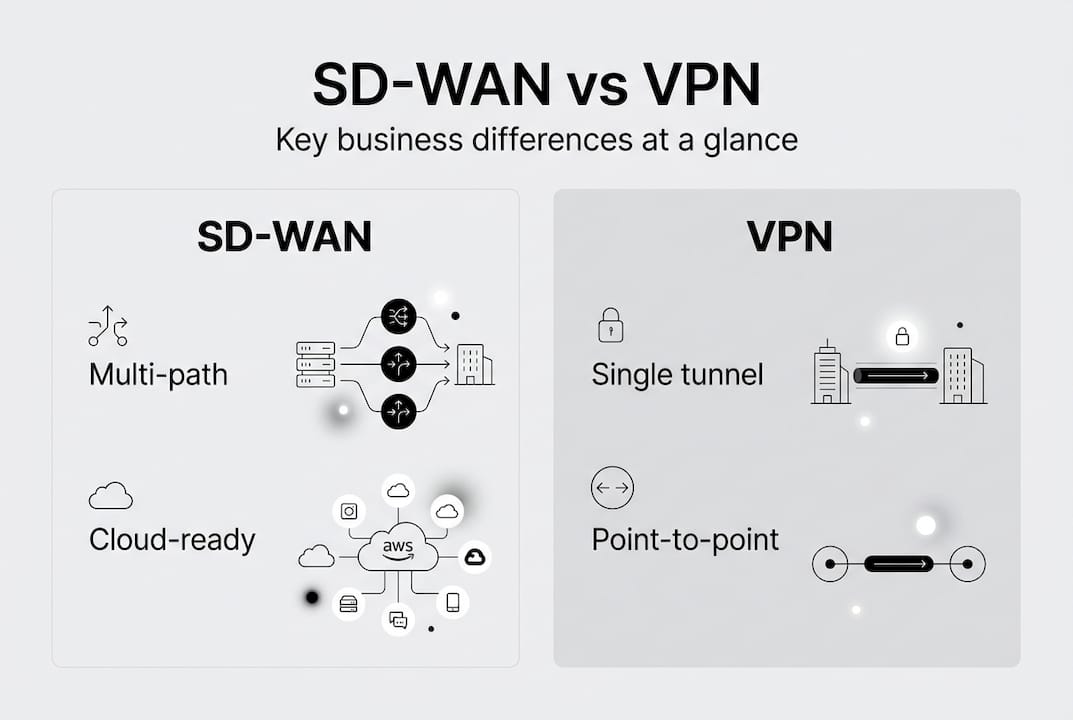
| Criterion | VPN | SD-WAN |
|---|---|---|
| Security approach | Point-to-point encryption | Policy-based security fabric |
| Initial investment | $500-2,000 per site | $2,000-5,000 per site |
| Monthly operational cost | Low | Medium |
| Setup complexity | Moderate | High initially, simple ongoing |
| Performance optimization | Manual | Automated |
| Remote management | Limited | Comprehensive |
| Scalability ceiling | 20-30 sites | Hundreds of sites |
| Cloud application performance | Poor to fair | Excellent |
VPN remains appropriate in several scenarios:
- Small teams under 25 users with straightforward connectivity needs
- Organizations with limited IT expertise and no dedicated network staff
- Temporary or project-based secure access requirements
- Budget-constrained deployments prioritizing basic security over performance
- Simple remote access for individual workers rather than site-to-site connectivity
SD-WAN becomes the superior choice when:
- Managing 5 or more physical locations requiring interconnectivity
- Cloud applications constitute primary business tools
- Network performance directly impacts customer experience or revenue
- IT resources exist to manage initial deployment complexity
- Business growth projections indicate expanding geographic footprint
- Regulatory compliance demands consistent security policy enforcement
Recent technological advances have accelerated SD-WAN adoption among mid-market companies. Cloud-managed SD-WAN platforms now offer intuitive interfaces that reduce the expertise barrier. Integration with security frameworks like SASE (Secure Access Service Edge) delivers comprehensive protection without deploying separate security appliances at each location. These developments make SD-WAN increasingly accessible to organizations previously limited to VPN solutions due to technical constraints.
Small and medium businesses face unique considerations when evaluating these technologies. Budget limitations often favor VPN’s lower entry costs, but total cost of ownership calculations should include management time and productivity losses from poor performance. A company spending $500 monthly on VPN services might lose $2,000 in productivity from slow cloud application access and network troubleshooting. SD-WAN and VPN comparison insights help quantify these hidden costs.
Geographic factors also influence technology selection. Rural locations with limited connectivity options benefit from SD-WAN’s ability to aggregate multiple connection types. VPN usage in rural settings works adequately when reliable primary internet exists, but struggles in areas requiring cellular backup or satellite connectivity as failover options.
Implementing your choice: practical steps for deploying SD-WAN or VPN
Successful deployment requires methodical planning regardless of chosen technology. Proper deployment and ongoing management are critical for maximizing benefits from SD-WAN or VPN implementations.
VPN deployment checklist:
- Assess current network infrastructure and identify connection points requiring secure access
- Select VPN protocol based on security requirements and device compatibility (OpenVPN, IKEv2, or WireGuard)
- Size VPN gateway capacity for peak concurrent users plus 30% growth buffer
- Configure strong authentication using multi-factor authentication and certificate-based validation
- Establish split tunneling policies to route only corporate traffic through VPN
- Test connection stability and performance from representative user locations
- Document configuration procedures and create user guides with troubleshooting steps
- Implement monitoring for connection failures and unusual traffic patterns
SD-WAN deployment checklist:
- Audit existing WAN contracts and identify optimization opportunities
- Map application requirements including latency sensitivity and bandwidth needs
- Evaluate SD-WAN vendors based on management interface, security integration, and support quality
- Design network topology with primary and backup connectivity at each location
- Establish baseline performance metrics before deployment for comparison
- Deploy pilot site to validate configuration and identify issues before wide rollout
- Create standardized templates for different location types (headquarters, branch, remote)
- Train IT staff on management console and troubleshooting procedures
- Migrate sites systematically with validation testing after each deployment
- Monitor performance continuously and adjust policies based on actual usage patterns
Vendor selection deserves careful attention. Evaluate not just feature lists but actual support responsiveness and deployment assistance. Many SD-WAN vendors offer proof-of-concept programs that let you test their solution in your environment before commitment. Take advantage of these trials to verify performance claims and assess management complexity.
Pro Tip: During initial deployment, maintain existing connectivity as backup until you’ve validated the new solution under real-world conditions for at least two weeks. Premature cutover creates unnecessary business risk if issues emerge.
Security best practices apply regardless of technology choice. Implement least-privilege access principles, restricting user permissions to only necessary resources. Enable comprehensive logging to detect anomalies and support forensic analysis if breaches occur. Regularly update firmware and software to patch vulnerabilities. For SD-WAN deployments, integrate with existing security tools rather than creating isolated security islands.
Common deployment pitfalls include underestimating bandwidth requirements, overlooking redundancy needs, and neglecting user training. Your network might handle typical loads but collapse during peak usage or when backup links activate. Build capacity buffers of at least 40% above measured peak utilization. Secure remote work connectivity demands particular attention to home office bandwidth and equipment quality.
Ongoing management requires establishing clear processes for configuration changes, incident response, and performance monitoring. Designate specific team members responsible for network operations and ensure they receive adequate training. Schedule quarterly reviews of network performance metrics and security logs to identify optimization opportunities and potential threats before they impact operations.
How Sabertooth Pro supports your network decisions
Navigating network modernization challenges requires both the right technology and reliable connectivity infrastructure. Whether you implement SD-WAN or VPN, underlying internet quality determines actual performance and user experience. Sabertooth Pro delivers the high-speed wireless internet and IoT connectivity that maximizes your network investment.
Our wireless internet provider solutions offer the bandwidth consistency and low latency SD-WAN requires for optimal performance. We specialize in locations where traditional broadband falls short, providing 4G LTE and 5G connectivity that serves as primary links or intelligent failover options. This flexibility proves invaluable for distributed organizations needing reliable connectivity across diverse geographic areas.

Beyond internet connectivity, our IoT solutions integrate seamlessly with modern network architectures. From device management platforms to specialized connectivity for retail, logistics, and manufacturing applications, we provide the complete stack. Our IT IoT solutions team works alongside your existing infrastructure, ensuring new deployments complement rather than complicate your network environment. Explore how our connectivity expertise can accelerate your SD-WAN deployment or enhance VPN performance across your organization.
What are the main differences between SD-WAN and VPN?
What are the main differences between SD-WAN and VPN?
SD-WAN orchestrates multiple network connections using intelligent software, while VPN creates encrypted tunnels over existing internet links. SD-WAN offers centralized management, application-aware routing, and dynamic path selection. VPN focuses primarily on security through encryption but lacks the performance optimization and management automation SD-WAN provides.
Is SD-WAN more secure than VPN?
Both technologies deliver strong security when properly configured, but through different approaches. SD-WAN implements centralized policy enforcement across all locations, making consistent security easier to maintain. VPN relies on point-to-point encryption, which protects data in transit but requires manual policy management at each endpoint. SD-WAN’s integrated security frameworks and real-time threat response typically provide more comprehensive protection for distributed organizations.
Can VPN and SD-WAN be used together?
Yes, VPN and SD-WAN frequently coexist in hybrid architectures. SD-WAN can establish encrypted tunnels similar to VPN while adding intelligent traffic management. Many organizations use this combination during migration phases, maintaining legacy VPN connections for specific applications while transitioning primary traffic to SD-WAN. The layered approach provides defense-in-depth security for particularly sensitive site-to-site communications.
What should small businesses consider when choosing between SD-WAN and VPN?
Evaluate your current IT resources, budget constraints, and growth trajectory. VPN suits smaller teams with basic security needs and limited technical staff. SD-WAN makes sense when managing multiple locations, relying heavily on cloud applications, or planning significant expansion. Consider total cost of ownership including management time, not just initial purchase price. Factor in your cloud adoption strategy and remote workforce requirements when making the decision.