


What is smart networking: a guide for SMB IT leaders

Network misconfigurations cause 70% of outages in traditional networks, yet smart networking reduces these errors dramatically through automation and centralized control. For SMB IT leaders managing limited resources, understanding smart networking is no longer optional. This guide clarifies what smart networking truly means, dispels common myths, and shows you exactly how to leverage SD-WAN, IoT, cloud, and security technologies to build resilient, scalable networks that drive real business value.
Table of Contents
- Definition And Fundamentals Of Smart Networking
- Key Technologies Underpinning Smart Networking
- Common Misconceptions About Smart Networking
- Comparison With Traditional Networking Methods
- Business Benefits And Performance Impacts For Smbs
- Implementation Considerations For Smbs
- Enhance Your Smb Network With Sabertooth Pro Solutions
- Faq
Key takeaways
| Point | Details |
|---|---|
| Smart networking integrates SD-WAN, IoT, cloud, and zero-trust security for automated, centralized network management | Smart networking leverages these technologies to enhance performance and reduce manual errors |
| Incremental adoption reduces upfront costs by 40% while delivering measurable benefits | SMBs can start with SD-WAN and expand gradually without full network replacement |
| Automation cuts network management risks by 70% compared to manual configuration | Software-defined control eliminates human error and accelerates provisioning by 30% |
| Zero-trust security reduces breach incidents by 50% while improving compliance scores by 20% | Security becomes integral to network architecture, not an afterthought |
| Mid-Atlantic SMBs achieved 40% downtime reduction and 25% cost savings through smart networking | Proven results from incremental deployment strategies tailored to SMB budgets |
Definition and fundamentals of smart networking
Smart networking represents a fundamental shift from hardware-centric, manually configured networks to software-driven, automated infrastructure. At its core, smart networking leverages SD-WAN, IoT, cloud, and security frameworks to enhance network management and performance for SMBs.
Traditional networks rely on technicians configuring individual routers and switches, creating bottlenecks and errors. Smart networking flips this model by using centralized software controllers that automate configuration, monitor performance in real time, and dynamically route traffic based on application needs. This matters enormously for SMBs where IT teams wear multiple hats and cannot afford constant manual network babysitting.
The key pillars include:
- Software-defined WAN (SD-WAN) for intelligent traffic routing across multiple connections
- IoT device management platforms that securely onboard and monitor connected devices
- Cloud connectivity that enables seamless access to applications and data regardless of location
- Integrated security frameworks like zero-trust that verify every access request continuously
Software-defined control is essential because it provides operational agility. Need to prioritize video conferencing over file downloads? A few clicks accomplish what previously required site visits and manual router changes. When your business opens a new location, smart networking provisions secure connectivity in hours instead of weeks. This agility translates directly to competitive advantage for SMBs operating in fast-moving markets.
The contrast with traditional networking is stark. Legacy networks treat the perimeter as the security boundary and route all traffic through centralized data centers, creating latency and vulnerability. Smart networking assumes zero trust, routes intelligently based on application performance, and scales effortlessly as your business grows. For SMBs in the Mid-Atlantic region supporting remote workers and multi-site operations, this architectural difference determines whether your network enables or hinders growth.
Key technologies underpinning smart networking
Four core technologies work together to deliver smart networking benefits. Understanding each helps you prioritize investments and build a roadmap tailored to your SMB needs.
SD-WAN sits at the foundation. It improves application performance by 35% by intelligently routing traffic across broadband, LTE, and fiber connections. Instead of forcing all traffic through expensive MPLS circuits, SD-WAN directs latency-sensitive applications like VoIP over the best available path while using cheaper broadband for bulk data. The software controller monitors performance continuously and reroutes around failures automatically.

IoT integration is the second pillar. IoT integration boosts efficiency by 25% by connecting sensors, cameras, and devices that provide operational intelligence. Smart thermostats reduce energy costs, security cameras enhance safety, and inventory sensors prevent stockouts. The challenge is managing hundreds or thousands of devices securely, which smart networking platforms handle through automated provisioning and continuous monitoring.
Cloud networking accelerates change. Cloud networking accelerates provisioning by 30% because resources spin up on demand without physical hardware installation. Your sales team needs access to CRM from home? Cloud networking provisions secure connectivity instantly. This matters enormously for SMBs where hiring freezes and budget constraints make agility the difference between winning and losing customers.
Zero-trust security is the fourth pillar. Zero-trust security reduces breaches by 50% by requiring continuous verification of every user and device. Traditional perimeter security assumes internal traffic is safe, which fails catastrophically when attackers breach the perimeter. Zero-trust verifies identity, device health, and access context for every request, blocking lateral movement even if credentials are compromised.
| Technology | Key Benefit | Performance Impact |
|---|---|---|
| SD-WAN | Intelligent routing | 35% performance boost |
| IoT Integration | Operational intelligence | 25% efficiency gain |
| Cloud Networking | Rapid provisioning | 30% faster deployment |
| Zero-Trust Security | Breach prevention | 50% risk reduction |
Pro Tip: Start your smart networking journey with cloud-based SD-WAN to gain centralized control immediately. This foundation lets you layer in IoT and enhanced security incrementally while delivering quick wins that build stakeholder confidence.
These technologies deliver compounding benefits when integrated. SD-WAN provides the secure connectivity foundation, IoT generates operational data, cloud services process that data into insights, and zero-trust protects everything. For SMBs, this integration means one platform instead of juggling multiple vendors, which reduces complexity and total cost of ownership significantly.
Common misconceptions about smart networking
Several myths prevent SMBs from capturing smart networking benefits. Let’s correct the most damaging misconceptions so you can evaluate options accurately.
-
Smart networking is just faster hardware. False. Speed comes from software intelligence, not bigger pipes. SD-WAN makes a 50 Mbps connection perform like 100 Mbps through traffic optimization and dynamic path selection.
-
You must replace your entire network. Wrong. Incremental deployment reduces upfront costs by 40% by starting with SD-WAN at headquarters and expanding site by site as budget allows.
-
Smart networking only benefits large enterprises. Completely backwards. SMBs gain proportionally more because automation eliminates the need for large IT teams. A two-person IT department manages networks that previously required five staff members.
-
Security is an optional add-on. Dangerous thinking. Smart networking embeds security at every layer through zero-trust principles, encrypted tunnels, and continuous monitoring. Treating security as separate creates gaps that attackers exploit ruthlessly.
-
ROI takes years to materialize. Incorrect. Most SMBs see payback within 12 to 18 months through reduced circuit costs, lower support overhead, and avoided breach expenses.
The incremental adoption myth deserves special attention. Many SMBs delay smart networking because they assume massive upfront investment is required. Reality is the opposite. Starting with SD-WAN at one or two sites proves value quickly while you learn the technology. This approach builds internal expertise, demonstrates ROI to stakeholders, and spreads costs over multiple budget cycles.
Pro Tip: Document your current network pain points before exploring solutions. Frequent outages, slow application performance, security concerns, and high support costs become measurable baselines that prove smart networking ROI clearly. Quantifying problems first prevents vendor feature hype from clouding your judgment.
Another critical misconception is that smart networking requires deep technical expertise to manage. Modern platforms feature intuitive dashboards that show network health, application performance, and security posture visually. You still need networking knowledge, but the days of memorizing arcane command-line syntax are fading fast. This accessibility democratizes advanced networking capabilities for SMBs that lack specialized staff.
Comparison with traditional networking methods
Comparing smart and traditional networking side by side reveals why leading SMBs are making the switch rapidly.
| Aspect | Traditional Networking | Smart Networking |
|---|---|---|
| Configuration | Manual, device-by-device | Automated, centralized |
| Traffic Routing | Static, hardware-based | Dynamic, application-aware |
| Security Model | Perimeter-focused | Zero-trust, continuous verification |
| Scalability | Requires site visits, hardware | Software-defined, rapid deployment |
| Cost Structure | High MPLS, low visibility | Broadband mix, full transparency |
| Management Overhead | High, error-prone | Low, policy-driven |
Manual configuration creates cascading problems. Manual management causes frequent errors that lead to outages, while automation reduces risks by 70%. Every manual router change introduces potential for typos, forgotten commands, or configuration drift where devices slowly diverge from standards. These errors accumulate until a major outage forces emergency troubleshooting.
Security differences are equally stark. Traditional perimeter security assumes internal traffic is trustworthy, creating a hard shell with a soft interior. Attackers who breach the perimeter move laterally with ease, exfiltrating data or deploying ransomware before detection. Zero-trust security in smart networking verifies every access request continuously, containing breaches even when perimeter defenses fail.
Cost implications surprise many decision-makers. Smart networking reduces costs by 25% despite the software licensing fees because it eliminates expensive MPLS circuits, reduces support labor, and prevents costly breach remediation. Traditional networks hide costs in operational inefficiency and reactive firefighting that smart networking eliminates through proactive monitoring and automation.
Scalability challenges in traditional networks become insurmountable as SMBs grow. Adding new sites requires weeks of planning, hardware procurement, and technician visits. Smart networking provisions new locations in hours by shipping preconfigured appliances that auto-connect to the central controller. This agility lets SMBs expand into new markets confidently instead of letting network limitations constrain business strategy.
The comparison reveals why smart networking adoption is accelerating. Traditional methods worked acceptably when networks were simpler, but today’s SMBs need to support cloud applications, remote workers, IoT devices, and stringent security requirements simultaneously. Traditional architectures crack under this complexity while smart networking thrives.
Business benefits and performance impacts for SMBs
Smart networking delivers tangible improvements across operations, costs, security, and customer experience that directly impact your bottom line.
Cost optimization starts with circuit consolidation. Smart networking achieves 25% cost reduction by replacing expensive MPLS with broadband and LTE while maintaining or improving performance through intelligent routing. One Mid-Atlantic manufacturing SMB eliminated three MPLS circuits totaling $4,200 monthly by switching to SD-WAN over fiber and LTE backup for $1,800 monthly, saving over $28,000 annually.
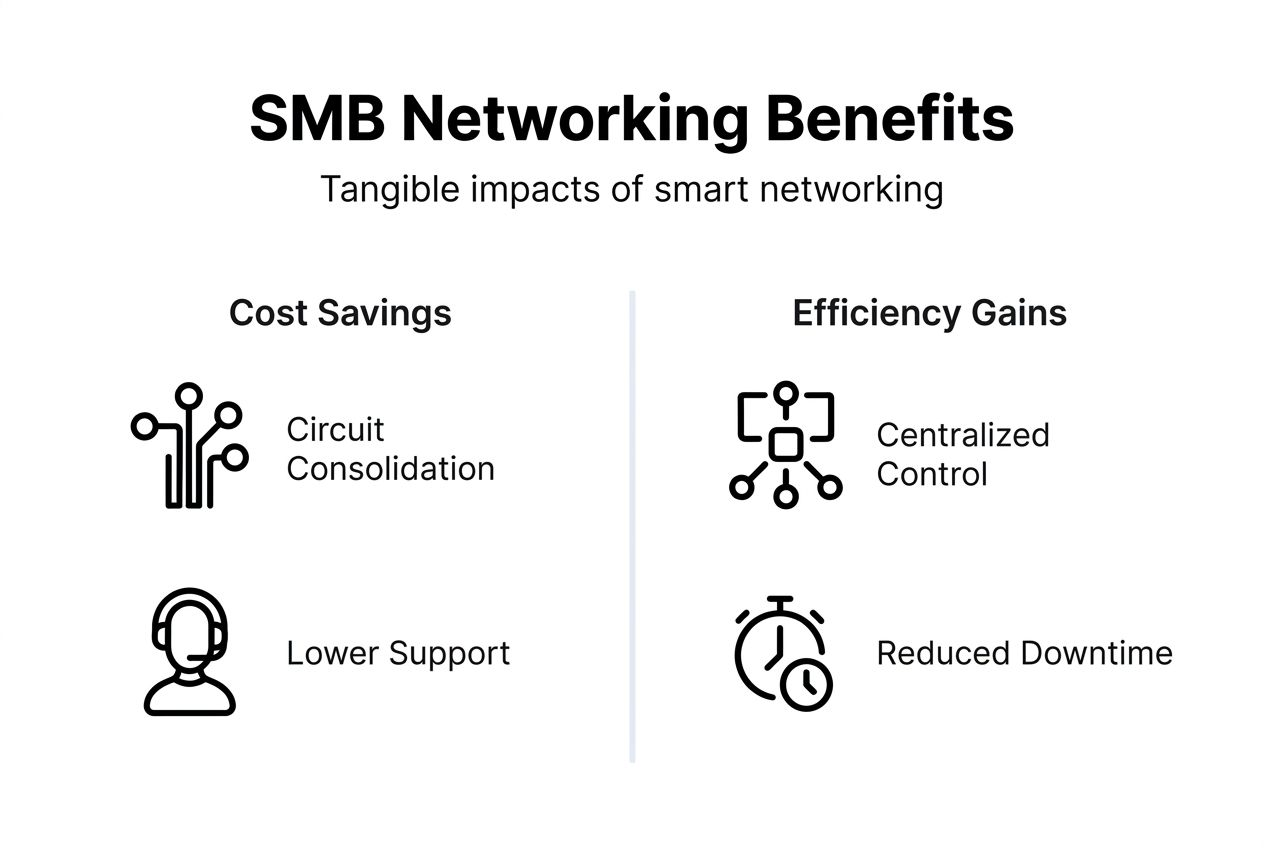
Operational efficiency gains compound over time. Centralized management means one administrator configures policies once instead of logging into dozens of devices individually. Automated monitoring detects issues before users complain, shifting IT from reactive to proactive mode. This efficiency lets small teams accomplish more without burning out from constant firefighting.
Enhanced security protects revenue and reputation. Data breaches cost SMBs an average of $200,000 in remediation, legal fees, and lost business. Smart networking with zero-trust principles and network security best practices prevents breaches that would otherwise devastate SMB finances. Compliance scores improve by 20% because continuous monitoring and automated logging provide audit trails that satisfy regulators.
Customer experience improvements drive revenue growth. 30% better customer analytics come from IoT sensors that track customer behavior, preferences, and pain points. A retail SMB used occupancy sensors to optimize staffing, reducing wait times and increasing sales by 15%. Application performance monitoring ensures your customer-facing systems respond quickly even during peak demand, preventing cart abandonment and frustrated buyers.
Remote monitoring cuts downtime by 40% because issues are detected and resolved before business impact occurs. When a circuit fails, SD-WAN fails over to backup connectivity in seconds instead of waiting for a technician to drive to the site. This resilience protects revenue that would be lost during extended outages.
Pro Tip: Calculate your current network cost per user per month including circuits, hardware, support labor, and downtime costs. This baseline lets you compare smart networking proposals accurately and identify the break-even point where monthly savings exceed new solution costs.
The performance impacts extend beyond IT into business operations. Sales teams close deals faster with reliable connectivity to CRM and communication tools. Finance processes payments without network delays. Operations coordinates efficiently across multiple locations through real-time data sharing. These improvements accumulate into competitive advantages that differentiate your SMB from rivals still struggling with legacy networks.
For Mid-Atlantic SMBs specifically, business broadband improvements enable smart networking success. The region’s expanding fiber and wireless infrastructure provides the diverse connectivity options that SD-WAN leverages effectively. Combining local broadband with cellular backup through smart networking delivers reliability that matches or exceeds expensive legacy MPLS circuits.
Implementation considerations for SMBs
Successful smart networking deployment requires methodical planning and phased execution matched to SMB realities.
-
Assess your current infrastructure thoroughly. Document every circuit, device, application, and user need. Identify pain points like frequent outages, slow performance, or security gaps that smart networking must address specifically.
-
Start with SD-WAN for centralized control. Deploy at headquarters first to gain experience and demonstrate value before expanding to branch sites. This foundation provides immediate benefits while preparing your team for subsequent phases.
-
Integrate IoT devices strategically. Focus on high-impact use cases like security cameras, environmental sensors, or asset tracking that deliver clear ROI. Avoid IoT sprawl by standardizing on platforms that scale efficiently.
-
Leverage cloud services for scalability. Migrate applications to SaaS and cloud infrastructure incrementally to reduce on-premises complexity and enable remote work. Smart networking optimizes cloud application performance through direct internet breakout instead of backhauling traffic through headquarters.
-
Adopt zero-trust security from day one. Implement multi-factor authentication, device posture checks, and least-privilege access policies as foundational elements. Retrofitting security later is exponentially harder than building it in from the start.
-
Roll out incrementally to manage risk and budget. Incremental deployment lowers upfront costs by 40% while building internal expertise progressively. Prove ROI at one site before expanding widely.
Vendor selection deserves careful attention. Prioritize partners with SMB experience who offer bundled solutions instead of piecemeal components. Local presence matters because Mid-Atlantic SMBs achieved 40% downtime reduction by working with regional providers who understand local connectivity challenges and respond quickly to issues.
Pro Tip: Build a phased deployment plan spanning 12 to 24 months. Phase one focuses on quick wins like SD-WAN at headquarters. Phase two expands to branch sites. Phase three adds IoT and advanced analytics. This approach spreads costs, builds momentum, and adapts based on lessons learned.
For rural and small-town SMBs, connectivity challenges require special attention. Rural connectivity strategies and SD-WAN advantages for small towns highlight how smart networking overcomes limited infrastructure through multi-connection diversity and optimization. Combining fiber, fixed wireless, and cellular intelligently through SD-WAN delivers reliability that no single connection type achieves alone.
Training your team is critical. Smart networking shifts workflows from device-focused to policy-focused management. Invest in training that covers the platform’s dashboards, policy creation, troubleshooting workflows, and security monitoring. This upfront investment prevents frustration and accelerates time to value.
Enhance your SMB network with Sabertooth Pro solutions
Ready to modernize your network infrastructure with proven smart networking technologies?

Sabertooth Pro delivers comprehensive IoT solutions and flexible data plans that power your smart networking deployment. As an experienced wireless internet provider serving the Mid-Atlantic region, we understand the unique connectivity challenges SMBs face and design solutions that deliver reliability, security, and scalability. Our team combines deep networking expertise with local market knowledge to build infrastructure that supports your growth without breaking your budget. Contact us today to assess your current network and develop a smart networking roadmap tailored to your business objectives.
FAQ
What is the difference between SD-WAN and traditional WAN?
SD-WAN uses software-defined controls for dynamic, application-aware routing across multiple connection types including broadband, fiber, and cellular. Traditional WAN relies on manual configuration of static routes through dedicated MPLS circuits, requiring technician intervention for changes. This fundamental difference gives SD-WAN superior agility, cost efficiency, and performance for modern SMBs supporting cloud applications and remote workers.
Can SMBs implement smart networking incrementally?
Absolutely. Many benefits emerge from incremental SD-WAN and IoT deployments without full network replacement. Start with SD-WAN at your primary location to gain centralized visibility and control immediately. Expand to additional sites progressively as budget allows and your team gains expertise. This phased approach reduces upfront investment by 40% while delivering quick wins that build stakeholder confidence and justify continued expansion.
How does smart networking improve security for SMBs?
Smart networking embeds zero-trust principles that continuously verify every access request based on user identity, device health, and context. This approach reduces breach risk by 50% compared to perimeter-focused security that assumes internal traffic is safe. Continuous monitoring, encrypted tunnels, and automated threat response contain incidents quickly. Smart networking also supports compliance by maintaining detailed audit logs that satisfy regulatory requirements and improve compliance scores by 20%.
What are key considerations when choosing smart networking vendors?
Focus on scalability to support growth without platform replacement, integrated security that embeds zero-trust from the start, and transparent cost structures that align with SMB budgets. Local vendor support matters enormously for rapid issue resolution and understanding regional connectivity challenges. Prioritize partners who offer bundled solutions instead of forcing you to integrate disparate components yourself. Request references from similar-sized SMBs in your industry to validate performance claims and support quality.
How quickly can SMBs see ROI from smart networking investments?
Most SMBs achieve payback within 12 to 18 months through reduced circuit costs, lower support labor, and avoided breach expenses. Quick wins like circuit consolidation and automated management deliver immediate savings that offset deployment costs. Long-term ROI compounds as operational efficiency gains, improved customer experience, and business agility enable revenue growth that far exceeds the initial investment. Document baseline costs carefully before deployment to measure and communicate ROI clearly to stakeholders.