


Why Rural Internet Matters: Complete Guide

Over 42 million american residents live without reliable broadband, creating a digital divide that shapes daily life in rural communities. Slow or limited internet access cuts off entire regions from economic growth, education, and essential services many take for granted. Understanding the roots of these connectivity gaps goes beyond technology alone and reveals the real impact on families and businesses. This guide brings clarity to the most pressing rural internet challenges and highlights solutions that can help close the gap.
Table of Contents
- Defining Rural Internet and Connectivity Challenges
- Types of Rural Internet Solutions Available
- Key Benefits for Communities and Businesses
- Barriers to Rural High-Speed Internet Access
- Comparing Rural and Urban Internet Experiences
Key Takeaways
| Point | Details |
|---|---|
| Rural Connectivity Challenges | Rural areas face unique challenges such as low population density and difficult terrain that hinder internet infrastructure deployment. |
| Economic Impact | Limited internet access restricts opportunities for remote work, education, and healthcare, deepening the digital divide in rural communities. |
| Innovative Solutions | Technological advancements like satellite and wireless networks are critical in bridging connectivity gaps for underserved regions. |
| Disparity with Urban Areas | Rural communities experience slower internet speeds and fewer service options compared to urban populations, affecting economic and educational outcomes. |
Defining Rural Internet and Connectivity Challenges
Rural internet represents more than just a technological service — it’s a critical lifeline connecting remote communities to economic opportunities, education, and essential services. Understanding the unique challenges of rural connectivity requires examining the complex landscape of infrastructure, geography, and technological limitations that impact these areas.
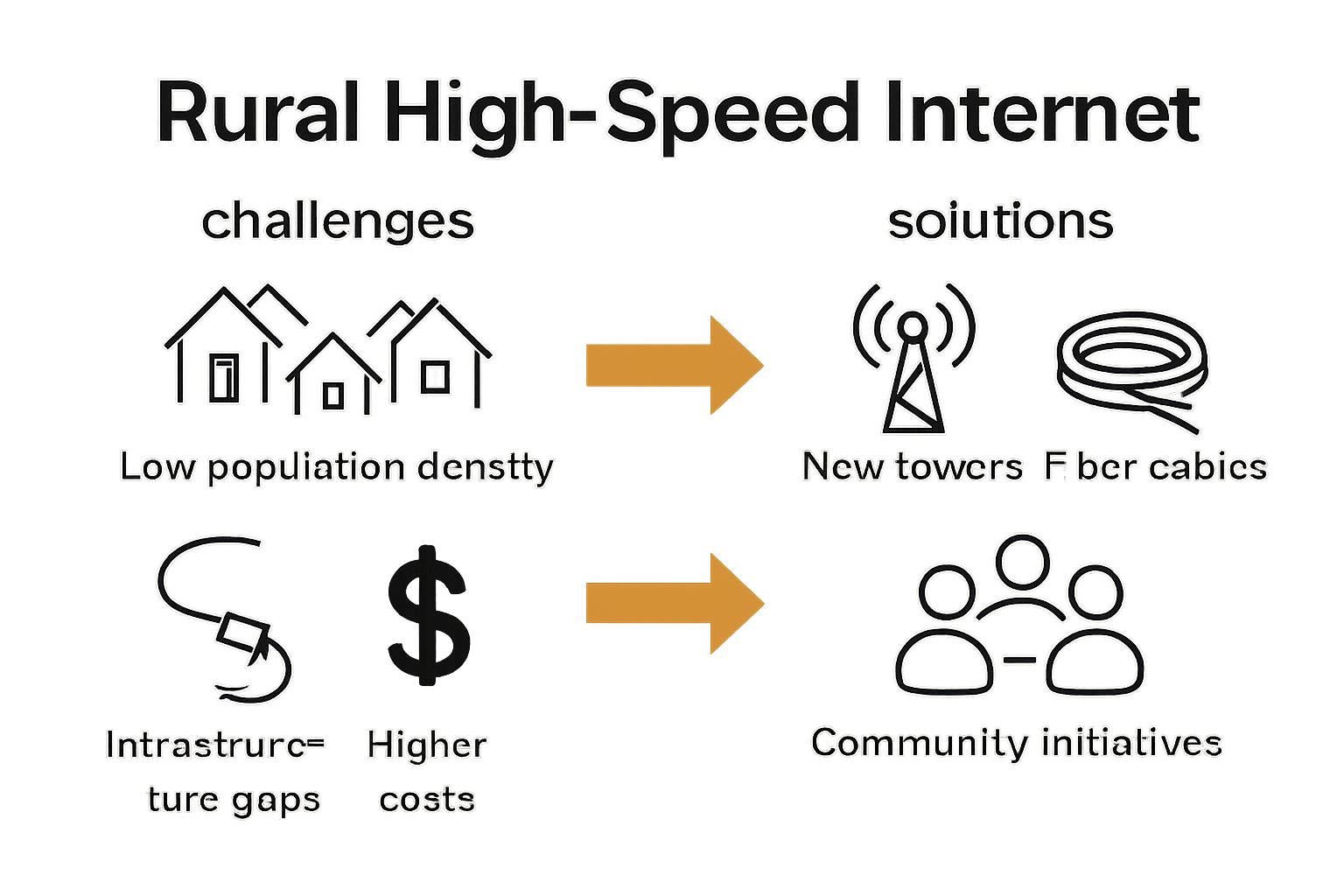
The fundamental challenge in rural internet delivery stems from infrastructure deployment complexities. Rural regions typically have low population densities spread across expansive geographical areas, making traditional internet infrastructure investments financially challenging for telecommunications providers. The Benton Institute for Broadband & Society highlights that these areas face significant internet access barriers due to several key factors:
- Low Population Density: Fewer potential customers per square mile reduce provider incentives
- Challenging Terrain: Mountainous, forested, or remote landscapes increase installation difficulties
- Limited Competition: Minimal market pressure prevents robust service development
Economic implications of these connectivity challenges are substantial. The US Department of Agriculture emphasizes that limited rural broadband access directly impacts community development, creating substantial digital divides that prevent rural residents from accessing:
- Remote work opportunities
- Online educational resources
- Telehealth services
- Digital government services
- E-commerce platforms
Addressing rural internet challenges requires comprehensive strategies that combine technological innovation, targeted infrastructure investments, and policy support to bridge existing connectivity gaps and empower rural communities with reliable, high-speed internet access.
Types of Rural Internet Solutions Available
Rural internet connectivity requires innovative solutions that address the unique challenges of remote and low-density geographical areas. Advanced technological approaches have emerged to bridge the digital divide, offering multiple methods for delivering internet access to communities traditionally underserved by conventional infrastructure.
The primary rural internet solutions can be categorized into several key technologies. Satellite internet remains a critical option for extremely remote locations, providing widespread coverage where terrestrial networks cannot economically reach. Researchers investigating rural connectivity technologies highlight several primary solution categories:
- Terrestrial Wireless Networks: Utilizing cellular and fixed wireless technologies
- Satellite Networks: Offering broad geographical coverage
- Fixed Broadband: Leveraging existing telephone and cable infrastructure
- Mobile Broadband: Using cellular data networks
- Hybrid Solutions: Combining multiple connectivity technologies
According to advanced research on rural connectivity, emerging technologies are increasingly integrating artificial intelligence and innovative network design to optimize internet delivery. These advanced networking strategies explore multiple transmission mediums, including:
- Ground-based terrestrial networks
- Non-terrestrial satellite systems
- Integrated air and space communication platforms
- Adaptive network routing technologies
- Energy-efficient transmission methods
The ultimate goal of these rural internet solutions is to provide reliable, high-speed connectivity that enables economic development, educational opportunities, and improved quality of life for residents in underserved areas.
Key Benefits for Communities and Businesses
Rural internet connectivity represents far more than a technological upgrade — it’s a transformative economic and social catalyst that fundamentally reshapes opportunities for communities and businesses. Economic research demonstrates that robust internet infrastructure delivers profound, measurable impacts across multiple dimensions of rural life.
For businesses, high-speed rural internet enables unprecedented operational capabilities. Small enterprises can now compete on a global scale, accessing cloud-based services, conducting seamless remote communications, and leveraging digital marketing platforms that were previously inaccessible. The connectivity revolution allows rural businesses to:
- Expand Market Reach: Connect with customers beyond local geographic boundaries
- Reduce Operational Costs: Utilize cloud computing and remote collaboration tools
- Attract Remote Talent: Offer flexible working arrangements
- Implement Advanced Technologies: Integrate IoT and digital management systems
- Streamline Supply Chain Management: Use real-time tracking and communication platforms
Community benefits extend far beyond economic metrics. Improved internet access transforms critical social infrastructure by enabling:
- Enhanced educational opportunities through online learning platforms
- Improved telehealth services for remote medical consultations
- Better access to government services and digital administrative tools
- Increased civic engagement through digital communication channels
- More efficient emergency response and communication systems
Research conclusively demonstrates that broadband expansion directly correlates with increased employment rates and household incomes, highlighting internet connectivity as a fundamental driver of rural economic resilience and social development.

Barriers to Rural High-Speed Internet Access
Rural communities face significant challenges in accessing high-speed internet, with infrastructure limitations creating substantial connectivity obstacles. The digital divide is not merely a technological issue but a complex economic and geographical problem that impacts millions of Americans.
According to U.S. government research, approximately 42 million Americans lack reliable broadband access, primarily concentrated in rural regions. The primary barriers to high-speed internet deployment include:
- Geographic Complexity: Mountainous, forested, and sparsely populated landscapes
- Economic Disincentives: Low population density reduces telecommunication provider investments
- Infrastructure Costs: Expensive network installation and maintenance
- Technological Limitations: Challenging terrain disrupts signal transmission
- Regulatory Hurdles: Complex permitting and zoning requirements
Educational institutions are particularly impacted by these connectivity challenges. Rural school districts struggle to provide consistent remote learning opportunities due to limited internet infrastructure. The consequences extend beyond education, affecting:
- Economic development opportunities
- Healthcare access
- Professional training and workforce development
- Community engagement
- Digital skills acquisition
Addressing these barriers requires comprehensive strategies that combine technological innovation, targeted infrastructure investments, and policy support to bridge the digital divide and create equitable access to high-speed internet for rural communities.
Comparing Rural and Urban Internet Experiences
The digital landscape presents dramatically different internet experiences for rural and urban populations, with significant disparities in connectivity, speed, and access. Rural internet challenges fundamentally reshape how residents interact with digital technologies and online resources.
Research from the Benton Institute reveals stark differences in online engagement between rural and urban communities. Rural residents are substantially less likely to have home broadband and go online with the same frequency as their urban counterparts. These connectivity gaps manifest in multiple critical domains:
- Internet Speed: Urban areas consistently offer faster, more reliable connections
- Accessibility: Urban residents have multiple internet service provider options
- Cost: Rural internet services often come at premium prices
- Technology Adoption: Slower technological integration in rural regions
- Infrastructure Support: More robust digital infrastructure in urban environments
The educational implications are particularly profound. Michigan State University research demonstrates that limited internet access directly correlates with academic performance, with rural students experiencing lower standardized test scores and reduced educational opportunities compared to urban students. These disparities extend beyond academics:
- Reduced economic opportunities
- Limited professional development options
- Decreased access to telehealth services
- Restricted digital skill development
- Diminished social connectivity
Addressing these inequities requires comprehensive strategies that recognize the unique challenges faced by rural communities and develop targeted solutions to bridge the digital divide.
Unlock Reliable Rural Internet with SabertoothPro
The challenge of limited internet infrastructure in rural areas affects your everyday access to education, telehealth, and remote work. You need dependable solutions designed to overcome geographic and economic barriers and bridge the digital divide. At SabertoothPro, we specialize in providing advanced connectivity options tailored to rural communities, including 4G LTE and 5G hotspots, powerful routers, and innovative wireless technology.
Explore our Titan WiFi collection for devices that enhance signal strength and bring you closer to the speed and reliability you deserve.

Start transforming your rural internet experience today by visiting SabertoothPro.com. Discover how our cutting-edge solutions and expert support can help you unlock new opportunities, improve your quality of life, and stay connected with less frustration. Act now to secure the connectivity that powers your future.
Frequently Asked Questions
What are the main challenges of rural internet connectivity?
Rural internet connectivity faces several challenges, including low population density that decreases economic incentives for providers, challenging terrain that complicates infrastructure deployment, and limited competition that reduces service options.
What types of technology are used to provide rural internet access?
Rural internet solutions mainly include terrestrial wireless networks, satellite networks, fixed broadband options, mobile broadband, and hybrid solutions that combine multiple technologies to enhance connectivity.
How does rural internet connectivity impact education and healthcare?
Improved rural internet access enables better educational opportunities through online learning platforms and enhances telehealth services, providing essential medical consultations to remote areas, thereby supporting overall community well-being.
Why is broadband expansion important for rural communities?
Broadband expansion is crucial for rural communities as it directly correlates with increased employment rates, household incomes, and overall economic resilience, enabling residents to access vital services, job opportunities, and digital resources.