


Cloud networking for SMBs: connectivity and security in 2026

Small and medium-sized businesses adopting Secure Access Service Edge (SASE) architectures see a 70% drop in security incidents, yet many SMBs still hesitate to move beyond traditional networks. Cloud networking transforms how your business connects offices, remote workers, and critical applications while strengthening security and reducing costs. This guide shows Mid-Atlantic SMB decision-makers how to leverage cloud networking effectively without falling into common traps.
Table of Contents
- Understanding Cloud Networking: Definition And Core Mechanisms
- Security In Cloud Networking: Enhancing SMB Protection
- Cost Implications And Savings From Cloud Networking Adoption
- Comparing Cloud Networking Models For SMBs
- Common Misconceptions About Cloud Networking
- Practical Steps For Cloud Networking Implementation In SMBs
- Leveraging Cloud Networking For SMB Growth And Security
- Find The Right Cloud Networking Solution With Sabertooth Pro
Key takeaways
| Point | Details |
|---|---|
| Cloud networking delivers measurable security gains | SASE implementations reduce security incidents by 70% for SMBs through unified threat monitoring. |
| Cost savings require careful planning | SMBs cut WAN costs by 15-25% with SD-WAN, but hidden operational expenses can erode savings. |
| Model selection depends on your infrastructure | Hybrid cloud networking balances control and scalability for most Mid-Atlantic SMBs. |
| Misconceptions lead to poor outcomes | Misconfigured SD-WAN can increase latency by 25%, making professional design essential. |
Understanding cloud networking: definition and core mechanisms
Cloud networking applies software-defined networking (SDN) principles to manage network resources dynamically across cloud and on-premises environments. Unlike traditional hardware-centric networks, cloud networking uses centralized software controllers to route traffic intelligently based on real-time conditions.
SD-WAN represents the most common cloud networking technology for SMBs. It connects distributed locations using internet circuits instead of expensive dedicated lines. When one connection fails, SD-WAN automatically reroutes traffic through alternative paths, ensuring business continuity.
Dynamic traffic routing delivers three core benefits:
- Improved uptime through automatic failover between multiple internet connections
- Enhanced performance by selecting optimal paths based on application requirements
- Cost reduction by leveraging cheaper broadband instead of MPLS circuits
Hybrid infrastructure combining on-premises equipment with cloud resources gives SMBs flexibility. Your critical databases might stay local while collaboration tools run in the cloud, with cloud networking managing seamless connectivity between both.
Growth trends show increasing SMB adoption of cloud networking technologies such as SD-WAN across the Mid-Atlantic region. SMBs recognize that traditional networks cannot support modern distributed workforces or cloud-first application strategies. Connectivity challenges in rural Mid-Atlantic areas make business-grade internet insights particularly valuable for planning reliable deployments.
Pro Tip: Start with a network assessment identifying current bottlenecks and single points of failure before selecting cloud networking solutions. This baseline helps measure improvements accurately.
Security in cloud networking: enhancing SMB protection
SASE combines networking and security into a single cloud-delivered service. Rather than routing traffic through physical firewalls at headquarters, SASE applies security policies wherever users connect, whether at branch offices, home, or coffee shops.
Cloud networking enables continuous monitoring impossible with traditional architectures. Security information flows to centralized dashboards in real time, letting your IT team spot anomalies before they escalate into breaches. Automated response systems can isolate compromised devices within seconds.
Common SMB security challenges addressed by cloud networking include:
- Inconsistent security across locations when branches manage their own firewalls
- Blind spots where remote workers bypass corporate protections
- Slow incident response due to manual processes and fragmented tools
- Difficulty enforcing policies across cloud applications and on-premises systems
SMBs adopting SASE architectures report a 70% drop in security incidents because unified frameworks eliminate gaps between network and security teams. When everything operates from one control plane, misconfigurations and policy conflicts decrease dramatically.
Cloud-based SD-WAN security benefits extend beyond threat prevention. Encrypted tunnels protect data in transit across public internet connections. Zero-trust principles verify every access request regardless of source location. These layers work together to create defense in depth.

Pro Tip: Update cloud security policies quarterly to address emerging threats and adjust rules based on actual traffic patterns, not just vendor defaults.
Cost implications and savings from cloud networking adoption
SMBs reduce WAN costs by 15-25% on average when migrating to cloud networking from MPLS circuits. This savings comes primarily from replacing expensive dedicated lines with commodity broadband connections that deliver comparable or better performance.
MPLS monthly costs typically run $300 to $800 per location for modest bandwidth. SD-WAN using business fiber or fixed wireless often costs $100 to $250 monthly while providing higher speeds. Over a three-year period, a five-location SMB saves $36,000 to $99,000 on connectivity alone.
Common budgeting mistakes erode these savings:
- Ignoring integration costs with existing security tools and applications
- Underestimating staff training requirements for new management interfaces
- Overlooking subscription fees for cloud controllers and security services
- Forgetting to account for redundant internet circuits needed for failover
Long-term ROI depends on matching the solution to your operational model. SMBs with stable locations see faster payback than those frequently opening or closing offices. Organizations already using cloud applications gain more value than those running mostly on-premises systems.
Pro Tip: Include full lifecycle costs spanning equipment replacement cycles, vendor support fees, and bandwidth growth when calculating cloud networking cost savings. Three-year total cost of ownership provides clearer comparison than just monthly recurring charges.
Comparing cloud networking models for SMBs
Four primary models serve SMB needs, each with distinct tradeoffs:
| Model | Core Features | Best For | Typical Cost |
|---|---|---|---|
| SD-WAN | Intelligent routing, multiple transports | Multi-location SMBs needing reliable connectivity | $150-400/location/month |
| SASE | Integrated networking and security | Remote-heavy workforces requiring consistent protection | $200-500/location/month |
| MPLS | Dedicated circuits, guaranteed performance | Legacy applications requiring predictable latency | $400-900/location/month |
| Hybrid | Combines MPLS for critical apps with SD-WAN for general traffic | SMBs transitioning gradually from traditional networks | $250-650/location/month |
SD-WAN excels at connecting branch offices cost-effectively. It cannot inherently provide security, so you must add firewalls or security services. Deployment complexity stays moderate because existing equipment often remains in place.
SASE delivers comprehensive protection but requires shifting security functions to the cloud provider. SMBs comfortable with cloud services adopt SASE faster than those preferring on-premises control. Performance depends heavily on provider edge locations.
MPLS still makes sense for specific workloads like voice systems or real-time applications that cannot tolerate packet loss. However, MPLS costs limit scalability as bandwidth needs grow.
Hybrid cloud networking is preferred by most SMBs due to balanced control and scalability. You keep MPLS for mission-critical connections while using SD-WAN for general internet traffic. This approach lets you test cloud networking without betting everything on a single model.
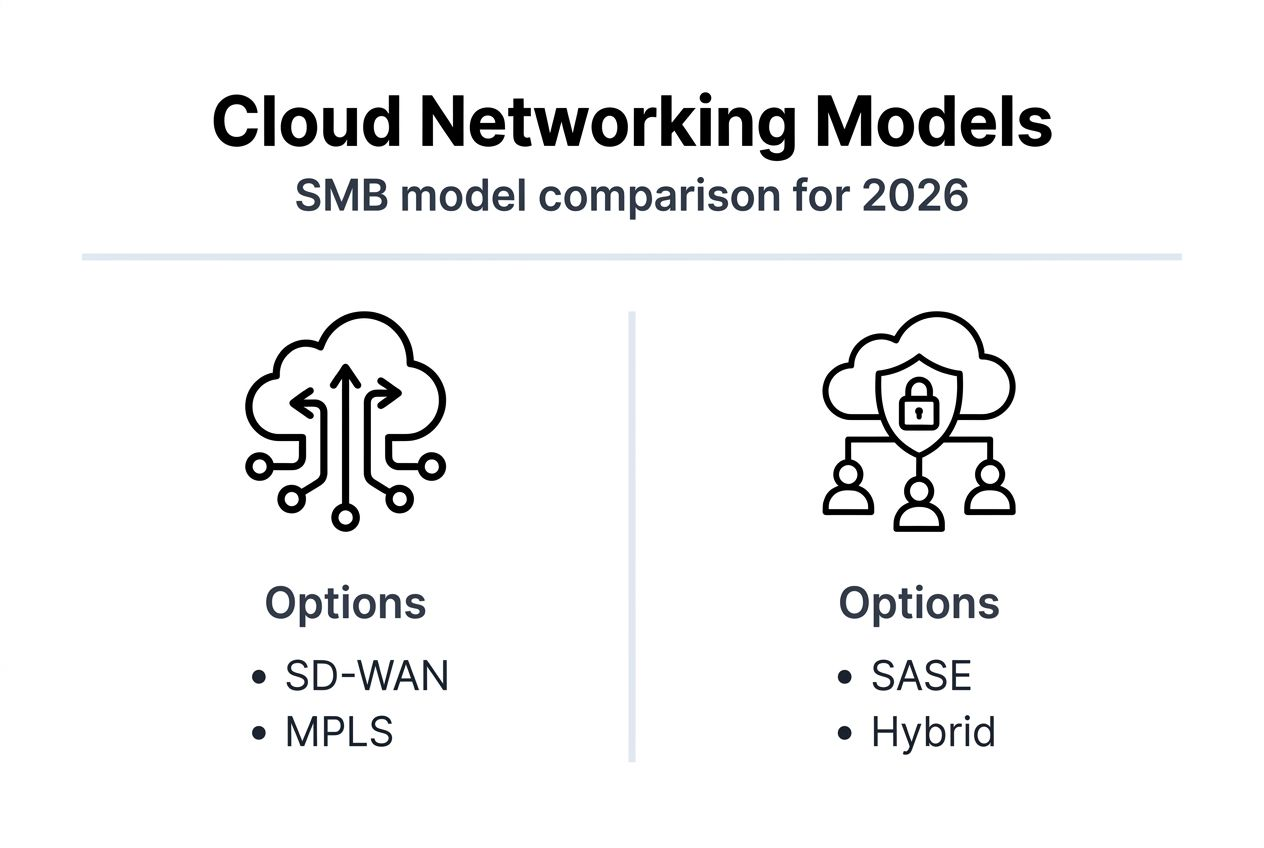
Adoption rates across Mid-Atlantic SMBs show SASE gaining momentum in 2026. Cloud networking model comparison data reveals that organizations with distributed workforces prioritize SASE, while manufacturing and retail SMBs often choose hybrid designs to support point-of-sale and inventory systems.
Common misconceptions about cloud networking
Myth one: cloud networking always reduces latency compared to traditional networks. Reality shows that poorly designed SD-WAN can increase latency significantly. Latency can increase by up to 25% if cloud networking solutions like SD-WAN are misconfigured compared to MPLS. Application-aware routing requires careful tuning to prioritize time-sensitive traffic properly.
Myth two: cloud networking eliminates all security risks automatically. While SASE and SD-WAN improve security posture, they introduce new management responsibilities. You must maintain current policies, monitor for anomalies, and respond to alerts. Cloud providers secure their infrastructure, but securing your data and access controls remains your job.
Myth three: cloud networking always lowers costs with no hidden expenses. Initial savings look impressive until you factor in:
- Ongoing subscription fees that escalate with user growth
- Professional services for design and deployment
- Additional internet circuits for redundancy
- Integration work connecting cloud networking to existing tools
“Professional design prevents the 25% latency penalty that misconfigured SD-WAN imposes, making vendor selection and implementation expertise critical investment areas for SMBs.”
SMBs approaching cloud networking misconceptions with realistic expectations avoid disappointment. Cloud networking delivers genuine value, but success requires planning, investment, and active management rather than set-it-and-forget-it deployment.
Practical steps for cloud networking implementation in SMBs
Successful implementation follows a structured approach:
- Assess your current infrastructure, documenting all locations, applications, bandwidth usage, and security requirements
- Evaluate models based on your specific needs rather than industry hype or vendor marketing
- Select vendors offering consolidated stacks to minimize integration complexity and finger-pointing between providers
- Phase deployment starting with non-critical locations to validate design before rolling out enterprise-wide
- Monitor performance continuously using built-in analytics and adjust policies based on real traffic patterns
Compatibility with legacy systems determines whether you can pursue aggressive migration or need gradual transition. Manufacturing equipment, security cameras, and older phone systems often require special handling. Hybrid designs accommodate these constraints while modernizing the rest of your network.
Vendor selection criteria should prioritize:
- Transparent pricing with clear explanations of subscription tiers and overage charges
- Proven integration with your existing security tools and cloud applications
- Local support availability for Mid-Atlantic time zones and on-site assistance if needed
- Migration assistance including design services and deployment support
Vendor consolidation and hybrid designs reduce complexity and improve cloud networking success in SMBs. Working with fewer vendors streamlines support and often yields better pricing through bundled services.
Pro Tip: Enable secure remote access from day one to support flexible work arrangements and give employees consistent network experience regardless of location. This capability prevents shadow IT where frustrated workers adopt unauthorized tools to bypass network restrictions.
Leveraging cloud networking for SMB growth and security
Cloud networking empowers SMB competitiveness through enhanced connectivity, robust security, and better cost control. The evidence shows measurable benefits when you choose appropriate models and avoid common pitfalls. SASE architectures deliver 70% fewer security incidents while SD-WAN cuts WAN costs by up to 25%.
Informed decision-making matters more than jumping on trends. Assess your actual requirements, understand tradeoffs between models, and select vendors based on capabilities rather than marketing promises. Hybrid approaches often provide the best balance for Mid-Atlantic SMBs managing both legacy systems and modern cloud applications.
View cloud networking as foundational for your IT strategy moving into 2026 and beyond. Remote work, cloud applications, and security threats continue evolving. Cloud networking gives you the flexibility to adapt quickly while maintaining reliable connectivity and protection across all locations and users.
Find the right cloud networking solution with Sabertooth Pro
Sabertooth Pro specializes in helping Mid-Atlantic SMBs deploy cloud networking solutions that match your specific infrastructure and budget. Our team brings deep expertise in SD-WAN, SASE, and hybrid designs tailored for businesses facing regional connectivity challenges.

We offer comprehensive solutions addressing connectivity, security, and IoT requirements through our wireless internet solutions and IoT connectivity solutions. Whether you need reliable failover for retail locations or secure remote access for distributed teams, our comprehensive IT and IoT solutions deliver the performance and protection your business demands. Contact us for a customized consultation that identifies the optimal cloud networking approach for your organization.
Frequently asked questions
What are the main benefits of cloud networking for SMBs?
Cloud networking offers scalability, improved security, cost savings, and enhanced network reliability for SMBs. It supports flexible remote access and optimizes traffic dynamically based on application requirements and real-time conditions.
How does cloud networking improve security for SMBs?
By integrating networking and security in architectures like SASE, cloud networking offers unified policy enforcement, continuous monitoring, and faster threat response for SMBs. Automation reduces incident response times from hours to seconds while shrinking the overall attack surface.
What should SMBs consider when choosing a cloud networking model?
Consider your existing infrastructure, budget, security needs, and vendor support capabilities when evaluating models. Hybrid and SASE architectures often offer balanced benefits for SMBs managing both legacy systems and modern cloud applications.
Can cloud networking reduce network latency for SMBs?
Latency can improve or worsen depending on design and routing configuration. Misconfigured SD-WAN can increase latency by up to 25% compared to MPLS. Professional design and ongoing monitoring prove essential for maintaining optimal performance.
What are common challenges SMBs face when implementing cloud networking?
Underestimating ongoing operational costs and ignoring integration challenges with existing tools rank as top issues. Neglecting security updates and routing optimization also creates problems. Planning phased deployment and selecting experienced vendors mitigate these implementation risks.