
Managed connectivity: reliable enterprise networks in 2026

Network outages cost mid-sized enterprises an average of $5,600 per minute, yet 73% still rely on fragmented connectivity solutions without expert oversight. Managed connectivity transforms this landscape by outsourcing network management to specialized providers who deliver proactive monitoring, guaranteed uptime, and rapid incident response. For IT leaders juggling security threats, scaling demands, and limited internal resources, managed solutions offer a strategic path to reliability. This guide explores what managed connectivity delivers, the challenges it solves, and how to evaluate providers to match your specific operational needs.
Table of Contents
- Key takeaways
- What is managed connectivity and why does it matter?
- Common connectivity challenges managed solutions address
- Comparing managed, self-managed, and hybrid connectivity models
- How to evaluate managed connectivity providers and SLAs effectively
- Explore managed connectivity solutions with Sabertooth
- Frequently asked questions
Key Takeaways
| Point | Details |
|---|---|
| Reliability via managed connectivity | Managed services provide proactive monitoring, guaranteed uptime, and rapid incident response that reduce outages and free IT staff for strategic work. |
| Cost and complexity tradeoffs | While it reduces risk and outages, managed connectivity can have higher ongoing costs that must be weighed against internal resource savings. |
| Self managed risks | Self managed networks expose gaps in security, expertise, and scalable support that are costly to maintain. |
| Hybrid co managed balance | A blended model provides vendor support while preserving internal control for mid sized businesses. |
| SLA and real world tests | Evaluating SLAs against real world network conditions helps choose the right solution. |
What is managed connectivity and why does it matter?
Managed connectivity means outsourcing your network infrastructure to specialized providers who handle monitoring, maintenance, and optimization under defined service level agreements. Instead of your team troubleshooting router failures at 2 AM, experts manage everything from circuit provisioning to security patches. These providers deliver continuous oversight, proactive threat detection, and guaranteed response times that most internal teams cannot match.
Typical managed connectivity features include real-time network monitoring, automated failover systems, 24/7 incident response, bandwidth optimization, and security compliance management. Providers track performance metrics constantly, identifying issues before they impact operations. When problems arise, dedicated engineers respond within minutes rather than hours, minimizing business disruption.
For mid-sized enterprises, this approach directly addresses resource constraints. Your IT staff focuses on strategic initiatives like digital transformation instead of firefighting connectivity issues. Benchmarking SLAs against empirical data shows the importance of context-aware managed connectivity that adapts to your specific environment rather than generic promises.
Core benefits include:
- Round-the-clock expertise without hiring specialized staff
- Compliance support for industry regulations like HIPAA or PCI DSS
- Scalability that grows with business needs without infrastructure overhauls
- Predictable costs replacing unpredictable emergency spending
- Enhanced security posture through continuous monitoring and updates
Managed providers also handle vendor relationships, negotiate better rates through volume purchasing, and maintain relationships with carrier partners that accelerate problem resolution. This ecosystem approach delivers value beyond simple connectivity, creating a foundation for reliable business-grade internet that supports modern operations. As enterprise connectivity trends evolve toward cloud-first architectures, managed solutions provide the stability required for distributed workforces and multi-site operations.
Common connectivity challenges managed solutions address
Network disconnections stem from complex technical failures that self-managed teams often struggle to diagnose quickly. Cellular networks experience poor SINR, roaming policy triggers, hardware failures, and intermittent connectivity requiring sophisticated recovery mechanisms like watchdog timers and automated reboots. When a remote site loses connection, determining whether the issue involves the carrier, router firmware, or local interference demands specialized knowledge most IT generalists lack.

Managed providers implement multi-layer recovery logic that maintains uptime even during component failures. If a primary circuit drops, automatic failover switches to backup connections within seconds. Providers monitor signal quality metrics continuously, detecting degradation patterns before complete outages occur. This proactive stance prevents the reactive scrambling that characterizes self-managed environments.
Edge deployments introduce additional unpredictability. Retail locations, logistics hubs, and remote facilities operate in environments with variable power quality, temperature extremes, and physical security risks. Managed connectivity addresses these through:
- Remote device management with automatic configuration updates
- Environmental monitoring that triggers alerts before hardware damage
- Redundant connectivity paths using diverse carrier networks
- Security protocols preventing unauthorized access to network equipment
Security vulnerabilities multiply when networks lack consistent oversight. Unpatched routers, misconfigured firewalls, and weak access controls create entry points for attacks. Managed providers enforce security baselines, apply patches systematically, and conduct regular vulnerability assessments. They maintain current threat intelligence, updating defenses against emerging attack vectors faster than internal teams can track.
“Organizations without 24/7 networking depth face exponentially higher risk during off-hours incidents when response delays compound damage.”
Data loss during connectivity interruptions represents another critical challenge. Applications expecting persistent connections may corrupt transactions or lose sync state when networks fail ungracefully. Managed solutions implement session persistence mechanisms and graceful degradation protocols that preserve data integrity even during disruptions.
The hidden cost of self-managed connectivity includes opportunity cost. Every hour your team spends troubleshooting network issues subtracts from strategic projects that drive business value. Understanding why secure connectivity matters helps frame this trade-off clearly.
Pro Tip: Before selecting a managed provider, request detailed documentation of their incident response procedures including mean time to detection, escalation paths, and recovery mechanisms. Verify they maintain redundant monitoring systems to ensure oversight continues even if their primary systems fail.
Comparing managed, self-managed, and hybrid connectivity models
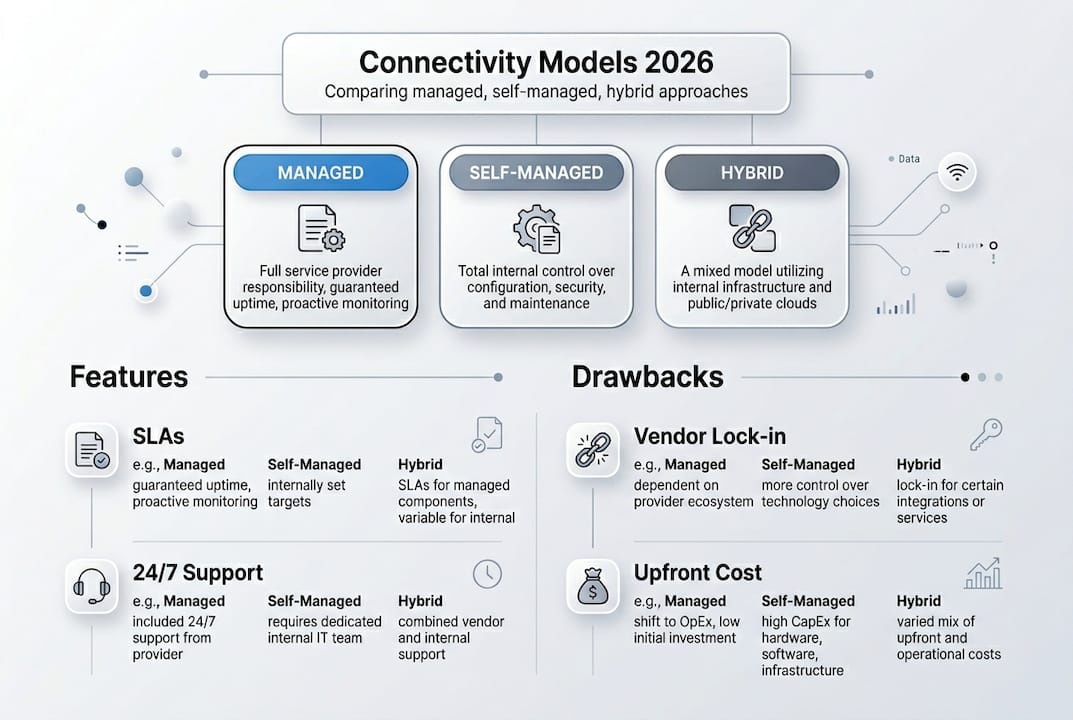
Choosing between connectivity management approaches requires understanding trade-offs across cost, control, and operational complexity. Each model suits different organizational profiles based on technical expertise, risk tolerance, and growth trajectory.
| Factor | Managed | Self-Managed | Hybrid/Co-Managed |
|---|---|---|---|
| Upfront Cost | Higher monthly fees | Lower initial spend | Moderate fees |
| Operational Cost | Predictable, bundled | Variable, hidden expenses | Balanced |
| Control | Limited customization | Full flexibility | Shared decision-making |
| Expertise Required | Minimal internal staff | Deep networking skills | Moderate skills |
| Scalability | Provider-driven expansion | Manual planning/execution | Collaborative scaling |
| Security Posture | Professional-grade | Depends on team capability | Enhanced baseline |
| SLA Guarantees | Contractual commitments | No external guarantees | Negotiated terms |
Managed connectivity offers SLAs and expertise but with vendor lock-in and higher upfront costs, while self-managed reduces raw costs but increases operational expenses and security risks. Hybrid models balance these extremes, making them particularly attractive for mid-sized enterprises.
Managed solutions excel when you lack 24/7 networking staff or face strict compliance requirements. Providers absorb the complexity of maintaining certifications, conducting audits, and implementing controls that satisfy regulators. You gain enterprise-grade capabilities without enterprise-scale IT departments. However, customization limitations may frustrate organizations with unique requirements or those wanting granular control over network policies.
Self-managed approaches work when you employ experienced network engineers who understand routing protocols, security frameworks, and carrier relationships. You control every configuration decision and optimize for specific use cases without vendor constraints. The challenge emerges during incidents requiring immediate expertise outside your team’s specialty areas or when staff turnover creates knowledge gaps.
Hybrid models split responsibilities strategically. Providers handle infrastructure management, monitoring, and first-line response while you retain policy control and application-layer decisions. This arrangement works well for multi-site connectivity where standardized management across locations delivers efficiency but local teams need flexibility for site-specific needs.
Key selection criteria include:
- Current team size and skill depth in networking and security
- Budget allocation between capital expenses and operational spending
- Compliance requirements and audit frequency
- Growth plans requiring rapid site additions or bandwidth scaling
- Risk tolerance for downtime and security incidents
Pro Tip: Calculate total cost of ownership including hidden self-managed expenses like emergency vendor calls, after-hours staff time, training costs, and productivity losses during outages. Many organizations discover managed solutions cost less than maintaining equivalent internal capabilities.
Vendor lock-in concerns deserve attention in managed contracts. Negotiate exit clauses defining data portability, configuration documentation, and transition assistance if you later switch providers. Ensure contracts avoid proprietary technologies that prevent migration to alternative solutions.
How to evaluate managed connectivity providers and SLAs effectively
Selecting the right managed connectivity provider requires systematic evaluation beyond marketing promises. Start by examining SLA metrics that directly impact business operations.
Critical SLA components to compare:
- Uptime guarantees expressed as percentages and translated to allowable downtime hours annually
- Latency commitments for real-time applications like VoIP or video conferencing
- Incident response timeframes from detection through resolution
- Financial penalties when providers miss SLA targets
- Maintenance window policies and advance notification requirements
- Escalation procedures for critical issues requiring immediate attention
Many providers advertise 99.9% uptime without clarifying exclusions. That percentage allows 8.76 hours of downtime yearly, but does the calculation exclude scheduled maintenance? Does it cover only the provider’s core network or include last-mile circuits where most failures occur? Benchmark SLAs with empirical data from real network tests rather than accepting claims at face value.
| SLA Metric | Strong Commitment | Weak Commitment | Red Flag |
|---|---|---|---|
| Network Uptime | 99.95%+ with credits | 99.9% no penalties | Below 99.9% |
| Incident Response | 15 min acknowledgment | 1 hour acknowledgment | No defined time |
| Mean Time to Repair | 4 hours maximum | 24 hours typical | No commitment |
| Latency | <50ms guaranteed | Best effort | Not measured |
| Packet Loss | <0.1% guaranteed | <1% typical | Not specified |
Security evaluation requires probing beyond generic compliance certifications. Request specifics about:
- Encryption standards for data in transit and management interfaces
- Access control mechanisms limiting who can modify your network configuration
- Vulnerability scanning frequency and patch management procedures
- Incident response protocols when security breaches occur
- Third-party audit results and penetration testing reports
- Data residency policies ensuring information stays in required jurisdictions
Ask how providers handle the reality that 99% of operational teams lack the 24/7 depth making managed support critical for maintaining reliability. Do they staff network operations centers around the clock with experienced engineers, or do they rely on overseas contractors with limited authority?
“The difference between mediocre and exceptional managed connectivity lies in provider responsiveness during the 3 AM crisis when your payment processing goes offline.”
Test provider claims through reference checks with current customers in similar industries. Ask about actual incident response experiences, not hypothetical scenarios. How quickly did the provider diagnose and resolve unexpected outages? Did they proactively communicate during problems or require customers to chase updates?
Contract terms deserve careful legal review. Watch for automatic renewal clauses, early termination penalties, and limitation of liability provisions that cap damages far below actual business impact. Negotiate service credits that meaningfully compensate for SLA violations rather than token gestures.
Evaluate provider financial stability and longevity. Startups may offer attractive pricing but lack staying power if funding dries up. Established providers bring proven operations but may deliver impersonal service. Balance these factors against your risk tolerance and relationship preferences.
Technical compatibility matters when integrating managed connectivity with existing infrastructure. Confirm the provider supports your required protocols, can interface with current monitoring tools, and accommodates future technology adoption like SD-WAN or SASE frameworks. Flexibility here prevents costly rework as your architecture evolves.
For organizations prioritizing reliable connectivity as a competitive advantage, provider selection represents a strategic decision warranting thorough due diligence. The right partner becomes an extension of your team, while the wrong choice creates ongoing friction and risk. Consider secure internet for enterprise requirements when evaluating how providers implement defense-in-depth approaches.
Explore managed connectivity solutions with Sabertooth
Applying these managed connectivity insights to your specific environment requires partners who understand mid-sized enterprise challenges. Sabertooth specializes in delivering managed wireless internet solutions tailored for organizations needing reliability without enterprise-scale IT departments. Our approach combines carrier-grade infrastructure with personalized support that treats your network as mission-critical.

Whether you need primary connectivity, failover protection, or IoT device management at scale, we design solutions matching your operational requirements and budget realities. Our wireless internet provider services deliver the uptime guarantees and expert oversight this guide describes, backed by transparent SLAs and responsive engineering teams. For distributed operations requiring device connectivity across multiple sites, explore our IoT solutions and flexible IoT data plans that scale with your deployment. We help you move from connectivity concerns to connectivity confidence, freeing your team to focus on strategic initiatives that drive business growth.
Frequently asked questions
What types of businesses benefit most from managed connectivity?
Mid-sized enterprises without dedicated 24/7 networking teams gain the most value from managed connectivity. Organizations in regulated industries like healthcare, finance, and retail particularly benefit from compliance support and security monitoring that managed providers deliver. Companies operating multiple locations or supporting remote workforces also see significant advantages through centralized management and consistent service quality across sites.
How does managed connectivity improve network security?
Managed providers implement continuous monitoring that detects threats in real time, responding faster than internal teams can typically react. They maintain current threat intelligence, apply security patches systematically, and conduct regular vulnerability assessments. Professional oversight reduces risks from misconfigurations and ensures compliance with industry security standards. Understanding why secure connectivity matters helps frame these security benefits in business terms.
Can mid-sized enterprises customize managed connectivity solutions?
Customization availability varies by provider and service model. Fully managed solutions may limit configuration flexibility to maintain standardized support processes, though most providers accommodate reasonable customization requests. Hybrid or co-managed approaches offer greater flexibility, letting you control specific aspects while the provider handles infrastructure management. Discuss customization needs during provider evaluation to ensure the multi-site connectivity solution matches your operational requirements without unnecessary constraints.
What questions should I ask during managed connectivity provider demos?
Focus on operational specifics rather than marketing claims. Ask how they handle actual incident scenarios, request examples of recent customer problems they resolved, and inquire about their escalation procedures. Question their monitoring tools, staff qualifications, and average tenure of engineering teams. Request customer references in your industry and ask about contract flexibility, exit processes, and how they handle service disputes. Probe their roadmap for adopting emerging technologies relevant to your future needs.
How long does transitioning to managed connectivity typically take?
Transition timelines range from two weeks for simple single-site deployments to three months for complex multi-site implementations. Factors affecting duration include circuit provisioning by carriers, equipment installation and configuration, data migration from existing systems, staff training on new management interfaces, and parallel operation periods validating functionality before cutover. Reputable providers create detailed transition plans with milestones, responsibilities, and contingency procedures minimizing business disruption during migration.
Recommended
Quote of the Day
Style is more than what we wear or how we decorate our spaces — it’s the freedom to choose what reflects who we are. Every design, every detail, is crafted with intention: to inspire joy, to add meaning, and to transform the everyday into something extraordinary. Because when comfort meets elegance, life itself feels more beautiful.
Brand Description
At our core, we believe that style should feel effortless yet meaningful. Each collection is carefully designed with attention to detail, blending modern aesthetics with everyday comfort. From timeless silhouettes to refined textures, our pieces are crafted to inspire confidence and elevate the way you live and dress. More than fashion, it’s a lifestyle made for you.