
SD-WAN's impact on network security: 35% faster throughput

Open-source SD-WAN implementations deliver 35% higher throughput compared to traditional WANs, yet many IT professionals remain uncertain whether these performance gains come at the cost of security. This confusion stems from SD-WAN’s dual nature: it’s fundamentally a connectivity optimization technology, not a comprehensive security platform. While SD-WAN does introduce security enhancements through encrypted tunnels and centralized policy management, it also creates new attack surfaces, particularly in the control plane. Understanding this balance is crucial for SMB decision-makers who need both performance improvements and robust protection. This article clarifies SD-WAN’s actual security role, examines documented vulnerabilities, and provides actionable guidance for deploying SD-WAN as part of a layered security strategy.
Table of Contents
- Key takeaways
- How SD-WAN improves performance and operational costs for SMBs
- Understanding SD-WAN’s security architecture and vulnerabilities
- Balancing SD-WAN security with broader enterprise approaches
- Practical steps for SMBs to enhance network security with SD-WAN
- Enhance your network security and connectivity with Sabertooth Pro
- FAQ
Key Takeaways
| Point | Details |
|---|---|
| Performance and cost gains | Open source and commercial SD WAN implementations can deliver higher throughput while lowering monthly connectivity costs by using commodity internet alongside or instead of MPLS. |
| Control plane risks | While SD WAN adds encrypted tunnels and centralized policy management, its control plane becomes a high value target that requires proactive hardening and monitoring. |
| Security is not standalone | SD WAN should be integrated into a broader defense strategy such as SASE and layered security controls rather than serving as a sole security remedy. |
| Vendor transparency matters | Choose vendors with transparent performance benchmarks or open source implementations with verifiable testing to enable independent validation during selection. |
How SD-WAN improves performance and operational costs for SMBs
SD-WAN separates network control functions from data forwarding, allowing intelligent traffic routing across multiple connection types simultaneously. Traditional WANs rely on fixed MPLS circuits with manual configuration, while SD-WAN dynamically selects optimal paths based on real-time conditions. This architectural shift delivers measurable performance improvements that directly impact application responsiveness and user productivity.
Empirical testing shows SD-WAN reduces packet loss by 50% compared to conventional WAN setups, a critical metric for voice and video applications. The performance advantage extends beyond raw speed to include consistent quality of service across diverse connection types. When comparing SD-WAN vs traditional WAN architectures, the difference becomes apparent in how traffic adapts to changing network conditions.
| Metric | Traditional WAN | SD-WAN | Improvement |
|---|---|---|---|
| Throughput | Baseline | 35% higher | +35% |
| Latency | Baseline | 40% lower | -40% |
| Packet Loss | Baseline | 50% lower | -50% |
| Operational Costs | Baseline | 20% lower | -20% |
The operational cost benefits stem from SD-WAN’s ability to leverage commodity internet connections alongside or instead of expensive MPLS circuits. SMBs can maintain application performance while reducing monthly connectivity expenses, reallocating budget toward security tools or infrastructure upgrades. Organizations questioning why use SD-WAN find compelling answers in these combined performance and cost metrics.
Key advantages for SMB deployments include:
- Simplified management through centralized configuration and monitoring dashboards
- Application-aware routing that prioritizes business-critical traffic automatically
- Rapid deployment of new branch locations without complex on-site configuration
- Improved cloud application performance through direct internet breakout
- Reduced dependency on specialized networking expertise for daily operations
These benefits make SD-WAN particularly valuable for resource-constrained IT teams managing distributed locations. The advantages of SD-WAN for small towns extend to any organization operating outside major metropolitan areas where MPLS availability and pricing create barriers.
Pro Tip: Choose SD-WAN vendors that publish transparent performance benchmarks or use open-source implementations with verifiable testing methodologies. Proprietary systems often make optimization claims that lack independent validation, making accurate comparison difficult during vendor selection.
Understanding SD-WAN’s security architecture and vulnerabilities
SD-WAN security relies on separating the control plane, which manages policies and routing decisions, from the data plane, which forwards actual traffic. The control plane operates as a centralized or distributed system that pushes configurations to edge devices, while the data plane executes those policies locally. This separation enables consistent security enforcement across all locations but also creates a high-value target for attackers.

The control plane vulnerability CVE-2026-20127 affecting Cisco SD-WAN demonstrates how compromising control functions allows attackers to manipulate routing, intercept traffic, or disable security policies across an entire network. This specific exploit leveraged insufficient authentication between control and data plane components, allowing unauthorized configuration changes. The vulnerability remained undetected for months in production environments, highlighting the challenge of securing complex distributed systems.
SD-WAN implementations typically include these security features:
- IPsec or proprietary encryption for data in transit between sites
- Centralized firewall policy management applied consistently across branches
- Application identification and access control based on user identity
- Segmentation capabilities to isolate traffic types or departments
- Integration points for third-party security services like threat detection
However, these built-in features address only a subset of security requirements. The control plane itself requires protection through network isolation, strong authentication, and regular patching. Many organizations focus on data plane security while leaving control functions exposed to internal network threats.
“The SD-WAN control plane represents the keys to your entire network kingdom. Compromise it once, and an attacker controls routing, policies, and visibility across every location simultaneously. Isolation and zero-trust principles must apply to control communications, not just user traffic.”
Implementing effective SD-WAN security requires specific practices:
- Isolate control plane communications on dedicated management networks separate from production traffic
- Implement certificate-based mutual authentication between all SD-WAN components
- Apply patches and firmware updates within 48 hours of vendor security advisories
- Monitor control plane logs for unauthorized configuration attempts or anomalous access patterns
- Conduct quarterly penetration testing focused specifically on SD-WAN management interfaces
- Restrict administrative access to SD-WAN controllers using multi-factor authentication and IP allowlists
These measures address the unique risks SD-WAN introduces while maintaining the performance and operational benefits. Organizations should review wireless security tips for IT managers and broader network security for enterprises to understand how SD-WAN fits within comprehensive security programs.
Pro Tip: In multi-vendor SD-WAN environments, establish a security vulnerability tracking system that monitors advisories from all vendors simultaneously. Different manufacturers release patches on varying schedules, and missing updates from a single vendor can expose your entire network through that component.
Balancing SD-WAN security with broader enterprise approaches
SD-WAN provides connectivity optimization and basic security functions, but it lacks the comprehensive threat prevention, detection, and response capabilities required for modern enterprise security. Treating SD-WAN as a complete security solution leaves organizations vulnerable to advanced threats that bypass network-layer controls. The technology works best when integrated with complementary security frameworks that address its limitations.
Secure Access Service Edge (SASE) represents the architectural approach that combines SD-WAN’s networking capabilities with cloud-delivered security services. This integration addresses SD-WAN’s security gaps by adding features like secure web gateways, cloud access security brokers, and zero-trust network access. Practitioners report that organizations initially deploying SD-WAN alone often face pressure from security teams to add these protective layers within 12 to 24 months.
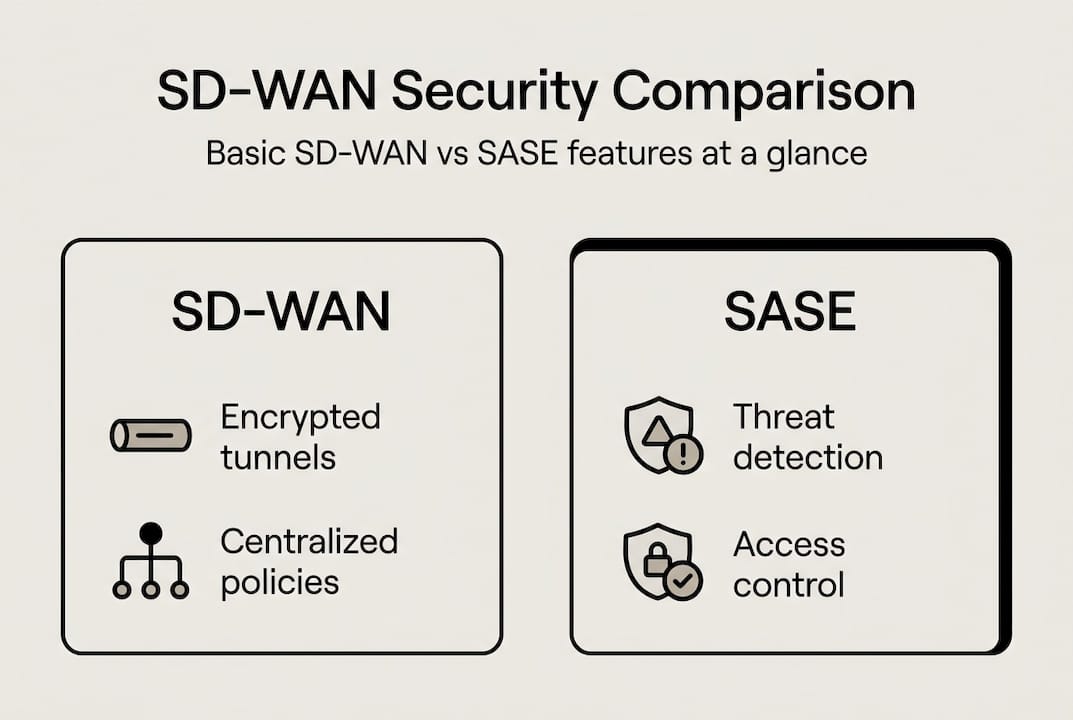
| Security Aspect | SD-WAN Alone | SD-WAN + SASE |
|---|---|---|
| Encrypted tunnels | Yes | Yes |
| Basic firewall rules | Yes | Yes |
| Advanced threat detection | No | Yes |
| Data loss prevention | No | Yes |
| Cloud application security | Limited | Comprehensive |
| Zero-trust access control | No | Yes |
| Unified policy management | Network only | Network + security |
Multi-vendor SD-WAN environments introduce additional complexity that impacts both performance and security. When branch locations use equipment from different manufacturers, troubleshooting becomes challenging because each vendor’s diagnostic tools and logging formats differ. Security teams struggle to correlate events across disparate systems, creating blind spots where attacks can progress undetected.
Common multi-vendor challenges include:
- Inconsistent security policy syntax requiring manual translation between platforms
- Incompatible encryption standards forcing fallback to lowest common denominator protocols
- Fragmented visibility requiring multiple management consoles and reporting systems
- Delayed patching cycles as each vendor releases updates independently
- Finger-pointing during incidents as vendors blame each other’s implementations
Artificial intelligence and machine learning technologies offer emerging solutions for SD-WAN security challenges. These systems analyze traffic patterns to detect anomalies indicating attacks, automatically adjust policies in response to threats, and predict potential failures before they impact operations. AI integration improves threat detection by identifying subtle indicators that rule-based systems miss, particularly for zero-day exploits and insider threats.
Best practices for layered SD-WAN security include:
- Deploy next-generation firewalls at internet breakout points to inspect traffic leaving the SD-WAN overlay
- Implement endpoint detection and response on devices accessing SD-WAN resources
- Use network access control to verify device posture before allowing SD-WAN connectivity
- Enable logging and SIEM integration to correlate SD-WAN events with broader security telemetry
- Conduct regular security assessments that specifically test SD-WAN components and configurations
Organizations exploring cloud-based SD-WAN solutions should evaluate how security services integrate with networking functions. The goal is secure internet for enterprise operations that balances performance, cost, and protection without forcing tradeoffs between these priorities.
Practical steps for SMBs to enhance network security with SD-WAN
SMBs implementing SD-WAN should adopt hybrid architectures that combine multiple connection types for resilience and security. Hybrid MPLS and internet deployments provide redundant paths that maintain connectivity during attacks or outages affecting a single circuit. This approach also enables security policies that route sensitive traffic through trusted MPLS connections while using internet circuits for general web access.
Vendor-agnostic security audits identify vulnerabilities that manufacturers may not disclose or prioritize in their own assessments. Independent security firms test SD-WAN implementations without the bias of protecting a specific product’s reputation. These audits should occur before initial deployment, after major configuration changes, and at least annually for ongoing environments.
Actionable implementation steps for SMB IT teams:
- Conduct a comprehensive network assessment documenting current traffic patterns, application requirements, and security policies before selecting SD-WAN vendors
- Require vendors to demonstrate specific security features during proof-of-concept testing, including control plane isolation and encryption verification
- Establish a phased rollout plan that deploys SD-WAN to non-critical locations first, allowing time to identify issues before expanding
- Configure centralized logging and integrate SD-WAN events into existing security monitoring systems from day one
- Document all security policies and configuration standards in a format accessible to both networking and security teams
- Schedule quarterly reviews of SD-WAN security configurations to identify drift from established baselines
- Implement automated patch management systems that deploy updates during approved maintenance windows
- Train help desk staff on SD-WAN-specific troubleshooting procedures to reduce escalations and improve response times
Professional services from experienced network security consultants simplify multi-vendor environment management by providing expertise that SMBs may lack internally. These specialists design security architectures that integrate SD-WAN with existing tools, establish monitoring and response procedures, and transfer knowledge to internal teams. The investment in professional guidance often prevents costly security incidents that result from misconfigurations or overlooked vulnerabilities.
Organizations should reference resources on improving internet reliability for SMBs and essential features of business routers when building comprehensive network strategies. SD-WAN represents one component of modern connectivity infrastructure that must work alongside other technologies to deliver both performance and protection.
Regular training ensures IT staff understand SD-WAN security implications and recognize indicators of compromise. This education should cover control plane architecture, common attack vectors, and specific response procedures for SD-WAN-related incidents. As the technology evolves and new vulnerabilities emerge, ongoing training keeps teams prepared to address emerging threats.
Enhance your network security and connectivity with Sabertooth Pro
Implementing SD-WAN successfully requires reliable, high-performance internet connectivity as the foundation. Sabertooth Pro delivers wireless internet solutions optimized for business applications, providing the consistent bandwidth and low latency that SD-WAN depends on. Our IoT connectivity services extend beyond traditional networking to support the connected devices increasingly common in modern business environments.

Our solutions include high-speed 4G LTE and 5G options suitable for primary or backup connectivity, ensuring your SD-WAN maintains performance during circuit failures. We provide expert consultation to help you design network architectures that balance performance, cost, and security requirements. Whether you need residential internet for remote workers or enterprise-grade connectivity for distributed locations, Sabertooth Pro offers tailored solutions that integrate seamlessly with SD-WAN deployments. Our technical support team understands the unique requirements of SD-WAN implementations and can help you optimize configurations for maximum reliability.
Pro Tip: Partner with connectivity providers who offer hybrid network architectures combining multiple connection types. This approach delivers the redundancy and failover capabilities essential for maintaining security and performance when individual circuits experience issues.
FAQ
What are the main security risks associated with SD-WAN?
The primary security risks involve control plane vulnerabilities like CVE-2026-20127 that allow attackers to manipulate routing and policies across entire networks. Configuration errors represent another significant risk, as centralized management means mistakes propagate instantly to all locations. Insufficient isolation between management and production traffic creates opportunities for lateral movement after initial compromise. These risks require proactive mitigation through regular patching, network segmentation, and continuous monitoring of control plane access.
Is SD-WAN a complete security solution for SMBs?
SD-WAN provides valuable security features like encryption and centralized policy management, but it does not replace comprehensive security platforms. Organizations need additional layers including next-generation firewalls, threat detection systems, and endpoint protection to address the full spectrum of modern threats. Integrating SD-WAN with SASE frameworks delivers more complete protection by combining networking and security services. Treating SD-WAN as the sole security solution leaves significant gaps in threat prevention and detection capabilities.
How can SMBs effectively manage multi-vendor SD-WAN environments?
Effective multi-vendor management requires centralized monitoring tools that aggregate data from different platforms into unified dashboards. Regular vendor audits ensure all components receive timely security updates and maintain consistent configurations. Establishing clear documentation standards helps teams understand how different systems interact and troubleshoot issues efficiently. Professional services from experienced consultants can bridge knowledge gaps and establish management processes that reduce complexity. The key is treating vendor diversity as a security challenge that demands additional oversight and coordination.
What role does AI and ML play in improving SD-WAN security?
AI and ML technologies enhance SD-WAN security by analyzing traffic patterns to detect anomalies indicating attacks or policy violations. These systems learn normal behavior baselines and alert security teams when deviations suggest compromise. Machine learning algorithms identify subtle indicators of advanced persistent threats that evade signature-based detection. AI-driven systems also automate response actions like isolating compromised segments or adjusting policies to block emerging attack patterns. This proactive approach significantly improves detection speed and reduces the window of exposure during security incidents.
Quote of the Day
Style is more than what we wear or how we decorate our spaces — it’s the freedom to choose what reflects who we are. Every design, every detail, is crafted with intention: to inspire joy, to add meaning, and to transform the everyday into something extraordinary. Because when comfort meets elegance, life itself feels more beautiful.
Brand Description
At our core, we believe that style should feel effortless yet meaningful. Each collection is carefully designed with attention to detail, blending modern aesthetics with everyday comfort. From timeless silhouettes to refined textures, our pieces are crafted to inspire confidence and elevate the way you live and dress. More than fashion, it’s a lifestyle made for you.