
How connectivity drives manufacturing efficiency: 5 key gains

Poor connectivity costs manufacturers $50B annually in unplanned downtime alone. For Mid-Atlantic plant managers and IT leaders, that number is not abstract. It shows up as stalled production lines, missed shipments, and maintenance crews chasing problems they could have predicted. This article lays out exactly how advanced connectivity transforms manufacturing operations, from the shop floor to the cloud, with real benchmark numbers, architecture choices, and a practical pilot roadmap you can act on today.
Table of Contents
- Why connectivity is the backbone of modern manufacturing
- Operational gains: Efficiency, downtime reduction, and cost savings
- Architecting connectivity: Wired, wireless, and hybrid methodologies
- Challenges and risks: Connectivity pitfalls, cybersecurity, and edge complexity
- Next steps for Mid-Atlantic manufacturers: Practical pilot and optimization strategies
- Connect with regional experts for advanced manufacturing solutions
- Frequently asked questions
Key Takeaways
| Point | Details |
|---|---|
| Connectivity drives efficiency | Enabling seamless data flows and IT/OT integration leads to major reductions in downtime and increases in productivity. |
| Hybrid networks are optimal | Combining wired, wireless, and edge solutions ensures reliability, scalability, and cost-effectiveness for manufacturing operations. |
| Empirical ROI from pilots | Pilot projects targeting critical assets can deliver millions in annual savings and measurable operational improvements. |
| Cybersecurity is crucial | Segmentation and IT/OT collaboration are key to reducing risks as connectivity expands attack surfaces. |
| Expert strategies for scaling | Mid-Atlantic manufacturers should follow best practices for pilots, integration, and scaling to ensure long-term success. |
Why connectivity is the backbone of modern manufacturing
Connectivity in manufacturing is not just about internet access. It is the infrastructure that ties together machines, sensors, enterprise systems, and people into a single, responsive network. When that infrastructure works well, data moves in real time from a CNC machine to a dashboard in your operations center. When it fails, you are flying blind.
Connected manufacturing enables IT/OT convergence, real-time data flow, and supports IoT, AI, and edge computing for operational efficiency. IT/OT convergence means your information technology systems (ERP, MES, analytics) and your operational technology systems (PLCs, SCADA, sensors) finally speak the same language. That integration is what makes predictive maintenance, automated quality control, and real-time throughput monitoring possible.
“Connectivity is the bedrock of manufacturing transformation. Without it, digital initiatives stall at the pilot stage and never reach the floor.”
The advanced connectivity trends shaping 2026 point to one clear direction: manufacturers who invest in robust networks now will outpace competitors who treat connectivity as an afterthought. 5G is already transforming manufacturing by enabling ultra-low latency communication between autonomous guided vehicles (AGVs), robotic arms, and edge servers on the same factory floor.
Key capabilities that advanced connectivity unlocks:
- Real-time machine monitoring across all production assets
- Edge computing that processes data locally, reducing cloud dependency
- AI-driven quality inspection that flags defects before they leave the line
- Remote diagnostics that cut mean time to repair (MTTR) significantly
- Horizontal data integration across suppliers, logistics, and customers
Understanding digital growth through connectivity starts with recognizing that your network is not a utility. It is a competitive asset. And the importance of IoT connectivity becomes obvious the moment you see how many devices on a modern factory floor depend on it.
Operational gains: Efficiency, downtime reduction, and cost savings
Let’s get specific. The benchmark numbers for advanced connectivity in manufacturing are compelling, and they hold up across industries and facility sizes.
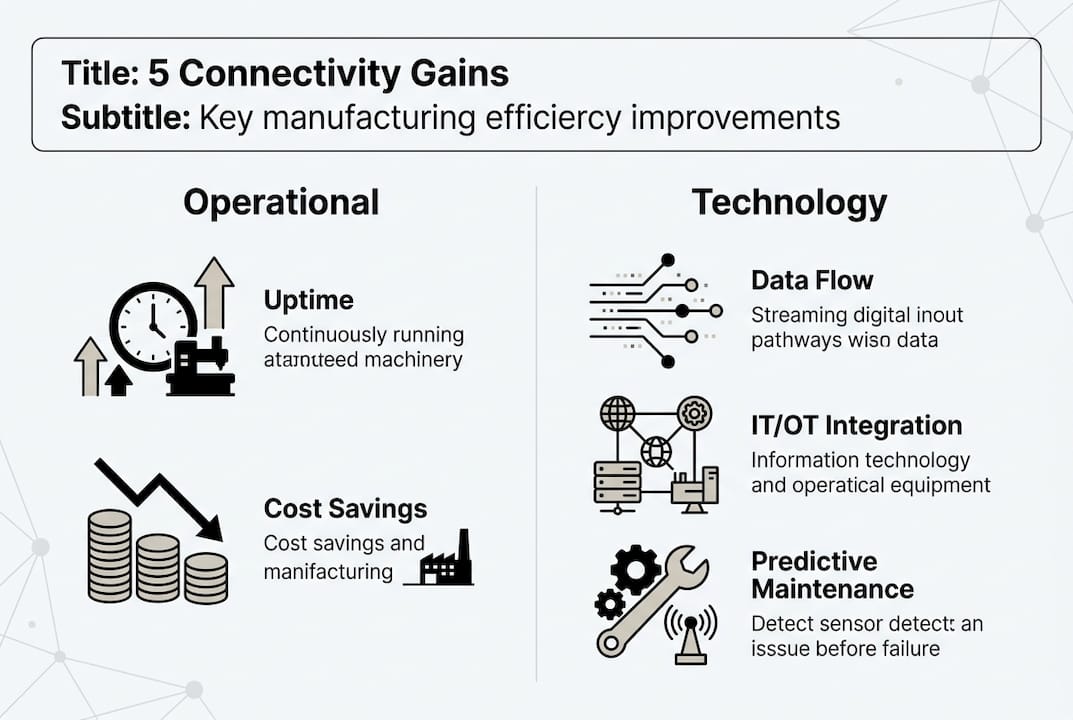
Advanced connectivity delivers measurable manufacturing results: a 25% reduction in unplanned downtime, a 10 to 20% efficiency gain in throughput, and 5 to 15% savings on maintenance costs. One real-world case study showed $4.5M in savings from real-time data operations alone, with projections of up to $10M in annual savings at scale.
| Metric | Baseline (no advanced connectivity) | With advanced connectivity |
|---|---|---|
| Unplanned downtime | High, reactive response | Up to 25% reduction |
| Throughput efficiency | Standard OEE | 10 to 20% improvement |
| Maintenance costs | Break-fix model | 5 to 15% savings |
| Annual savings potential | Minimal | $4.5M to $10M |
The real-time visibility ROI is clearest when you look at predictive maintenance. Instead of replacing parts on a fixed schedule or after failure, sensors feed live vibration, temperature, and pressure data to an analytics engine that tells you exactly when a component needs attention.
A practical pilot sequence for Mid-Atlantic manufacturers:
- Identify your three highest-cost failure points on the production line
- Deploy sensors and edge gateways on those assets first
- Connect to a centralized dashboard with real-time alerting
- Measure baseline vs. post-deployment downtime over 90 days
- Scale to adjacent assets using the ROI data from your pilot
Pro Tip: Start predictive maintenance on your most expensive or most failure-prone asset. The ROI from that single asset often funds the broader rollout and builds internal support for the program.
Tracking connectivity-driven efficiency trends shows that manufacturers who follow this staged approach consistently hit positive ROI within the first year.
Architecting connectivity: Wired, wireless, and hybrid methodologies
Choosing the right connectivity architecture is not a one-size-fits-all decision. The right answer depends on your assets, your facility layout, and your tolerance for latency and packet loss.
Layered IoT integration follows a clear structure: machine connectivity at the edge, edge gateways for local processing, and data normalization before it reaches your cloud or on-premise systems. Each layer has specific requirements that drive your technology choices.
| Technology | Best use case | Latency | Cost | Scalability |
|---|---|---|---|---|
| Wired Ethernet | Zero-loss, vibration-sensitive assets | Very low | High upfront | Limited |
| WiFi 6 | HMI terminals, flexible workstations | Low | Moderate | High |
| Private 5G | AGVs, dense IoT, mobile assets | Ultra-low | High upfront | Very high |
| Hybrid | Mixed environments, full coverage | Optimized | Balanced | Optimal |
Private 5G delivers under 5ms latency and supports up to 1 million devices per square kilometer. Edge computing reduces latency by 40 times compared to cloud-only processing. Those numbers matter when you are running AGVs that need to react in milliseconds or running vision-based quality inspection at line speed.
Key architecture considerations:
- Wired connections remain the gold standard for CNC machines and robotic arms where packet loss is unacceptable
- WiFi 6 handles human-machine interface (HMI) terminals and flexible assembly stations well
- Private 5G excels in high-density IoT environments and facilities with significant mobile equipment
- Hybrid networks combine all three to cover every use case without compromise
The 5G advantages for IT leaders go beyond speed. Private 5G gives you network slicing, meaning you can dedicate bandwidth to critical processes and isolate them from general traffic. For a deeper look at device selection, the best IoT devices for connected environments guide covers hardware that performs in demanding industrial settings. Optimizing IoT connectivity principles apply equally to urban factories with complex RF environments. For a direct comparison, 5G vs WiFi 6 in smart factories breaks down the tradeoffs in detail.
Challenges and risks: Connectivity pitfalls, cybersecurity, and edge complexity
Advanced connectivity creates real value, but it also introduces risks that executives need to understand before scaling.
Edge AI in manufacturing surfaces three core challenges: intermittent connectivity that drops packets in sensitive environments, compute constraints at the edge that degrade AI model accuracy, and an expanded cybersecurity attack surface as more devices connect to the network. Each of these can undermine the ROI you are targeting if not addressed in the architecture phase.
40% of manufacturers cite cybersecurity as their top connectivity risk. That is not surprising when you consider that OT networks were historically air-gapped and are now being connected to IT systems and the internet for the first time. The attack surface expands dramatically, and legacy OT equipment often lacks basic security features.
“The biggest mistake manufacturers make is treating OT security as an IT problem. It requires a joint team, shared protocols, and network segmentation from day one.”
A structured risk mitigation approach:
- Segment your OT and IT networks using VLANs and industrial firewalls from the start
- Implement zero-trust access controls so every device and user is authenticated before connecting
- Monitor edge nodes continuously for anomalous behavior using a SOC-as-a-Service model
- Conduct regular penetration testing on both IT and OT environments
- Align IT and OT teams on incident response protocols before an event occurs
Pro Tip: Network segmentation is your first and most important defense. A compromised sensor should never be able to reach your ERP system. Design your network so that lateral movement is impossible by default.
The IIoT growth trajectory means the attack surface will only expand. Building security into your architecture now is far cheaper than retrofitting it later. Review IoT security strategies and understand why secure connectivity matters before you scale any pilot program.
Next steps for Mid-Atlantic manufacturers: Practical pilot and optimization strategies
The path from connectivity investment to measurable ROI is well-documented. Connectivity-driven savings of $4.5M to $10M annually are achievable, but they require a disciplined approach that starts small and scales on evidence.
Here is how to build a winning pilot program:
- Select one production line or asset cluster with clear, measurable output metrics
- Establish a baseline for downtime, throughput, and maintenance costs before deployment
- Deploy sensors, edge gateways, and network infrastructure in a controlled sequence
- Integrate data into your existing MES or ERP using standard APIs to avoid custom development costs
- Set 90-day KPI targets and review them weekly with both IT and operations leadership
- Document every finding, including failures, so the next phase benefits from real learnings
Pro Tip: Track at least five KPIs during your pilot: uptime percentage, mean time between failures (MTBF), maintenance cost per unit, throughput rate, and energy consumption per unit produced. These give you a complete picture of ROI and make the business case for scaling undeniable.
For data integration in manufacturing, the key is normalizing data formats early so that insights from edge devices can flow cleanly into analytics platforms. Skipping this step creates data silos that limit the value of your investment. Building advanced connectivity for digital growth requires that your network architecture and your data architecture evolve together.
Mid-Atlantic manufacturers have a geographic advantage here. Proximity to major technology hubs, a dense supplier ecosystem, and access to regional connectivity providers means you can move faster than manufacturers in more isolated markets. Use that advantage.
Connect with regional experts for advanced manufacturing solutions
You now have the framework. The next step is finding a partner who understands both the technology and the operational realities of manufacturing in the Mid-Atlantic region.

At SabertoothPro, we work directly with manufacturing executives and IT teams to design, deploy, and manage connectivity infrastructure built for industrial environments. Our IoT solutions cover device management, edge integration, and network architecture tailored to your production environment. If your facility needs reliable wireless coverage, our wireless internet provider services deliver the uptime and throughput your operations demand. For IoT-heavy deployments, our IoT data plans are built to scale with your device count without surprise costs. Let’s build your pilot together.
Frequently asked questions
How does connectivity drive operational efficiency in manufacturing?
IT/OT convergence enables real-time data flow between machines and enterprise systems, which directly cuts unplanned downtime and increases throughput by giving operators and algorithms the information they need to act immediately.
What connectivity technologies are best for smart factories?
Hybrid networks combining private 5G, WiFi 6, and wired Ethernet with layered IoT integration deliver the best balance of reliability, speed, and scalability for high-device-count manufacturing environments.
What are typical connectivity-related risks in manufacturing?
Packet loss, cybersecurity vulnerabilities, and edge compute accuracy degradation are the three most common risks, all of which require deliberate architectural decisions to mitigate.
What is the ROI for investing in manufacturing connectivity?
Well-executed connectivity programs deliver $4.5M to $10M in annual savings through predictive maintenance and real-time visibility, with downtime reductions of up to 25% documented across multiple case studies.
How should Mid-Atlantic manufacturers start with advanced connectivity?
Begin with a focused pilot on your highest-cost failure assets, establish clear KPI baselines, and prioritize network segmentation and IT/OT team alignment before expanding to facility-wide deployment.
Recommended
Quote of the Day
Style is more than what we wear or how we decorate our spaces — it’s the freedom to choose what reflects who we are. Every design, every detail, is crafted with intention: to inspire joy, to add meaning, and to transform the everyday into something extraordinary. Because when comfort meets elegance, life itself feels more beautiful.
Brand Description
At our core, we believe that style should feel effortless yet meaningful. Each collection is carefully designed with attention to detail, blending modern aesthetics with everyday comfort. From timeless silhouettes to refined textures, our pieces are crafted to inspire confidence and elevate the way you live and dress. More than fashion, it’s a lifestyle made for you.