
Unlocking digital growth with advanced connectivity

Most business leaders assume digitalization is about choosing the right software or upgrading devices. That’s only half the story. Without robust connectivity, even the most advanced digital tools fail to deliver their promised value. Connectivity is the invisible backbone that determines whether your cloud applications respond instantly or lag, whether your IoT sensors transmit data reliably or drop offline, and whether your remote teams collaborate seamlessly or struggle with frozen video calls. This guide explores how connectivity enables digital transformation, which connectivity solutions align with different business needs, and practical steps to optimize your network infrastructure for sustained digital growth.
Table of Contents
- Key takeaways
- Why connectivity is the backbone of digitalization
- Comparing connectivity options for effective digitalization
- Emerging connectivity trends shaping digitalization strategies
- Practical steps to enhance your business connectivity for digitalization
- Enhance your digital transformation with Sabertooth Pro connectivity
- Frequently asked questions
Key Takeaways
| Point | Details |
|---|---|
| Connectivity backbone | Connectivity underpins digital tools and cloud services by ensuring fast, reliable access for data exchange and collaboration. |
| Impact on productivity | Poor connectivity turns advanced software into a liability by causing video freezes, slow uploads, and missed opportunities. |
| Choose connectivity by needs | Selecting the right connectivity requires aligning business size usage patterns and critical applications with appropriate technologies. |
| 5G and IoT potential | Emerging technologies such as 5G and IoT create new digital opportunities that require reliable, scalable networks to realize real time data and remote operations. |
Why connectivity is the backbone of digitalization
Digital transformation initiatives collapse without the network infrastructure to support them. When you migrate business applications to the cloud, you’re essentially moving critical operations outside your physical office. Every transaction, every data query, every user interaction now depends on your internet connection. Poor connectivity transforms cloud computing from a competitive advantage into a liability.
Consider IoT deployments in manufacturing or logistics. Smart sensors monitoring equipment health or tracking shipments generate constant data streams. If your network can’t handle this volume reliably, you lose the real-time visibility that justifies the IoT investment. A distribution center might install hundreds of IoT devices for inventory tracking, but intermittent connectivity means delayed updates, inaccurate stock counts, and frustrated warehouse managers reverting to manual processes.
Cloud connectivity quality directly impacts employee productivity. Video conferences freeze mid-presentation. File uploads time out. CRM systems lag during peak hours. These aren’t minor inconveniences. They represent lost sales opportunities, delayed project deliverables, and eroded customer trust. A financial services firm processing loan applications through cloud-based software can’t afford connectivity issues that prevent timely approvals.
The relationship between connectivity and digitalization works like this:
- Digital tools require constant data exchange between users, applications, and cloud servers
- Network speed determines how quickly information flows and applications respond
- Reliability ensures uninterrupted access to critical systems during business hours
- Bandwidth capacity supports simultaneous users and data-intensive operations
- Latency affects real-time applications like video conferencing and collaborative editing
“Without reliable connectivity, digital transformation becomes digital frustration. The most sophisticated software in the world can’t overcome a substandard network.”
Businesses often underestimate connectivity requirements when planning digital initiatives. They budget for software licenses and training but treat internet service as an afterthought. This backwards approach explains why many digital transformation projects fail to meet expectations. The foundation must support the structure you’re building on top of it.
Comparing connectivity options for effective digitalization
Selecting appropriate connectivity requires understanding how different technologies align with your digital strategy. Each option offers distinct advantages and limitations that impact your ability to execute digitalization plans effectively.
Fiber optic connections deliver the highest speeds and most reliable performance for businesses with access to fiber infrastructure. Symmetrical upload and download speeds support cloud-heavy workflows where employees constantly push data to remote servers. A graphic design agency uploading large creative files or a healthcare provider transmitting medical imaging benefits enormously from fiber’s capacity. The challenge? Fiber availability remains limited in many Mid-Atlantic suburban and rural locations.
Wireless internet solutions provide flexibility and faster deployment timelines. Business connectivity through wireless works particularly well for companies in areas without fiber access or those needing rapid installation. Fixed wireless and cellular-based internet can support most business applications, though performance varies based on signal strength and network congestion. Retailers opening new locations often choose wireless connectivity to avoid the months-long wait for fiber installation.
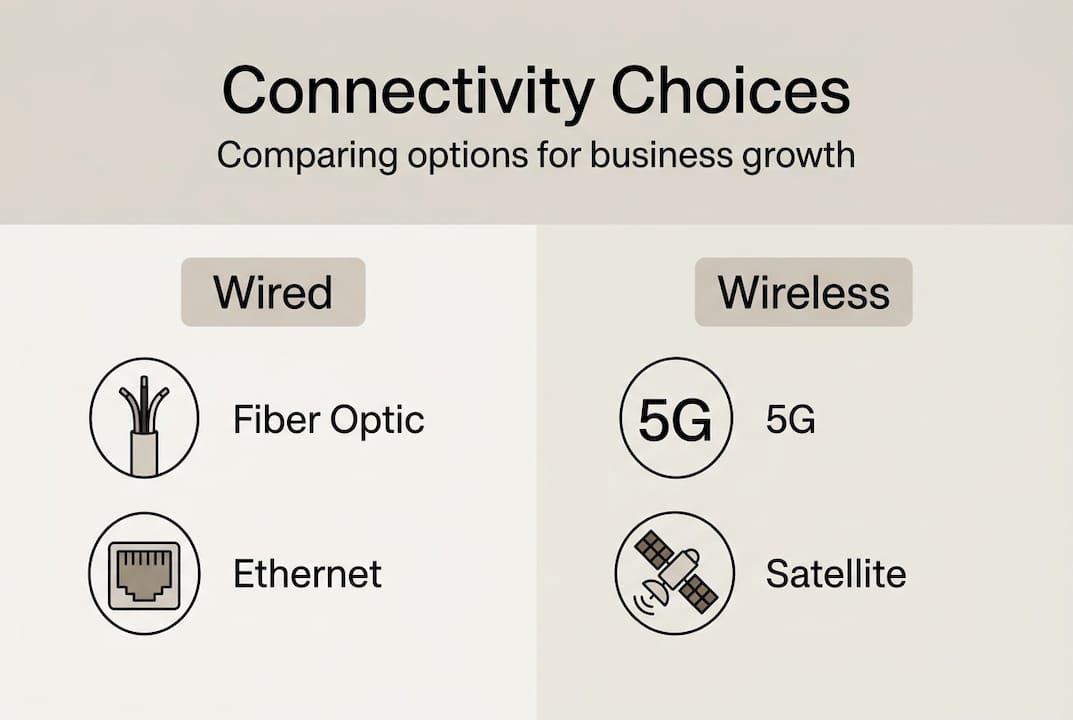
5G technology represents a significant leap in wireless capability. Lower latency and higher bandwidth make 5G viable for applications previously requiring wired connections. Manufacturing facilities deploying robotics or augmented reality training programs find 5G’s performance characteristics meet their demanding requirements. The technology is still rolling out across regions, but early adopters gain competitive advantages in digital innovation.
Satellite internet serves as the connectivity option of last resort for truly remote locations. Recent low-earth orbit satellite constellations have improved speeds and reduced latency compared to traditional satellite service, but performance still lags behind terrestrial options. A logistics company with warehouses in rural areas might use satellite connectivity as a backup or for locations where no other option exists.
| Connectivity Type | Typical Speed Range | Best For | Key Limitation |
|---|---|---|---|
| Fiber Optic | 100 Mbps to 10 Gbps | Data-intensive operations, large teams, cloud-heavy workflows | Limited geographic availability |
| Fixed Wireless | 25 Mbps to 1 Gbps | Rapid deployment, areas without fiber, backup connectivity | Weather and obstruction sensitivity |
| 5G Cellular | 100 Mbps to 1 Gbps+ | Mobile operations, IoT deployments, urban locations | Coverage area still expanding |
| Cable Internet | 50 Mbps to 1 Gbps | Small to medium businesses, mixed use cases | Asymmetric speeds, shared bandwidth |
| Satellite | 25 Mbps to 150 Mbps | Remote locations, backup connectivity | Higher latency, weather sensitivity |
Pro Tip: Evaluate connectivity options based on your three-year digital roadmap, not just current needs. If you’re planning IoT expansion or increased cloud migration, choose connectivity that scales without requiring infrastructure replacement.
Cost considerations extend beyond monthly service fees. Installation expenses, equipment costs, and contract terms all factor into total ownership. Enterprise internet solutions often include service level agreements guaranteeing uptime and response times, which justify higher costs for businesses dependent on constant connectivity. A call center losing revenue during every minute of downtime needs those guarantees more than a small office with flexible operations.
Redundancy deserves serious consideration for businesses where connectivity interruptions create immediate financial impact. Dual internet connections from different providers using different technologies provide failover capability. When your primary fiber connection fails, traffic automatically routes through your backup wireless connection. This approach costs more but prevents the catastrophic losses that occur when digital operations go dark.
Emerging connectivity trends shaping digitalization strategies
Technology evolution constantly reshapes what’s possible in digital transformation. Understanding emerging connectivity trends helps you anticipate opportunities and plan strategic investments that position your business ahead of competitors.
5G networks are revolutionizing enterprise connectivity by delivering fiber-like performance wirelessly. The technology’s ultra-low latency enables real-time applications previously impossible over cellular networks. Autonomous vehicles, remote surgery, and industrial automation all depend on 5G’s ability to transmit data with minimal delay. For businesses, this means new possibilities in mobile operations, distributed IoT deployments, and edge computing implementations.
Consider these 5G-enabled digitalization opportunities:
- Mobile point-of-sale systems with instant payment processing and real-time inventory updates
- Augmented reality applications for remote technical support and training
- High-definition video surveillance with cloud-based analytics and storage
- Fleet management systems with continuous vehicle telemetry and route optimization
- Pop-up retail locations with full connectivity without fixed infrastructure
IoT connectivity continues advancing with specialized networks designed for massive device deployments. Low-power wide-area networks (LPWAN) support thousands of sensors on a single connection, making large-scale IoT projects economically viable. A property management company can monitor HVAC systems, occupancy, and security across dozens of buildings without prohibitive connectivity costs. These networks sacrifice speed for coverage and battery life, perfect for sensors that transmit small data packets infrequently.
Edge computing shifts data processing closer to where information originates, reducing bandwidth requirements and improving response times. Instead of sending all sensor data to distant cloud servers, edge devices perform initial analysis locally and transmit only relevant insights. This approach becomes essential as IoT deployments scale and bandwidth costs rise. A manufacturing plant might process quality control imagery at the edge, flagging defects locally rather than streaming video to the cloud.
“The convergence of 5G, IoT, and edge computing creates a connectivity ecosystem where digital transformation accelerates exponentially. Businesses that understand and leverage these technologies gain measurable competitive advantages.”
Software-defined networking (SDN) and SD-WAN technologies give businesses unprecedented control over connectivity management. Instead of static network configurations, you can dynamically route traffic based on application requirements, network conditions, and cost considerations. Critical applications get priority bandwidth while background tasks use cheaper connections. This flexibility maximizes the value extracted from connectivity investments.
Internet technology trends for 2026 point toward increased network intelligence and automation. AI-driven network management predicts congestion, identifies security threats, and optimizes performance without human intervention. These capabilities matter most for businesses running complex digital operations across multiple locations where manual network management becomes impractical.
Private 5G networks represent another emerging option for enterprises with specific security or performance requirements. Rather than sharing public cellular infrastructure, businesses deploy dedicated 5G networks on their premises. This approach suits manufacturers, healthcare facilities, and logistics operations needing guaranteed performance and complete data control. The investment is substantial but justified for operations where connectivity directly impacts safety or revenue.
Practical steps to enhance your business connectivity for digitalization
Transforming connectivity from a commodity service into a strategic asset requires deliberate planning and ongoing management. These actionable steps help IT decision-makers optimize network infrastructure to support ambitious digitalization goals.
-
Conduct a comprehensive connectivity audit documenting current speeds, reliability metrics, and usage patterns across all locations. Identify bottlenecks where network performance limits business operations. Compare actual performance against service level agreements to verify you’re receiving contracted service quality.
-
Map connectivity requirements to your digital roadmap for the next 24 to 36 months. If you’re planning cloud migration, calculate bandwidth needed for application traffic plus a 30 percent buffer. IoT deployments require estimating device counts, data transmission frequency, and redundancy needs. Video conferencing demands symmetrical bandwidth and low latency.
-
Develop a business case for connectivity upgrades that quantifies both costs and benefits. Calculate productivity gains from faster application response times, revenue protection from improved uptime, and cost savings from cloud optimization. Present connectivity as an enabler of broader digital initiatives rather than an isolated IT expense.
-
Evaluate multiple providers and technologies rather than defaulting to incumbent carriers. Reliable connectivity in 2026 comes from various sources, and competitive evaluation often reveals better options. Request detailed proposals including installation timelines, equipment specifications, support response times, and total cost of ownership.
-
Implement monitoring systems that provide visibility into network performance, usage trends, and potential issues. Proactive monitoring catches problems before they impact operations. Track metrics like latency, packet loss, bandwidth utilization, and uptime to establish performance baselines and identify degradation.
-
Design redundancy appropriate to your business continuity requirements. Mission-critical operations justify dual internet connections from separate providers using different technologies and physical paths. Less critical locations might use cellular failover or accept occasional downtime.
-
Establish regular review cycles to reassess connectivity against evolving business needs. Digital transformation is ongoing, not a one-time project. Quarterly reviews help identify when current connectivity becomes a constraint rather than an enabler.
Pro Tip: Integrate connectivity planning into your broader IT strategy rather than treating it as standalone infrastructure. The most successful digital transformations align network capabilities with application requirements, security policies, and business objectives in a cohesive technology roadmap.
Reliable internet matters more as digitalization deepens. When business processes depend entirely on cloud applications and connected devices, network outages don’t just inconvenience employees but halt revenue-generating activities. A restaurant chain with cloud-based point-of-sale systems can’t process payments during connectivity failures. An accounting firm can’t access client files stored in the cloud. These scenarios transform connectivity from a utility into a business-critical asset deserving strategic investment.
Budget allocation for connectivity should reflect its strategic importance. Many businesses spend 60 percent of IT budgets on software and only 10 percent on the connectivity enabling that software. This imbalance creates situations where expensive applications underperform due to inadequate network infrastructure. Rebalancing investments to ensure connectivity matches application requirements delivers better overall ROI on digital initiatives.
Vendor relationships matter significantly for connectivity success. Providers offering proactive support, transparent communication, and rapid issue resolution become partners in your digital transformation rather than commodity suppliers. Evaluate potential providers on their technical expertise, local presence, and track record with businesses similar to yours. The cheapest option rarely proves most cost-effective when downtime and performance issues are factored in.
Enhance your digital transformation with Sabertooth Pro connectivity
Digitalization demands connectivity infrastructure that matches your ambitions. Sabertooth Pro specializes in delivering wireless internet solutions engineered for business performance, not consumer convenience. Our Mid-Atlantic expertise means we understand the unique connectivity challenges facing businesses in Harford County and surrounding regions where fiber availability remains inconsistent.

We design IoT connectivity solutions that scale with your device deployments, whether you’re monitoring a dozen assets or thousands. Our team works directly with IT decision-makers to assess requirements, recommend appropriate technologies, and implement solutions that support your digital roadmap. From rapid deployment wireless internet to redundant enterprise connectivity, we deliver the network foundation your digital transformation requires. Businesses throughout the region rely on our high-speed internet in Harford County, MD to power cloud applications, support remote teams, and enable IoT innovation without the limitations of legacy infrastructure.
Frequently asked questions
What role does connectivity play in digital transformation?
Connectivity enables access to cloud platforms, IoT devices, and digital collaboration tools that form the foundation of digital transformation. Without reliable, high-speed internet, these technologies can’t deliver their intended business value. Poor connectivity stalls digital initiatives by creating performance bottlenecks that frustrate users and limit operational capabilities.
Which connectivity options are best for small to medium businesses?
Fiber optic and fixed wireless internet offer the best combination of speed, reliability, and scalability for most small to medium businesses. Fiber provides superior performance where available, while wireless solutions deliver faster deployment and broader geographic coverage. The optimal choice depends on location, budget, digital application requirements, and growth plans over the next three years.
How can 5G improve digitalization strategies?
5G delivers significantly faster speeds, lower latency, and better support for high-density IoT deployments compared to previous cellular technologies. These capabilities enable new digital applications like augmented reality training, real-time analytics on mobile devices, and reliable connectivity for distributed operations. Businesses leveraging 5G gain flexibility to digitalize processes previously constrained by connectivity limitations.
What steps should businesses take to improve connectivity?
Start by evaluating current connectivity performance against actual business requirements and identifying gaps. Plan upgrades with scalability and redundancy appropriate to your digital roadmap and business continuity needs. Partner with providers offering expertise in business connectivity rather than residential service, and implement monitoring to maintain optimal performance. Regular reviews ensure connectivity evolves alongside digital transformation initiatives rather than becoming a constraint on growth.
Quote of the Day
Style is more than what we wear or how we decorate our spaces — it’s the freedom to choose what reflects who we are. Every design, every detail, is crafted with intention: to inspire joy, to add meaning, and to transform the everyday into something extraordinary. Because when comfort meets elegance, life itself feels more beautiful.
Brand Description
At our core, we believe that style should feel effortless yet meaningful. Each collection is carefully designed with attention to detail, blending modern aesthetics with everyday comfort. From timeless silhouettes to refined textures, our pieces are crafted to inspire confidence and elevate the way you live and dress. More than fashion, it’s a lifestyle made for you.